Drint Knowledge › Packaging glossary › Blind embossing
Blind embossing
Embossing or debossing with no ink or foil in register, so the design is shown only by its relief and the shadows it casts.
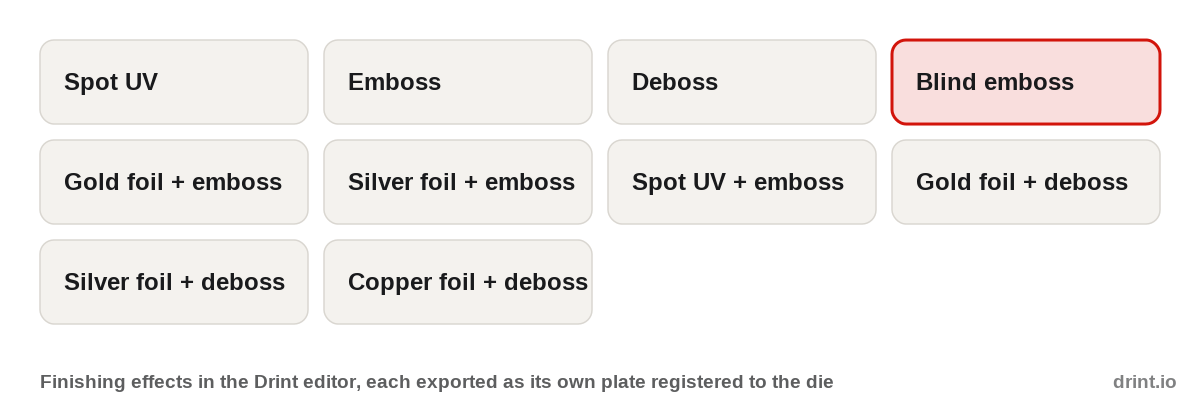
- Also called
- blind emboss, blind deboss, uninked emboss
- Kind
- Print & finishing
- Options in Drint
- 16
- Measured
A blind emboss uses the same matched dies as ordinary embossing, but the raised area is not printed or foiled underneath. The result is subtle and tactile: the shape appears only through light and shadow, which suits premium, minimal and tone-on-tone packaging.
Supply the shape as a separate plate file registered to the die, and keep the print file empty in that area unless a background colour runs under it. Because there is no colour to help it read, the shape should be fairly large and simple with bold lines. Uncoated, textured and thicker stocks give the clearest relief; a dark or busy printed background tends to hide it.
Questions
What is a blind embossing?
Embossing or debossing with no ink or foil in register, so the design is shown only by its relief and the shadows it casts.
More terms
Cite this page: Drint (2026). “Blind embossing”. Drint Knowledge. https://drint.io/glossary/blind-embossing