Drint Knowledge › Packaging glossary › Direct-to-garment printing
Direct-to-garment printing
An inkjet process that sprays water-based textile inks straight onto a garment, suited to full-colour designs in small quantities.
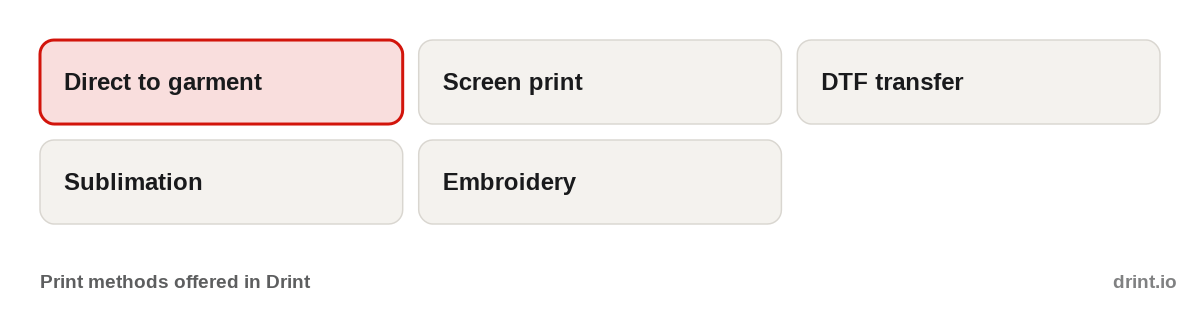
- Also called
- DTG, DTG printing, digital garment printing
- Kind
- Print & finishing
- Options in Drint
- 5
- Measured
The garment is loaded flat on a platen and an inkjet head prints the design directly into the fabric, which is then heat-cured. Dark garments are pre-treated and printed with a white underbase first so colours stay bright; light garments can skip the white.
Supply artwork as a high-resolution image with a transparent background, typically around 300 ppi at final print size, and avoid semi-transparent edges or soft glows that can print as a faint halo on dark shirts. DTG works best on cotton and high-cotton blends; polyester-heavy fabrics generally give duller, less durable results. Because there are no screens to make, it suits one-off and print-on-demand orders and photographic artwork.
Questions
What is a direct-to-garment printing?
An inkjet process that sprays water-based textile inks straight onto a garment, suited to full-colour designs in small quantities.
More terms
Cite this page: Drint (2026). “Direct-to-garment printing”. Drint Knowledge. https://drint.io/glossary/dtg-printing