Drint Knowledge › Packaging glossary › Dye sublimation
Dye sublimation
A process in which special dyes printed on transfer paper turn to gas under heat and bond into polyester fibres or polymer-coated items.
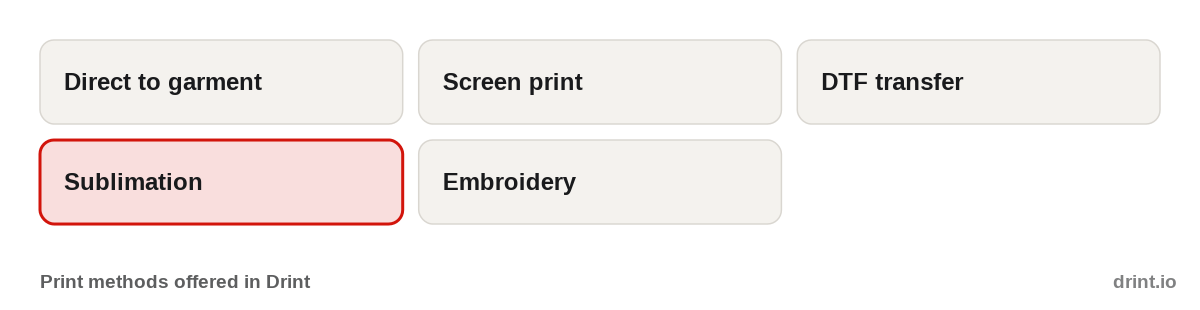
- Also called
- sublimation printing, dye-sub, sublimation transfer
- Kind
- Print & finishing
- Options in Drint
- 5
- Measured
The design is printed mirrored onto sublimation paper, placed on the product and heat-pressed; the dye turns from solid to gas and becomes part of the polyester or coating rather than sitting on top. The print has no feel on the surface, will not crack or peel, and can run edge to edge.
Sublimation only works on white or very light polyester fabric, or on hard items with a special polyester coating such as mugs, tumblers and panels; it does not work on cotton or dark colours, and white cannot be printed. Supply artwork at full product size with bleed for all-over prints, typically around 300 ppi, and keep important elements away from seams and edges. Colours are vivid, but expect slight shifts that depend on the base material.
Questions
What is a dye sublimation?
A process in which special dyes printed on transfer paper turn to gas under heat and bond into polyester fibres or polymer-coated items.
Can I sublimate onto a black or cotton shirt?
Not directly: the dye needs polyester or a polymer coating and there is no white ink, so dark or cotton items need DTG, DTF or screen printing instead.
More terms
Cite this page: Drint (2026). “Dye sublimation”. Drint Knowledge. https://drint.io/glossary/sublimation-printing