Drint Knowledge › Packaging glossary › Hot foil stamping
Hot foil stamping
A finish that transfers a thin metallic or pigment layer from a carrier film onto board or paper using a heated metal die and pressure.
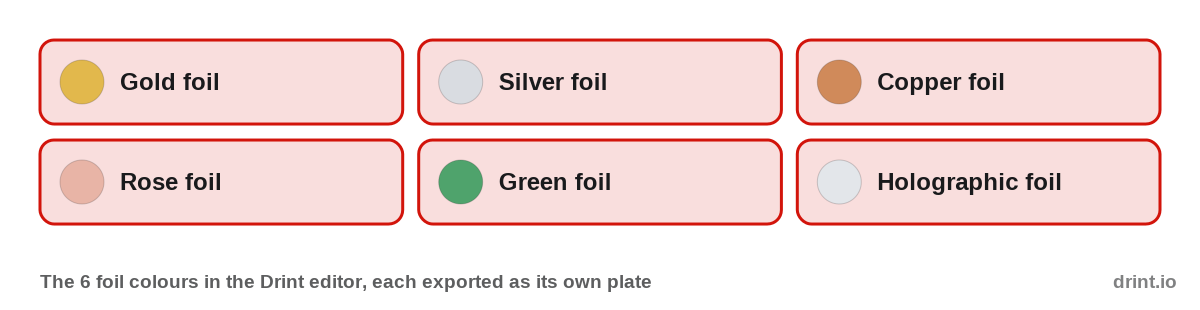
- Also called
- foil stamping, hot stamping, foil blocking
- Kind
- Print & finishing
- Options in Drint
- 6
- Measured
A metal die, usually magnesium, copper or brass, is engraved with the artwork and heated in a press. Foil film is fed between the die and the printed sheet, and where the die presses down the heat releases the foil layer and bonds it to the surface, leaving a bright metallic image that ink alone cannot imitate.
Supply the foil area as a separate plate file in solid 100% of a single spot colour, registered to the same die and artboard as the print file. Very fine lines and small text tend to fill in or break, so keep strokes and counters generous, with a few tenths of a millimetre as a typical lower limit. Foil sits well on laminated or smooth coated board; on rough uncoated or textured stock, expect a less even, more broken surface.
Questions
What is a hot foil stamping?
A finish that transfers a thin metallic or pigment layer from a carrier film onto board or paper using a heated metal die and pressure.
Can foil go on top of matte or soft-touch lamination?
Usually yes: foil is commonly stamped after lamination, but the foil grade must suit the film, so confirm the combination with the printer before finalising the file.
More terms
Cite this page: Drint (2026). “Hot foil stamping”. Drint Knowledge. https://drint.io/glossary/hot-foil-stamping