Drint Knowledge › Packaging glossary › CMYK / process colours
CMYK / process colours
The four standard printing inks, cyan, magenta, yellow and black, whose overlapping halftone dots reproduce full-colour images on press.
- Also called
- four-colour process, process colours, CMYK
- Kind
- Print & finishing
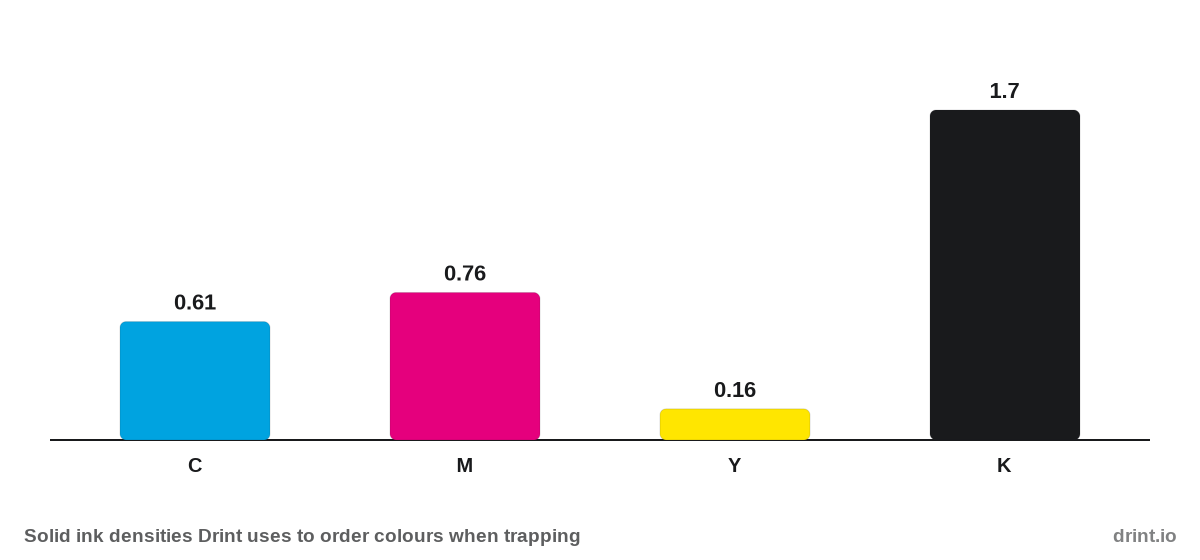
- Solid ink density
- C 0.61 · M 0.76 · Y 0.16 · K 1.70
- Measured
Printing is subtractive: each transparent ink absorbs part of the light reflected by the paper, so overlapping dots of cyan, magenta and yellow build the colours, and black adds depth, sharp text and stable greys. Because ink on paper covers a smaller range than a screen, some bright RGB colours, especially vivid greens, oranges and blues, cannot be matched in CMYK.
Set up packaging artwork in CMYK with the printer’s profile early, so you design with colours that will really print, and keep any extra inks such as white, varnish, foil or brand spot colours as named spot channels. If a brand colour must be exact and vivid across runs and stocks, a spot ink is often a better choice than a CMYK build.
Questions
What is a cmyk / process colours?
The four standard printing inks, cyan, magenta, yellow and black, whose overlapping halftone dots reproduce full-colour images on press.
Why does my design look duller once converted to CMYK?
The screen can show colours that four inks cannot reach, so conversion brings them into the printable range; a spot colour is the way to print a hue outside it.
More terms
Cite this page: Drint (2026). “CMYK / process colours”. Drint Knowledge. https://drint.io/glossary/cmyk