Drint Knowledge › Packaging glossary › Applied ceramic labelling
Applied ceramic labelling
Decorating glass bottles and drinkware by screen-printing glass enamel inks straight onto the surface and firing them, so the print fuses permanently with the glass.
- Also called
- ACL, ceramic screen print, glass screen printing, enamel printing on glass
- Kind
- Print & finishing
- Container
- Long-neck beer bottle: Ø 60.6 × 228.6 mm, 369 ml brim-full
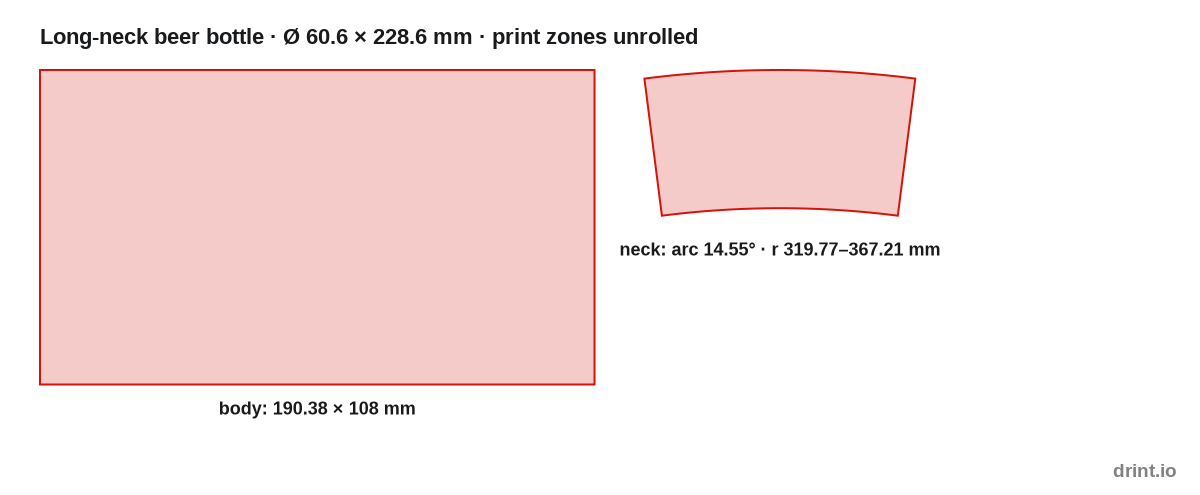
- Print zones (unrolled)
- body: 190.38 × 108 mm
neck: arc 14.55°, radius 319.77–367.21 mm - Printable cap top
- Ø 25.4 mm
- Mould seams
- yes
- Measured
In applied ceramic labelling, the container is turned against a fine screen while a squeegee pushes paste-like enamel through it, one screen and one pass per colour. The bottle then goes through a kiln where the enamel fuses into the glass surface, giving a print that survives washing, ice buckets and returnable-bottle cycles; organic UV-cured inks are an alternative that cures without high-temperature firing.
Design each colour as solid, separate artwork, because screen printing on glass does not reproduce photographs or fine tints well. On coloured or clear glass, plan a white underprint where colours must stay bright, keep artwork within the flat or gently curved print zones of the container, and allow for small shifts between colours as the bottle turns past each screen.
Questions
What is a applied ceramic labelling?
Decorating glass bottles and drinkware by screen-printing glass enamel inks straight onto the surface and firing them, so the print fuses permanently with the glass.
Why choose printed glass over a paper label?
The print becomes part of the bottle, so it does not peel, scuff or soak off, and it gives a premium no-label look; it costs more and suits longer runs.
More terms
Cite this page: Drint (2026). “Applied ceramic labelling”. Drint Knowledge. https://drint.io/glossary/applied-ceramic-labelling