Drint Knowledge › Packaging glossary › Ink density
Ink density
A measure of how much light an ink absorbs: solid ink density checks ink film on press, and neutral density ranks how dark colours look, guiding trap direction.
- Also called
- solid ink density, neutral density, optical density
- Kind
- Print & finishing
- Solid ink density
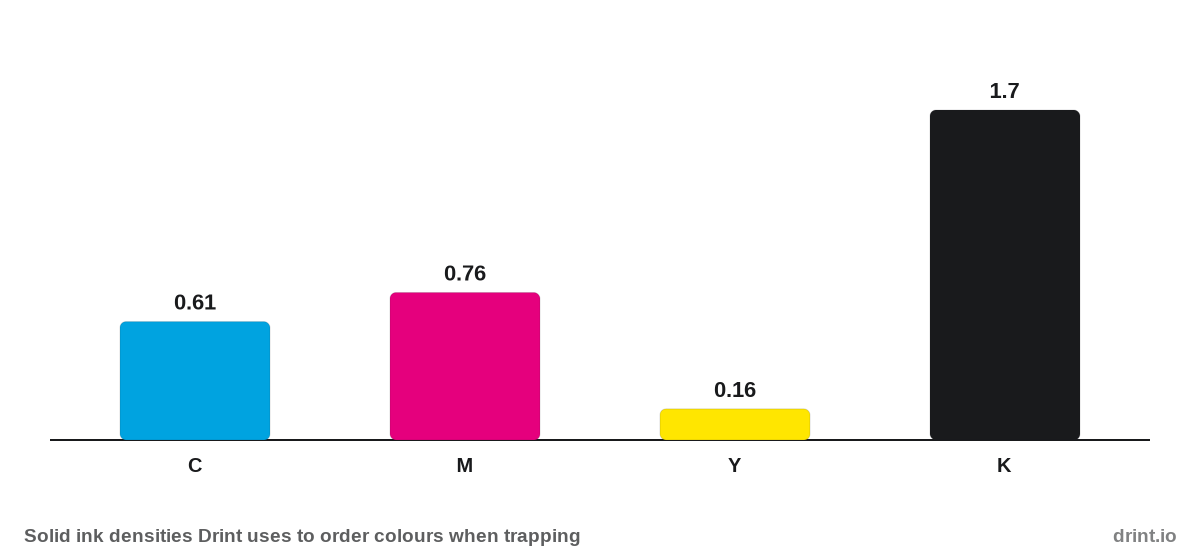
- C 0.61 · M 0.76 · Y 0.16 · K 1.70
- Measured
A densitometer reads how strongly a printed patch absorbs light through a filter matched to the ink, on a logarithmic scale; printers use solid ink density on the colour bar to keep each ink film at the right thickness through a run. Neutral density is a related single number that estimates how dark any colour appears to the eye, whatever its hue.
In prepress, neutral density decides which colour moves when two colours are trapped: the one with the lower value, the lighter-looking colour, spreads under the darker one so the darker edge keeps its shape. For metallic, opaque or very dark spot inks, rely on the printer’s or ink maker’s values rather than guessing from the screen, because on-screen brightness is a poor guide.
Questions
What is a ink density?
A measure of how much light an ink absorbs: solid ink density checks ink film on press, and neutral density ranks how dark colours look, guiding trap direction.
More terms
Cite this page: Drint (2026). “Ink density”. Drint Knowledge. https://drint.io/glossary/ink-density