Drint Knowledge › Packaging glossary › Screen printing on textiles
Screen printing on textiles
A stencil process that pushes thick ink, often plastisol, through a fine mesh screen onto fabric, one screen per colour.
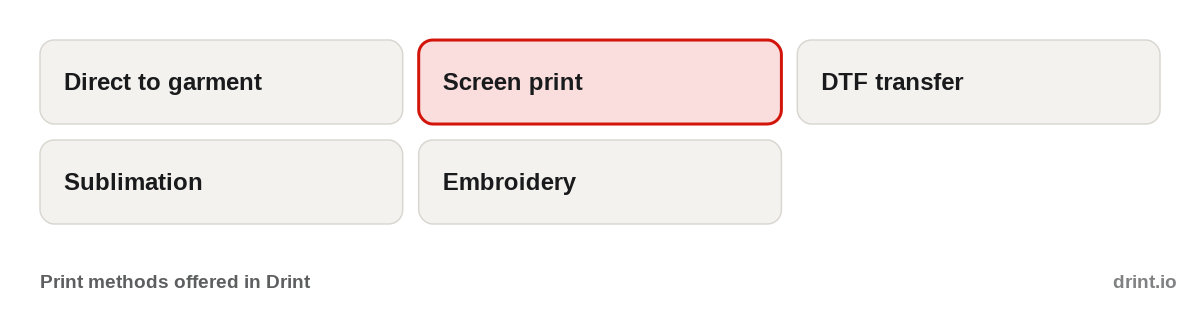
- Also called
- silkscreen, plastisol printing, serigraphy on garments
- Kind
- Print & finishing
- Options in Drint
- 5
- Measured
Each colour in the design gets its own screen, a mesh coated with emulsion and exposed so that ink passes only through the image areas. A squeegee drives the ink onto the garment, colour by colour, and the print is heat-cured; plastisol gives an opaque, slightly raised layer that holds bright colour on dark fabric.
Prepare vector artwork separated into solid spot colours, with each colour as its own layer, and keep the colour count low because every extra screen adds setup cost. Fine lines and small halftone dots need care, so keep strokes reasonably bold and halftones coarse. Screen printing pays off on larger runs of the same design and works on cotton, blends and many synthetics with the right ink.
Questions
What is a screen printing on textiles?
A stencil process that pushes thick ink, often plastisol, through a fine mesh screen onto fabric, one screen per colour.
When is screen printing better than DTG?
For larger quantities of one design with few solid colours, screen printing is usually cheaper per piece and more durable; DTG suits small runs and full-colour images.
More terms
Cite this page: Drint (2026). “Screen printing on textiles”. Drint Knowledge. https://drint.io/glossary/screen-printing-textile