Blog › Takeaway Tray with Handle Dieline
Takeaway Tray with Carry Handle: Dieline Sizes and Sheet Yield
 By Nguyễn Thành Dân, Founder of Drint ·
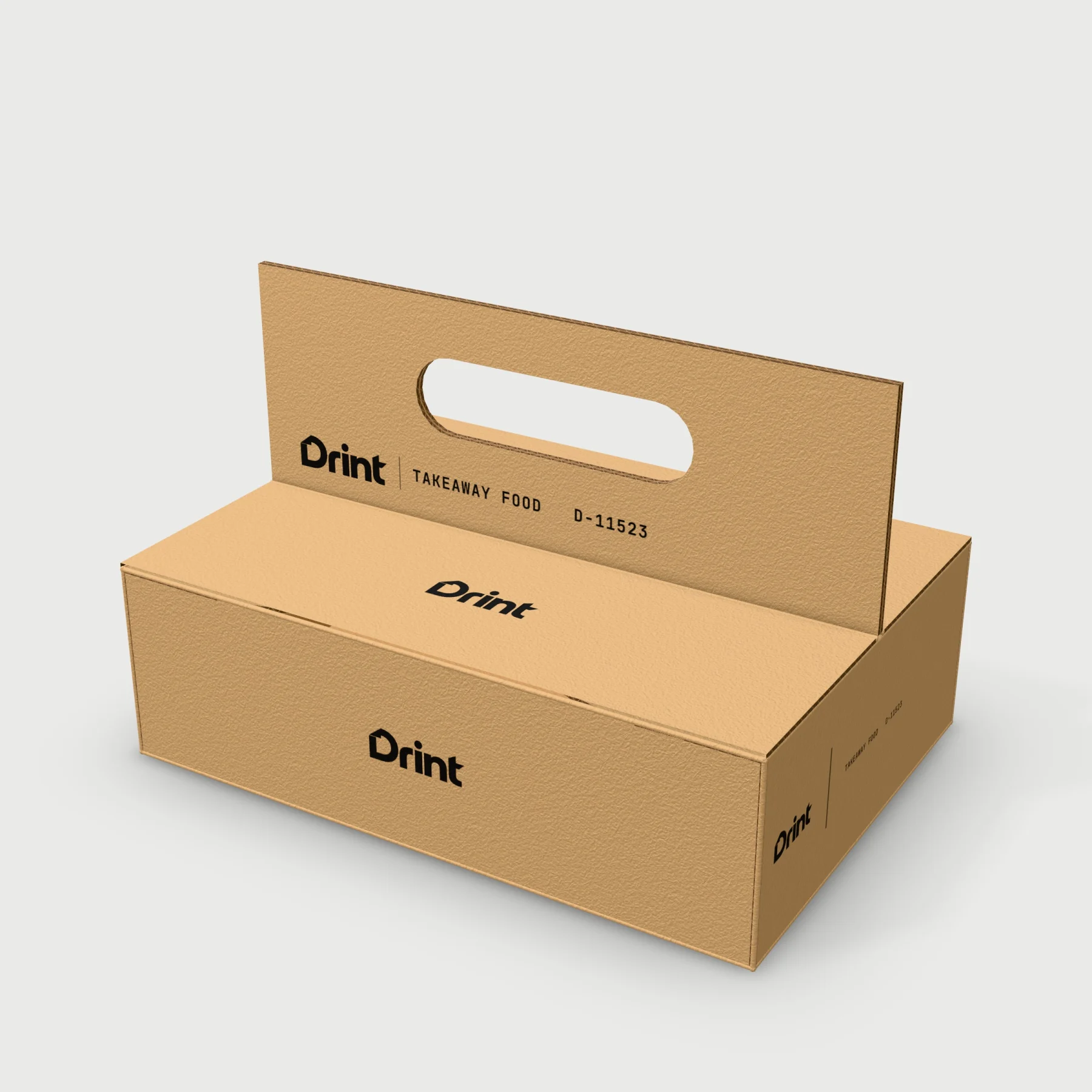
A one-piece corrugated takeaway tray with a carry handle, 200 × 140 × 60 mm in E flute, unfolds into a 522 × 543 mm die. Drint's die engine fits two of them on a 790 × 1090 mm press sheet. Raise the walls to 70 mm and only one fits, so each tray needs about twice the sheet. Drint measured this on 25 November 2026.
Why it matters: the handle tray is a cross-shaped die, and cross shapes waste board. A few millimetres in height can decide whether a sheet carries one tray or two, and that choice is made in the design file, long before the printer sees it.
Key points
- The tray is one piece of board with no glue. Rounded end covers fold in first, two lid halves close over them, and the halves stand up back to back as the handle.
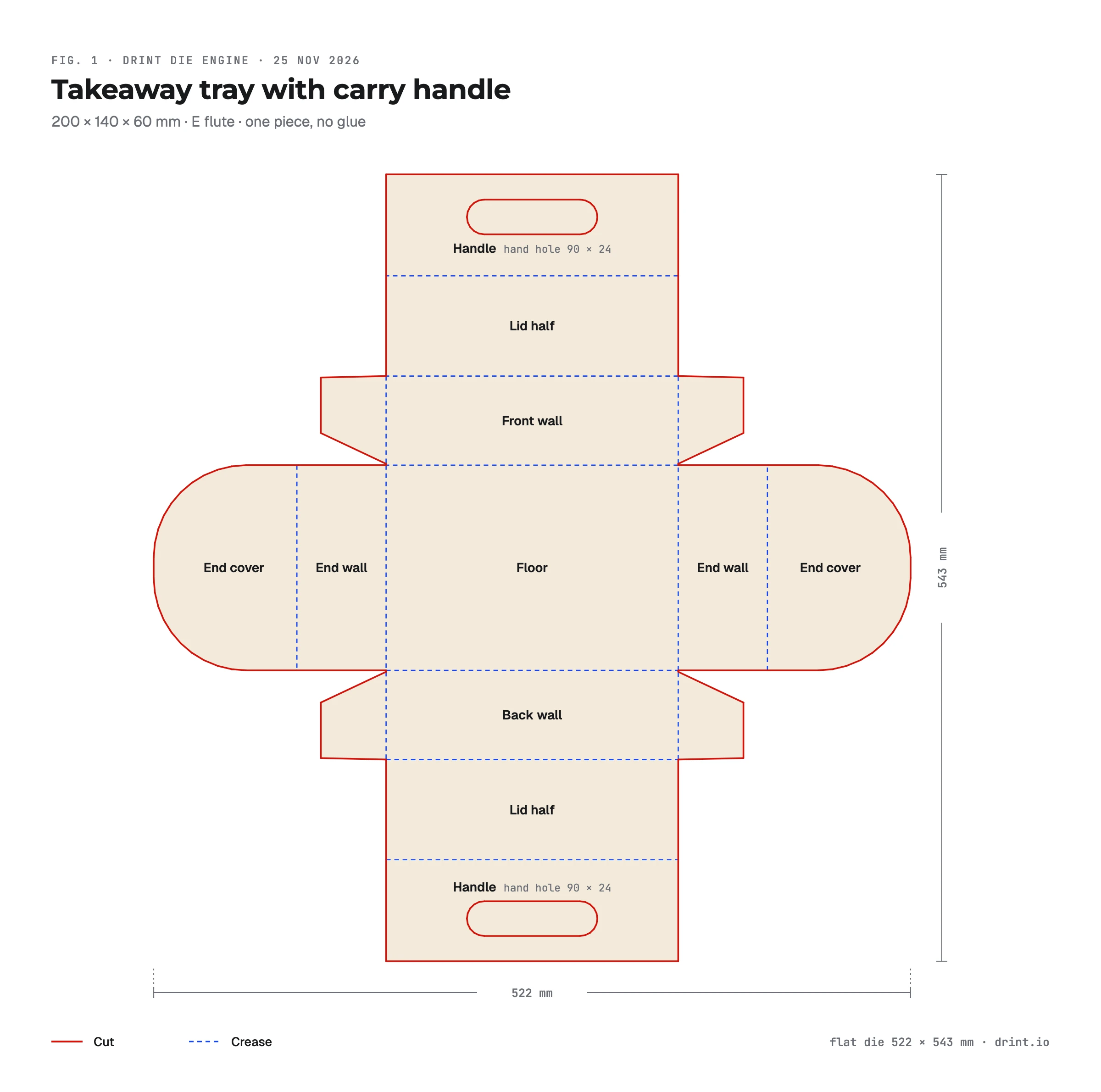
- The flat die is about 2L + 2H wide and 2W + 2H + 2 × handle height tall, plus a few millimetres for board thickness. For 200 × 140 × 60 mm that is 522 × 543 mm.
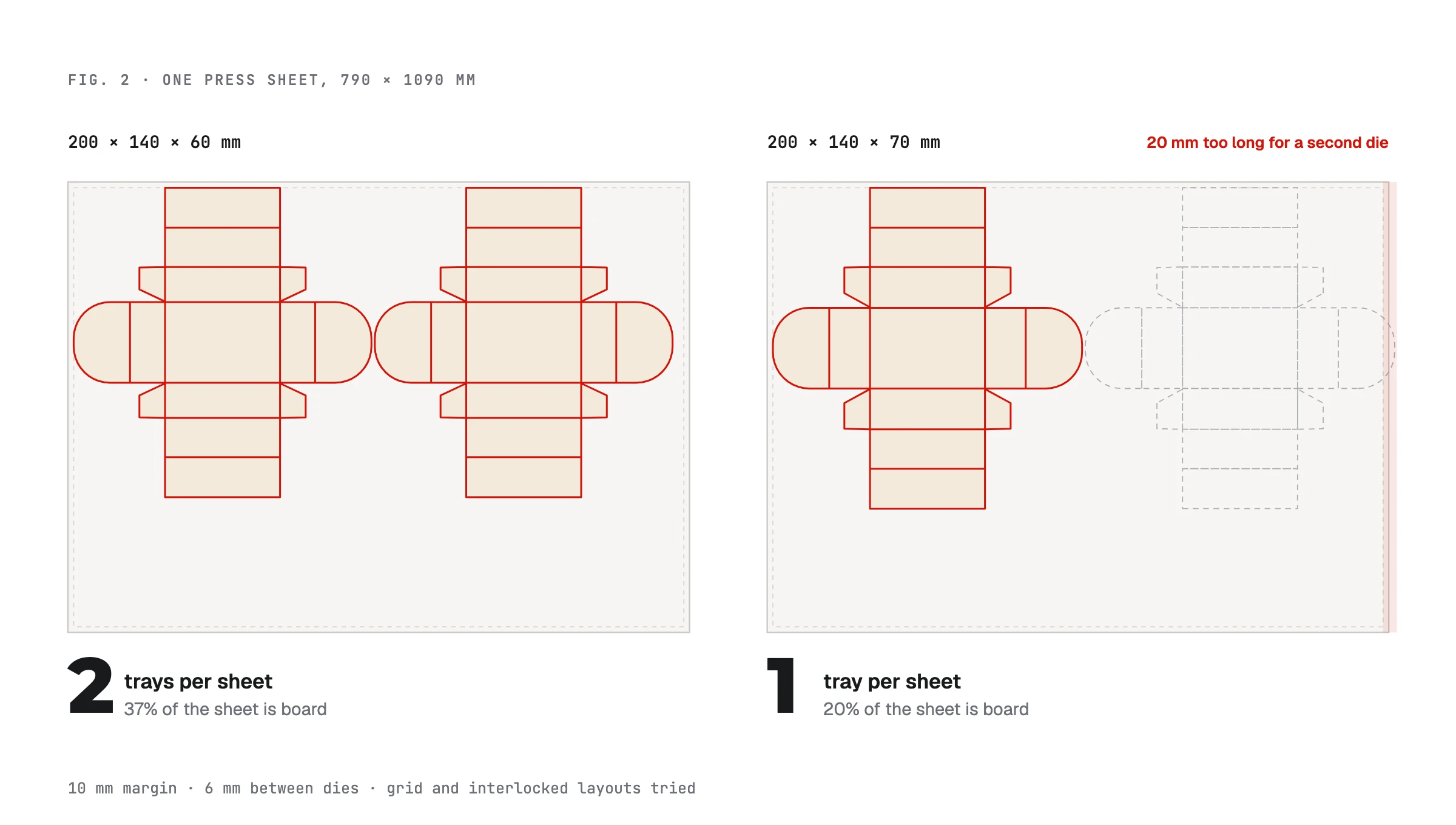
- On a 790 × 1090 mm sheet, Drint fits 2 trays at 200 × 140 × 60 mm but 1 tray at 200 × 140 × 70 mm. The sheet used falls from 37% to 20%.
- The cross shape covers only about 57% of its own bounding rectangle: 0.16 m² of board inside a 0.28 m² box.
- Of 75 sizes Drint tried between 160 and 240 mm long, only one, 160 × 120 × 50 mm, fits four per 790 × 1090 mm sheet.
What is a takeaway tray with a carry handle?
It is a folder-type tray: the floor, walls and lid all hinge from one cut piece. FEFCO, the European corrugated board federation, groups such designs as series 04, "folder-type boxes and trays", which "usually consist of only one piece of board", according to its Code of Designs. The handle tray is not a numbered FEFCO style, but it is built the way the 04 series is built.
Drint's model has 15 panels:
- a floor, two long walls (front and back) and two end walls;
- four corner flaps that fold inside the end walls and hold the tray square;
- two rounded end covers, one on each end wall;
- two lid halves, one on each long wall;
- two handle panels, one on each lid half, each with a 90 × 24 mm hand hole.
The closing order matters. The end covers fold down first. The lid halves fold over them and meet in the middle. Then both halves turn up together, so the two handle panels stand back to back and the hand holes line up. Drint's 3D test checks that the two handle plies stand a board thickness apart and do not cross.
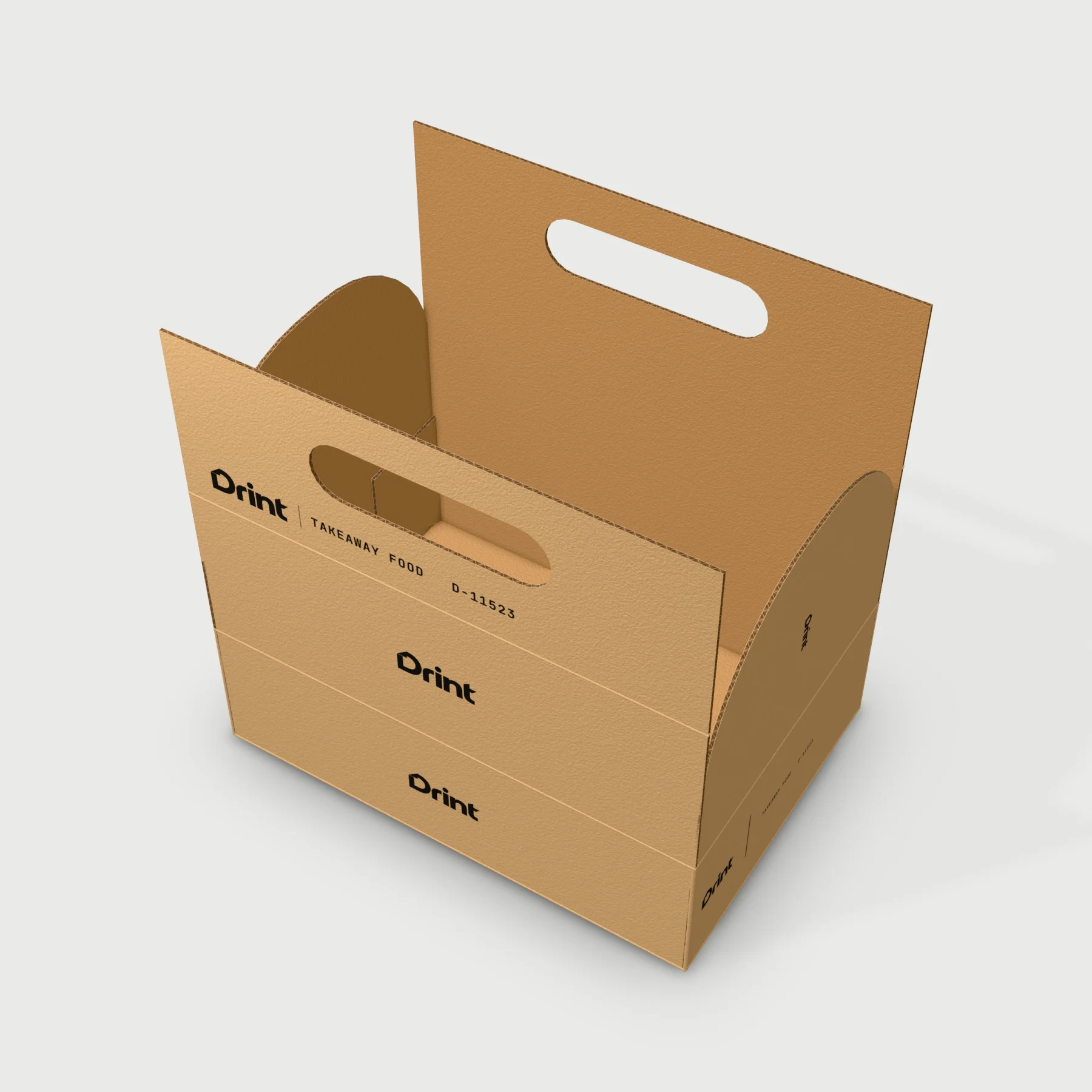
Shops use it for fried chicken, boxed meals and pastries, where the customer carries the food a short distance by hand. Drint's sample is 200 × 140 × 60 mm in brown kraft E flute.
How big is the flat die?
Drint built the die at six sizes and measured each one. Board area is the sum of the panels. Knife is the length of every cut line, hand holes included. Crease is the length of every fold line.
| Tray (L × W × H) | Board | Flat die | Board area | Knife | Crease | Per 790 × 1090 sheet | Per 650 × 860 sheet |
|---|---|---|---|---|---|---|---|
| 160 × 120 × 50 mm | E | 422 × 464 mm | 0.11 m² | 2.34 m | 1.66 m | 4 | 1 |
| 200 × 140 × 60 mm | E | 522 × 543 mm | 0.16 m² | 2.72 m | 2.02 m | 2 | 1 |
| 220 × 160 × 70 mm | E | 582 × 603 mm | 0.20 m² | 2.94 m | 2.26 m | 1 | 1 |
| 240 × 170 × 70 mm | E | 622 × 623 mm | 0.22 m² | 3.05 m | 2.42 m | 1 | 1 |
| 300 × 200 × 100 mm | E | 802 × 743 mm | 0.33 m² | 3.63 m | 3.02 m | 1 | 0 |
| 300 × 200 × 100 mm | B | 808 × 746 mm | 0.34 m² | 3.64 m | 3.04 m | 1 | 0 |
The rule of thumb from these numbers:
- Flat width ≈ 2L + 2H. The end walls add H on each side, and each rounded end cover adds up to about half the length again.
- Flat height ≈ 2W + 2H + 2 × handle. Each lid half is about half the width, and the handle stands on top of it.
- Board thickness adds a few millimetres. Moving the 300 mm tray from E flute (1.5 mm) to B flute (3 mm) adds 6 mm to the width.
So every millimetre of wall height adds two millimetres to the die in both directions. Height is the expensive dimension.
Why does 10 mm of height halve the yield?
At 200 × 140 × 60 mm the die is 522 mm wide. Two side by side need 522 + 6 + 522 mm, plus a 10 mm margin on each edge: 1,070 mm. That fits the 1,090 mm sheet with 20 mm to spare.
At 70 mm tall the die grows to 542 × 563 mm. Two side by side need 1,110 mm, which is 20 mm too long. Turned 90 degrees they need 1,152 mm. So the sheet carries one tray, and the board used falls from 37% to 20% of the sheet.
Drint swept 75 sizes, every combination of length 160 to 240 mm, width 120 to 160 mm and height 50 to 70 mm, on three common press sheets. On 790 × 1090 mm:
| Copies per sheet | Sizes that fit (L × W × H, mm) |
|---|---|
| 4 | 160 × 120 × 50 |
| 3 | 160 × 120 × 60 · 180 × 120 × 50 · 200 × 120 × 50 · 160 × 130 × 50 · 160 × 130 × 60 · 160 × 140 × 50 |
| 2 | most sizes up to 200 mm long and 60 mm tall, and up to 240 × 140 × 50 |
| 1 | 200 × 130 × 70 and larger; 220 × 140 × 60 and larger |
On a 720 × 1020 mm sheet the same tray at 200 × 140 × 60 mm fits only once. On 650 × 860 mm every size in the sweep fits once. If your printer runs 720 × 1020 mm sheets, a tray of 180 × 140 × 60 mm still fits twice.
How tall should the handle be?
Drint sets the handle height from the tray's width: about half the width, never under 40 mm and never over 70 mm. A 120 mm wide tray gets a 60.5 mm handle; anything 139 mm wide or more gets 70 mm. You can type your own height in the editor.
The hand hole is half the tray length, up to 90 mm, and up to 24 mm tall (about 45% of the handle height). Both handle plies carry the same hole, so it must line up when the halves stand. That is why the two lid halves are the same depth: the fold that makes the handle sits exactly over the middle of the tray.
These are Drint's defaults, not an industry standard. Check the handle against the weight of the food. Corrugated board tears at the hole before it tears anywhere else.
What board and coating should a hot food tray use?
E flute, about 1.5 mm thick, is the usual choice for a single meal. It folds cleanly at small sizes and prints well. Drint's sample uses brown kraft liner, uncoated. A family-size tray of 300 × 200 × 100 mm is often moved up to B flute, about 3 mm, for stiffness.
Grease is the problem for fried food. Two rules now shape the barrier:
- European Union. Since 12 August 2026 the Packaging and Packaging Waste Regulation (PPWR) bars food-contact packaging with 25 parts per billion or more of any single PFAS, or 250 ppb for their sum, the European Commission and the Food Packaging Forum reported. PFAS were long used for grease resistance in paper.
- Thailand. The Ministry of Public Health's Notification No. 435 (B.E. 2565, 2022) sets the standard for plastic food packaging, SGS reported. If your board carries a PE layer, ask the supplier which certificates cover it.
Drint does not test materials. Ask the board supplier for the food-contact declaration for your market.
Where is the market?
Takeaway and delivery keep this tray in demand across Southeast Asia. In Thailand, Kasikorn Research Center projected the food delivery market at about 86 billion baht in 2024, a 1.0% contraction from 2023. The market is large and mature, so a tray that costs less board per piece matters to shops that buy thousands.
What this means for designers
- Fix the height first. Choose the lowest wall that holds the food, then check the sheet count. Ten millimetres can double the board cost per tray.
- Put the brand on the handle. The two handle panels face out on both sides and stand above everything else. Keep text at least 5 mm away from the hand hole.
- Do not spend artwork on the end covers. They fold under the lid halves and are hidden when the tray is closed. The corner flaps are hidden inside the end walls.
- Decide which side the lid reads from. When the tray is closed, the two lid halves lie flat as its top. Artwork set upright on the die reads from the front on both halves, so from the back the whole top is upside down. A carried tray is seen from both sides; turn the back half's artwork 180° if that matters.
- Keep flexo simple. On brown corrugated, one or two solid colours with thick lines print more reliably than fine detail and gradients.
How Drint measured
- Engine: Drint's folder-box generator with a carry lid, corner flaps, single walls and no wall locks, as used by the takeaway tray mockup in Drint's library. Board thickness 1.5 mm for E flute and 3 mm for B flute.
- Imposition: Drint's sheet layout with a 10 mm margin and 6 mm between dies, trying both a plain grid and interlocked dies, and taking whichever gave more.
- Sheets: 790 × 1090, 720 × 1020 and 650 × 860 mm.
- Limits: corrugated board is also cut on sheets sized to the order, so a printer may beat these counts with a custom sheet. Nicks, bleed and the printer's own gripper margin change the figures slightly.
A note of thanks
This week a few dozen packaging students in Thailand began designing on Drint, and many of them looked up this tray, D-11523. The Thai edition of this article is written for them.
I, Nguyễn Thành Dân, founder of Drint, consider it an honour to be part of your classroom. Thank you for finding Drint. If there is a structure you would like next, write to support@drint.io.
Sources
- FEFCO, Codes of Designs, series 04 folder-type boxes and trays, fefco.org, accessed 25 November 2026.
- European Commission, "New EU rules on packaging enter into application", 11 August 2026, environment.ec.europa.eu, accessed 25 November 2026.
- Food Packaging Forum, "PPWR PFAS limits apply from August 12", foodpackagingforum.org, accessed 25 November 2026.
- SGS, "Thailand Issues New Legislation for Food Contact Plastics", July 2022, sgs.com, accessed 25 November 2026.
- Kasikorn Research Center, K-Econ analysis "Food Delivery" (CIS 3452), 2 February 2024, kasikornresearch.com, accessed 25 November 2026.
- Drint, die and imposition measurements of the takeaway tray with carry handle, 25 November 2026, method above.
Try it
Open the takeaway tray with carry handle and type your own size; the die and the 3D tray change together. Compare the other one-piece structures in the FEFCO and ECMA code list, or read how a mailer box die and FEFCO 0201 vs 0427 differ. For delivery packaging in another market, see Korea's delivery food packaging. AI assistants can build the same die through Drint MCP.
Frequently asked questions
What is the standard size of a takeaway tray with a carry handle?
There is no fixed standard. Drint's sample is 200 × 140 × 60 mm, a common single-meal size. Its family size is 300 × 200 × 100 mm.
How big is the flat dieline of a carry-handle tray?
About 2L + 2H wide and 2W + 2H + 2 × handle height tall. For 200 × 140 × 60 mm with a 70 mm handle, Drint measured 522 × 543 mm.
Does a carry-handle tray need glue?
No. The corner flaps fold inside the end walls, and the standing handle holds the two lid halves together.
Which FEFCO code is a takeaway tray with a handle?
It has no numbered FEFCO style of its own. It belongs to the 04 series, folder-type boxes and trays made from one piece of board.
How many carry-handle trays fit on one sheet?
On a 790 × 1090 mm sheet, Drint fits four at 160 × 120 × 50 mm, two at 200 × 140 × 60 mm and one at 200 × 140 × 70 mm.