Blog › Pint Glass Wrap Template
Pint Glass Print Template: Why a Tapered Glass Unrolls to an Arc
 By Nguyễn Thành Dân, Founder of Drint ·
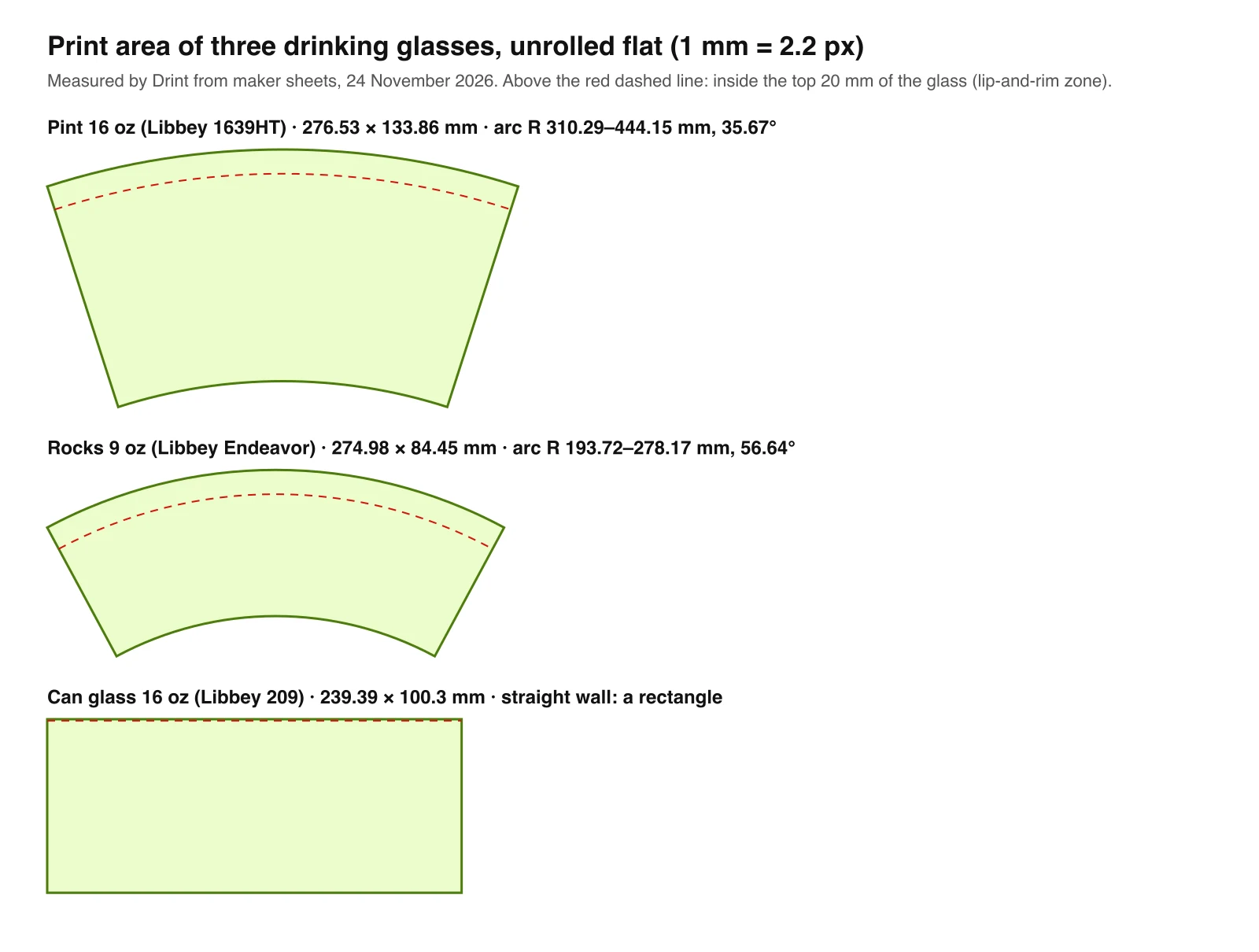
A tapered pint glass cannot take a rectangular print. On a 16 oz mixing glass (Libbey 1639HT), Drint's print zone unrolls to a ring slice with an inner radius of 310.29 mm, an outer radius of 444.15 mm and an angle of 35.67°. A straight-sided can glass, by contrast, takes a plain 239.39 × 100.3 mm rectangle. Drint worked out both on 24 November 2026.
Why it matters: art drawn as a rectangle and wrapped round a tapered glass ends up as a smile. Text dips at the sides and the two ends no longer meet level at the back.
Key points
- A tapered glass is a truncated cone. Unrolled, its surface is a slice of a ring, not a rectangle.
- Three numbers set the template: the outer radius, the inner radius and the angle.
- On a 16 oz pint the arc spans 35.67°. On a 9 oz rocks glass, with a sharper taper, it spans 56.64°.
- A straight-walled can glass needs no arc: its template is a 239.39 × 100.3 mm rectangle.
- The top 20 mm of a drinking glass is the lip-and-rim zone. Lead and cadmium rules apply to decoration there.
Why does a tapered glass need a curved template?
Picture the glass as a cone with its tip cut off. Slit it down one side and press it flat. The rim becomes a long outer arc. The bottom of the print becomes a shorter inner arc. Both share one centre point, which is where the cone's tip would have been.
The wider the taper, the closer that centre sits and the tighter the curve. A glass with straight sides has its centre infinitely far away, so its arc becomes a straight line and its template a rectangle.
How do you calculate a pint glass template?
You need three measurements of the print zone, taken on the glass:
- D, the outside diameter at the top of the print;
- d, the outside diameter at the bottom of the print;
- L, the length of the print measured along the slanted wall.
Then:
- Outer radius R = L × D ÷ (D − d).
- Inner radius r = R − L.
- Angle θ = 180° × D ÷ R.
The outer arc is then π × D long, the full circumference at the top of the print. The inner arc is π × d long.
Worked example: a 16 oz pint
Libbey lists its 1639HT mixing glass at 5 7/8 in high, 3 1/2 in across the top and 2 3/8 in across the bottom. Drint's print zone on it runs from 10 mm to 143.2 mm above the base, 133.86 mm along the wall. The zone's diameter is 88.02 mm at the top and 61.49 mm at the bottom.
- R = 133.86 × 88.02 ÷ (88.02 − 61.49) = 444.15 mm
- r = 444.15 − 133.86 = 310.29 mm
- θ = 180° × 88.02 ÷ 444.15 = 35.67°
The outer arc is 276.53 mm long. Drawn flat, the whole template fits in a box of 272.09 × 148.77 mm.
Template sizes for three common glasses
These are the zones Drint uses in Driglass. Outside sizes come from Libbey's published dimensions. Wall and base thickness are Drint's estimates.
| Glass | Outside H × top Ø | Brim-full | Print zone (from base) | Round × along the wall | Inner R | Outer R | Angle | Flat box |
|---|---|---|---|---|---|---|---|---|
| 16 oz pint, Libbey 1639HT | 149.2 × 88.9 mm | 496 ml | 10–143.2 mm | 276.53 × 133.86 mm | 310.29 mm | 444.15 mm | 35.67° | 272.09 × 148.77 mm |
| 9 oz rocks, Libbey Endeavor | 98.4 × 88.9 mm | 298 ml | 9–92.4 mm | 274.98 × 84.45 mm | 193.72 mm | 278.17 mm | 56.64° | 263.92 × 107.64 mm |
| 16 oz can glass, Libbey 209 | 133.4 × 69.9 mm | 492 ml | 14–114.3 mm | 239.39 × 100.3 mm | none | none | 0° | 239.39 × 100.3 mm |
The rocks glass is short but tapers hard, from 88.9 mm to 57.2 mm. So its arc is tighter than the pint's, even though its print is 49 mm shorter.
The can glass bulges and narrows at the top, like a drinks can. Drint stops its print zone at the widest straight part, 114.3 mm up. Above that the wall turns inward and a flat screen cannot reach it.
Where does the lip-and-rim zone fall on the template?
On a drinking glass, the top 20 mm of the outside touches the drinker's mouth. Canada's Glazed Ceramics and Glassware Regulations set lead and cadmium limits for decoration inside that band. California Proposition 65 settlements set their own limits for it. See lead rules for printed glassware for the numbers.
On the template, the 20 mm line is a third arc, concentric with the other two:
| Glass | Gap from rim to top of print | Part of the print inside the top 20 mm |
|---|---|---|
| 16 oz pint | 6 mm | top 14 mm |
| 9 oz rocks | 6 mm | top 14 mm |
| 16 oz can glass | 19.1 mm | top 0.9 mm |
Driglass writes the lip-and-rim warning into the notes it sends with every drinking-glass file.
How do you check a glass template before making screens?
- Measure your own glass. Libbey's figures are nominal and moulds vary.
- Print the template on plain paper at 100%, cut it out and wrap it round the glass. The ends should meet with no gap and no step.
- Check that a straight line of type sits level all the way round.
- Mark the lip-and-rim line and keep coloured decoration below it unless the enamel is tested.
- Only then send the art as one film per colour at 1:1.
The same arc logic applies to any cone: tumblers, flower pots, lamp shades and bottle necks. For the necks of beer bottles, see beer and wine bottle print sizes.
What this means for designers
Never stretch a rectangle to fit a tapered glass in layout software. Draw on the arc from the start, and leave the lip-and-rim band empty unless the glassworks says otherwise.
Driglass builds the arc from the glass size, shows the art in 3D glass, and exports a 1:1 film per colour. AI assistants can read the same numbers through the Driglass MCP server.
Sources
- Libbey, 1639HT 16 oz mixing glass, 209 16 oz beer can glass and Endeavor 9 oz rocks glass product sheets, accessed 23 November 2026: libbey.com
- Government of Canada, Glazed Ceramics and Glassware Regulations (SOR/2016-175), accessed 24 November 2026: laws-lois.justice.gc.ca
- ASTM International, C927 "Standard Test Method for Lead and Cadmium Extracted From the Lip and Rim Area of Glass Tumblers Externally Decorated With Ceramic Glass Enamels", accessed 24 November 2026: store.astm.org
- Drint, print zones in Driglass, measured 23–24 November 2026: drint.io/driglass
Try it
See the pint glass print template drawn to scale, or open it in Driglass and download the arc at 1:1.
Frequently asked questions
Why is my pint glass design curved?
A pint glass is a truncated cone. Flattened, its surface is a slice of a ring, so a design that reads level on the glass looks curved on paper. On a 16 oz Libbey 1639HT the arc spans 35.67°.
What size is a pint glass print template?
For Drint's zone on a 16 oz Libbey 1639HT: 276.53 mm round at the top, 133.86 mm along the wall, on an arc of radius 310.29–444.15 mm. Flat, it fits a 272.09 × 148.77 mm box.
How do I calculate the arc for a tapered tumbler?
Outer radius R = L × D ÷ (D − d), inner radius r = R − L, angle θ = 180° × D ÷ R. D and d are the top and bottom diameters of the print; L is its length along the wall.
Does a straight glass need an arc template?
No. A wall with no taper unrolls to a rectangle as wide as the circumference. A 16 oz can glass takes 239.39 × 100.3 mm.
Can I print right up to the rim of a drinking glass?
Only with enamels tested for lead and cadmium release. The top 20 mm is the lip-and-rim zone, and both Canadian law and Proposition 65 settlements set limits for it.