Blog › Mailer Box Die Explained
Mailer Box Die Explained: How FEFCO 0427 Locks Without Glue
 By Nguyễn Thành Dân, Founder of Drint ·
A FEFCO 0427 mailer is one die-cut sheet of corrugated board that locks into a box without glue. Its side walls roll over a corner flap, so each side is three boards thick. On Drint's die for a 200 × 150 × 50 mm box, each rolled side takes 5 mm of the width in E flute and 9.5 mm in B flute.
Why it matters: designers who size a mailer from the product and forget the rolled walls get a box that comes back tight. The same mistake costs money twice, once at the die maker and again at the courier, who bills by volume.
Watch the 6:48 video version, with every chapter drawn from the real die: Mailer Box Design, Explained (YouTube, subtitles in 10 languages). It also plays on the mailer box mockup page.
Key points
- FEFCO, the European corrugated board association, files the mailer as style 0427 in group 04, "folder-type boxes", and marks it "M" for usually manual erection.
- The rolled side wall stacks three boards plus 0.5 mm of play: 5 mm per side in E flute (1.5 mm board) and 9.5 mm in B flute (3 mm), in Drint's die generator.
- "3-ply" in India, China and Vietnam is "single wall" in Europe and the US. India's standard IS 2771 defines it that way.
- Couriers outside the US divide centimetres by 5000 (DHL Express, FedEx and UPS international) or 6000 (DPD, India Post) to get a volume weight in kilograms.
- China's GB 45186-2024, in force from 1 July 2026, limits express parcels to two packaging layers for ordinary goods and caps the box diagonal at twice the product's.
What is a FEFCO 0427 mailer?
The FEFCO International Fibreboard Case Code sorts corrugated boxes into numbered styles. Group 04 covers "folder-type boxes and trays". These "usually consist of only one piece of board", with the bottom "hinged to form two or all side walls and the cover".
The code marks 0427 "M", for usually manual erection. One US printer, Newprint, says a packer folds it in 30 seconds to a minute. In North America the same box is often called a roll end tuck front (RETF). That name describes how it closes. "Mailer" describes what it is used for.
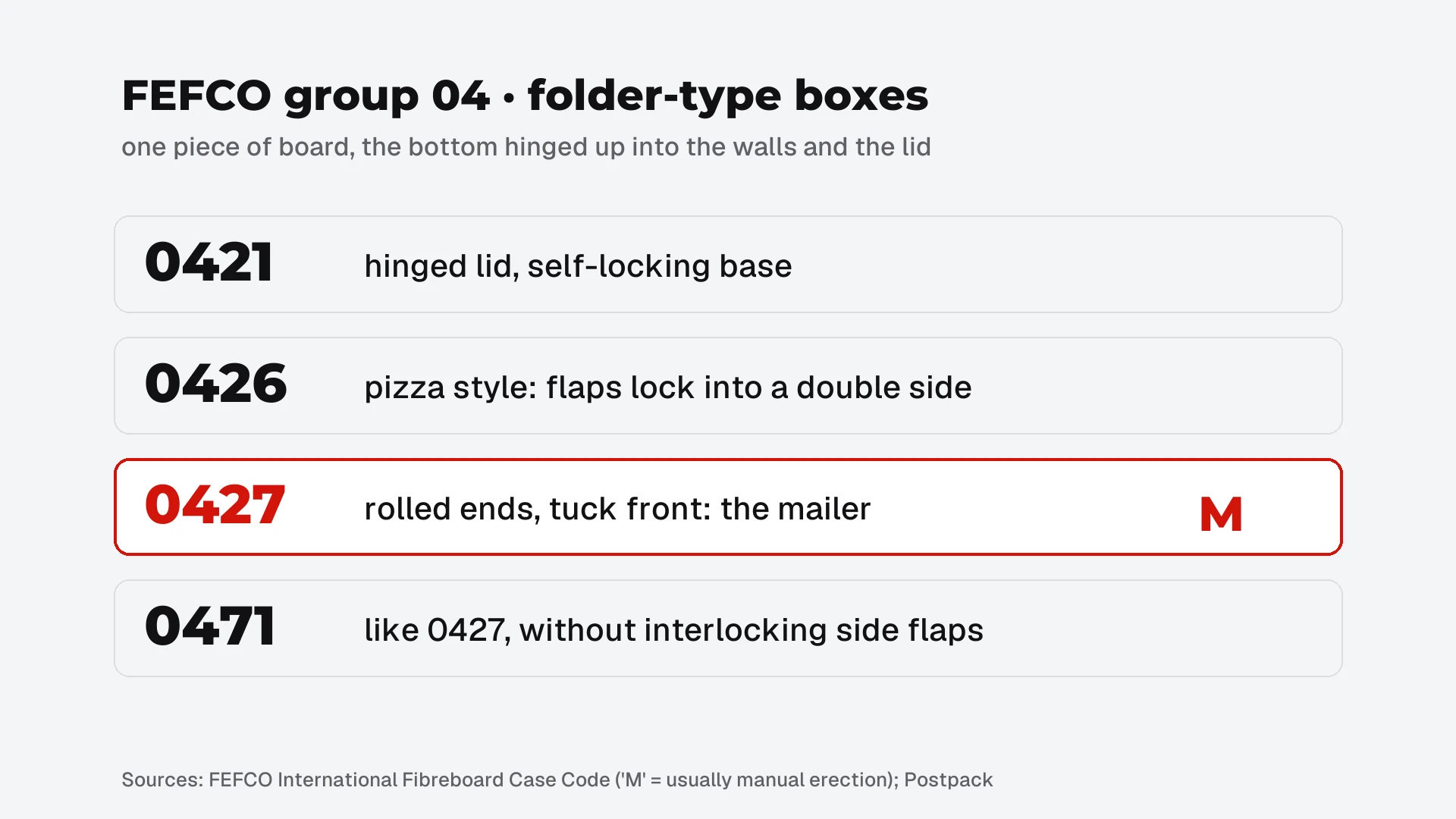
Its neighbours differ in small places. UK maker Postpack describes 0421 as a hinged-lid box with a self-locking base, 0426 as the pizza style, and 0471 as "similar to the 0427 but without interlocking side flaps".
How does the die lock without glue?
Read the die from the middle out:
| Part | What it does |
|---|---|
| Floor | The centre of the blank; it has slots for the locking tabs |
| Front wall and liner | The liner folds back inside, and its tabs drop into the floor slots |
| Back wall | Carries the lid and two corner flaps |
| Lid, tuck flap, dust flaps | The tuck slides down inside the front; the dust flaps tuck in by the sides |
| Side walls and rolled liners | Each side rolls over the back wall's corner flap and locks into the floor |
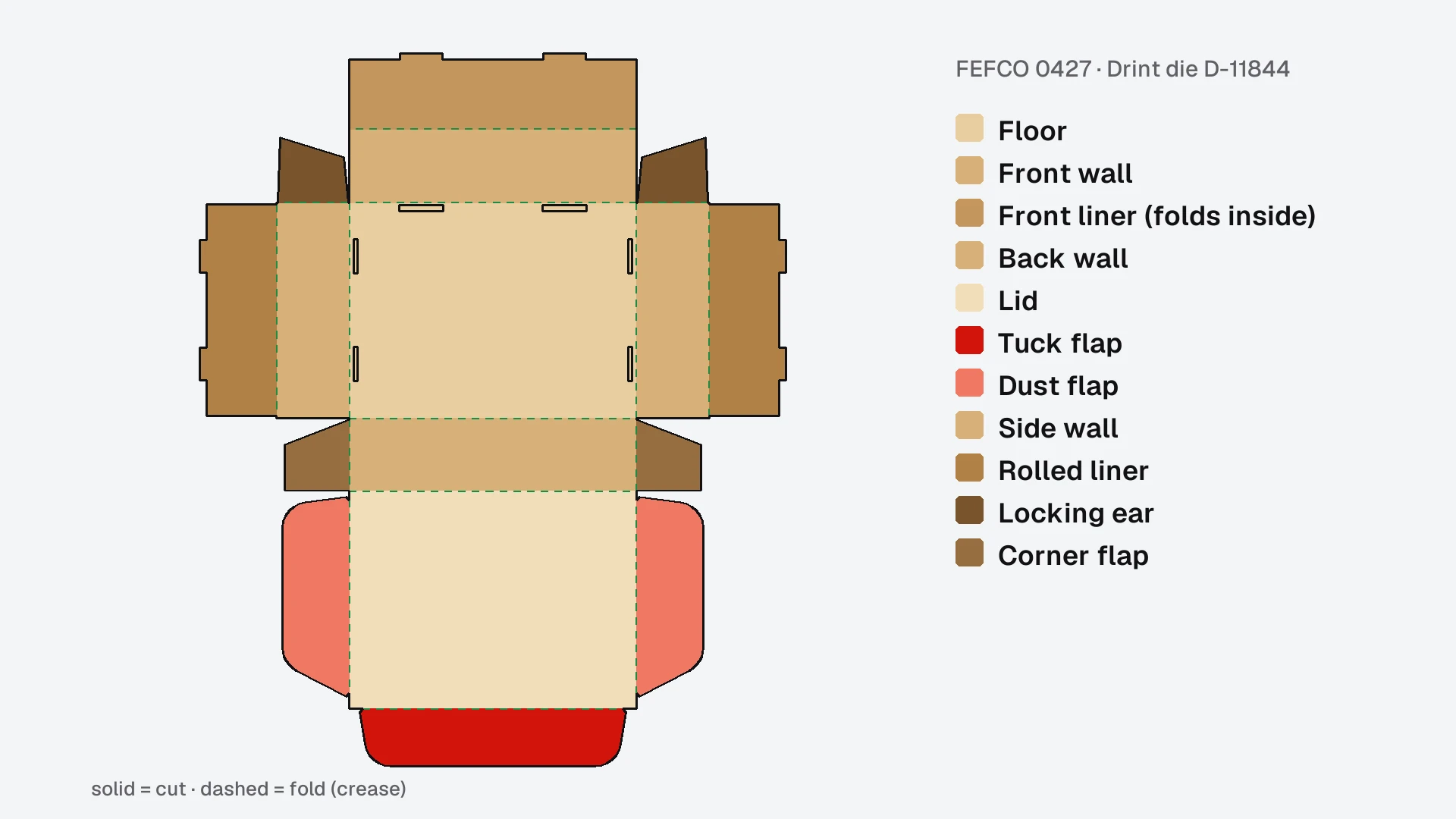
The corner flap is what holds the box up. It sits between the outer side wall and the rolled liner, so the back wall and the lid stand without glue.
"No glue" is not the same as "sealed for shipping". Amazon's Frustration-Free Packaging guidelines (v10.3, 2021) say "Locking tabs must be properly sealed with glue or tape". Its failure-mode guide lists a protruding tuck flap as a fail.
How much room do the rolled walls take?
FEFCO sizes are inside dimensions, length × width × height, measured on the flat blank "from the centre of crease". On a mailer, the rolled walls stand inside that space.
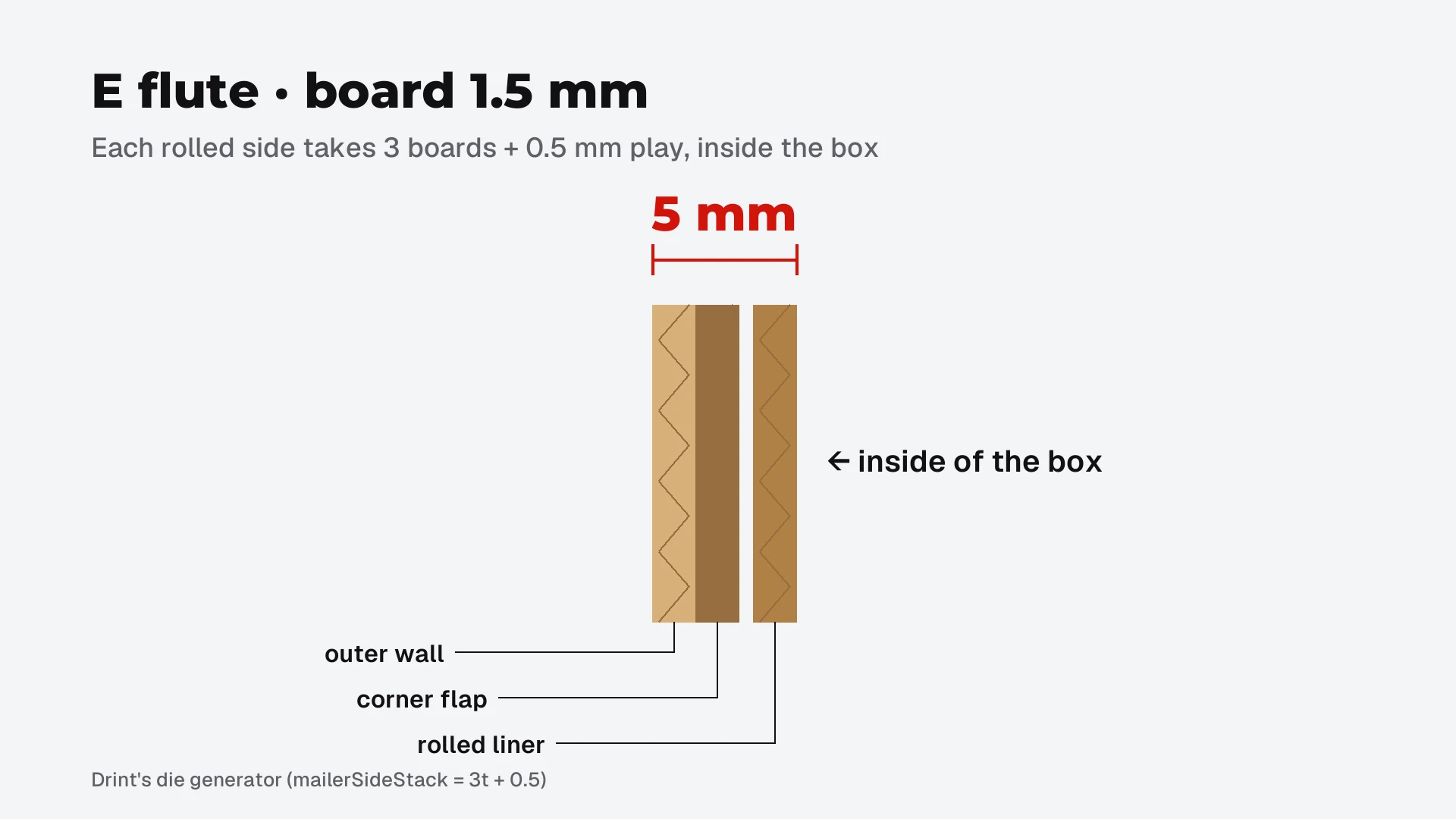
Drint's die generator puts each rolled liner three board thicknesses plus 0.5 mm in from the side crease. The three boards are the outer wall, the corner flap and the liner.
| Flute (Drint board) | Each rolled side takes | Both sides |
|---|---|---|
| E, 1.5 mm | 5 mm | 10 mm |
| B, 3 mm | 9.5 mm | 19 mm |
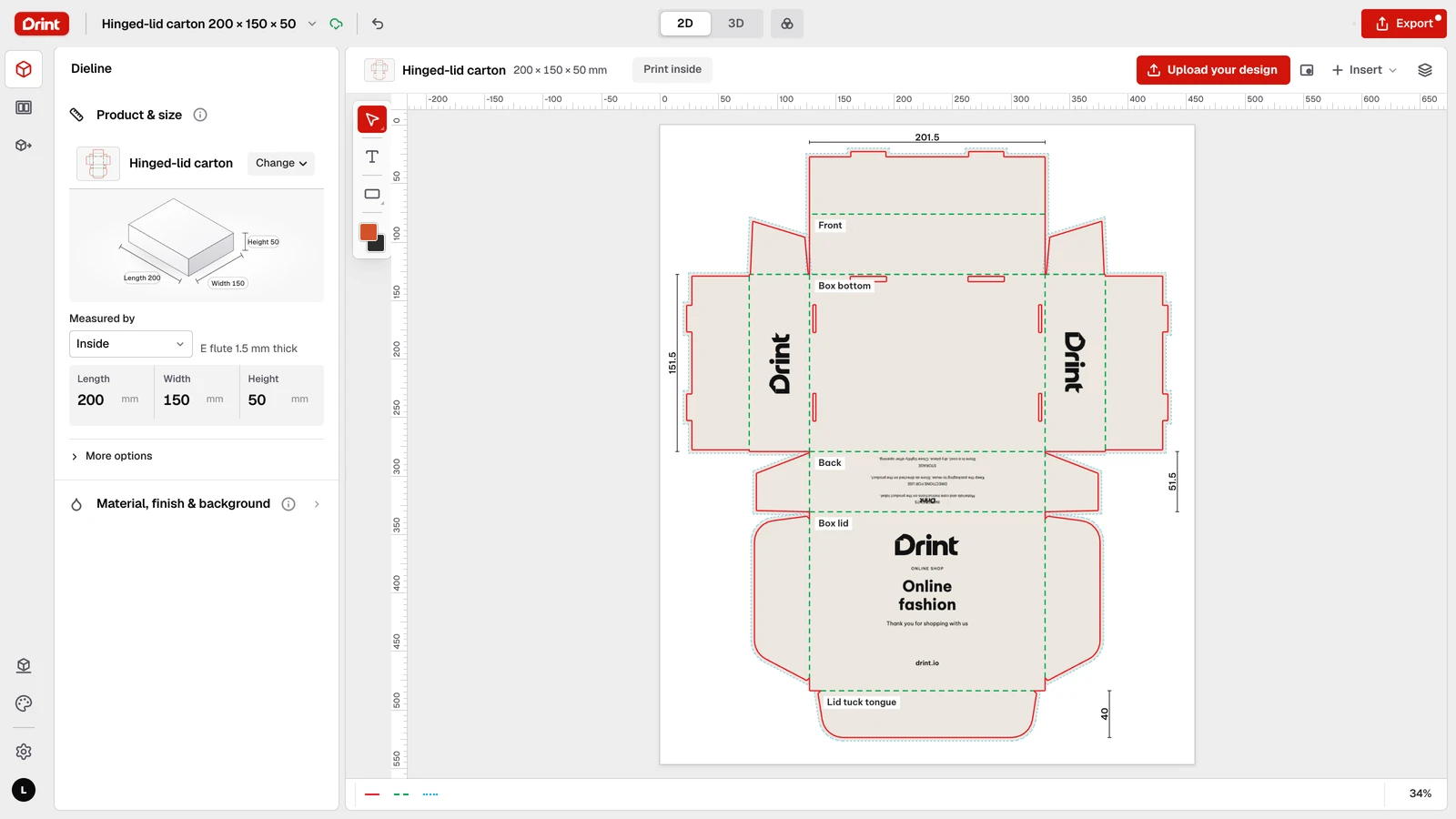
For a 200 × 150 × 50 mm inside size in E flute, Drint's die is a 411.5 × 501 mm flat blank. The editor shows the same box three ways: 200 × 150 × 50 mm inside, 201.5 × 151.5 × 51.5 mm at the crease, and 203 × 153 × 53 mm outside.
Start from the product. Packwire, a US mailer printer, suggests 0.25–0.5 in (6–13 mm) of room for tissue or thin inserts, and nearer 1 in for foam or dividers.
Is it 3-ply, single wall or 32 ECT?
The same board has different names around the world:
| Where | How it is named |
|---|---|
| India, China, Vietnam | 3-ply / 5-ply (paper layers) |
| Europe, US | Single wall / double wall (fluted layers) |
| Europe and Asia, by grade | Paper weight per layer + flute, e.g. "125 K/T B" |
| US, by test | 32 ECT (edge crush) or 200 lb burst (Mullen) |
India's corrugated box standard IS 2771 (Part 1) defines board lined on both sides as "single wall, 3-ply, or double-faced". Vietnamese maker THACO Industries sells "three-layer" and "five-layer" carton in B, C and E flute.
In metric, 32 ECT is 5.60 kN/m and a 200 lb burst is 1,379 kPa (about 14.1 kgf/cm²), using DS Smith's conversion factors. The tests are ISO 3037 (edge crush) and ISO 2759 (burst). They measure different things. Packwire's board chart warns that ECT and burst "cannot be converted" into each other.
Flute thickness depends on what is measured. FEFCO's table gives flute heights of about 1.2 mm (E) and 2.4 mm (B). Smurfit Kappa gives finished board of 1.6 mm (E) and 3.2 mm (B).
How do couriers outside the US bill a mailer?
They charge the higher of real weight and volume weight. In metric, volume weight is length × width × height in centimetres. Divide that by the carrier's divisor:
| Divisor | Carriers | 30 × 20 × 10 cm mailer |
|---|---|---|
| 5000 | DHL Express, FedEx and UPS international, Delhivery | 1.2 kg |
| 6000 | DPD, India Post | 1.0 kg |
DHL Express UK rounds chargeable weight up to the next 0.5 kg, so that 1.2 kg is billed as 1.5 kg. US divisors and rounding are in our guide to e-commerce shipping boxes.
What are the print rules on corrugated?
Print route depends on the run. Packwire puts flexo plates at $500–1,500 a colour and dies at $800–2,500, so flexo usually needs 5,000 or more boxes. Litho-lamination, offset printed on paper and laminated to the board, "usually makes more sense" around 5,000, according to Catalpha. Digital runs start at a few hundred.
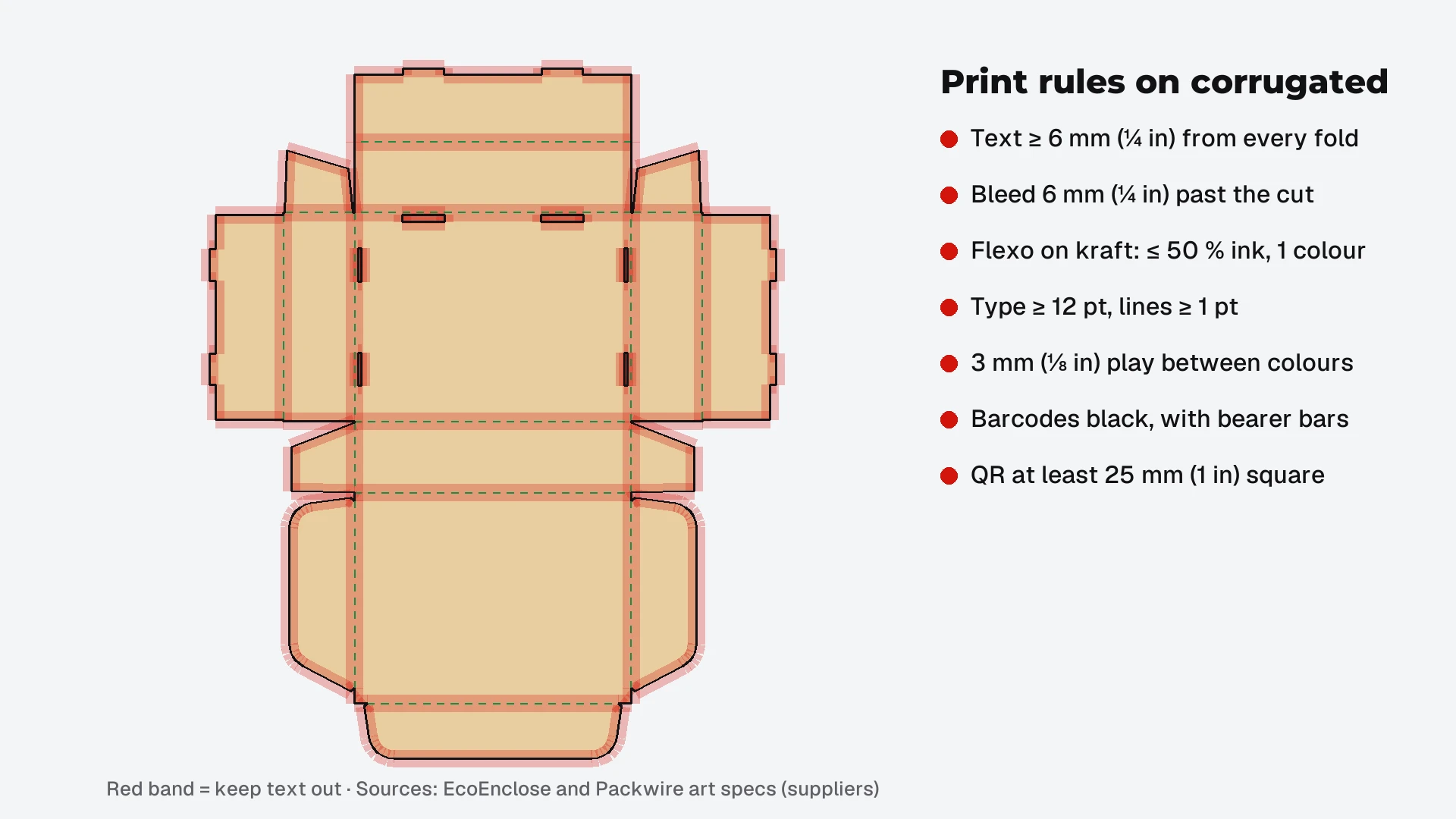
EcoEnclose's art specification for flexo on kraft asks for:
- One colour as standard, and no more than 50% ink coverage per side.
- Type at 12 pt or more (14 pt reversed), lines at least 1 pt.
- About 1/8 in (3 mm) of registration movement between colours, and no light colour over a dark one.
- Black barcodes with bearer bars, and QR codes at least 1 × 1 in (25 mm).
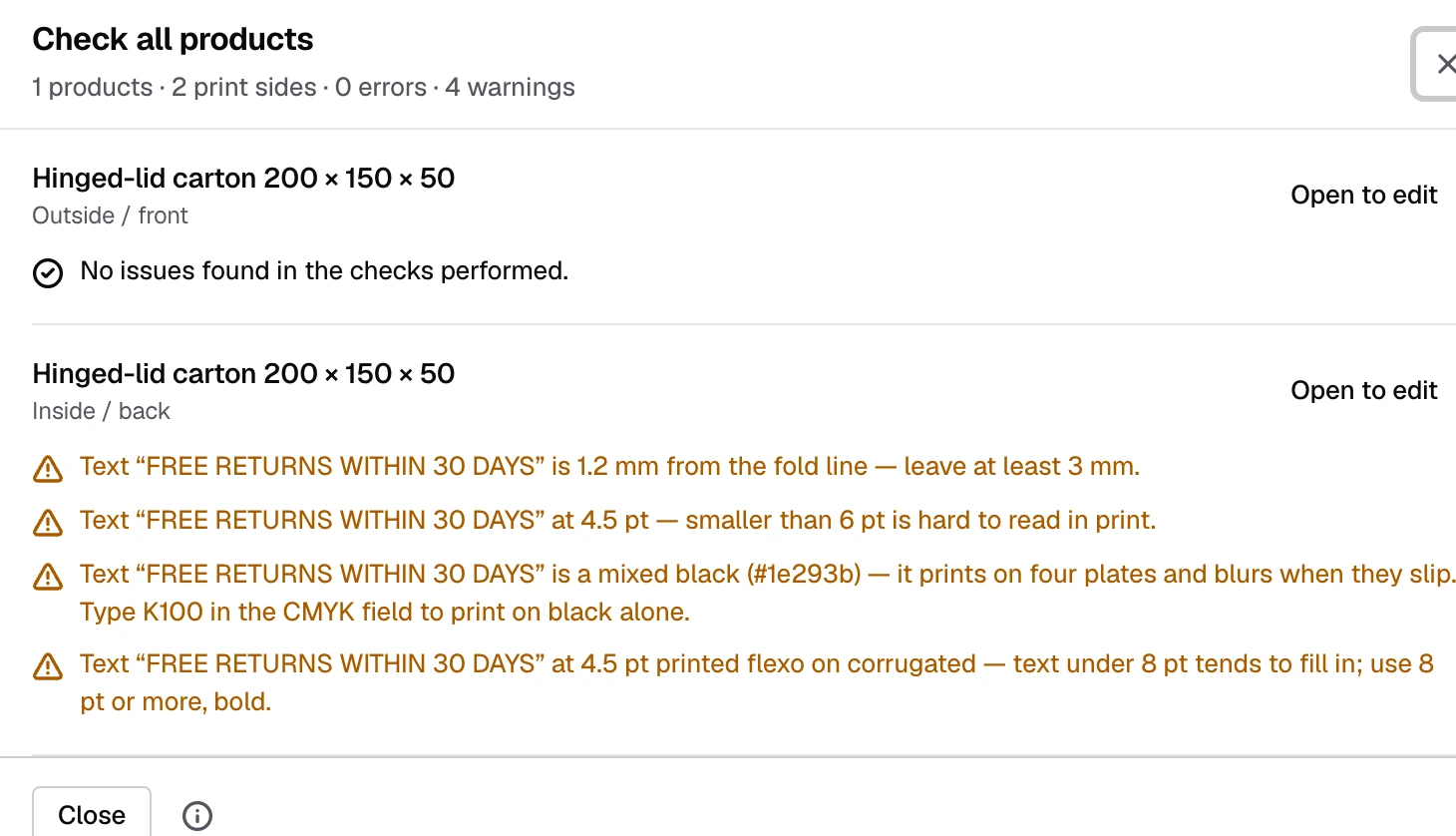
Drint's preflight checks the real die before export. We set a test line at 4.5 pt, 1.2 mm from the lid fold. Preflight raised four warnings: too close to the fold, under 6 pt, a mixed black on four plates, and under 8 pt for flexo on corrugated.
Which rules limit empty space in the box?
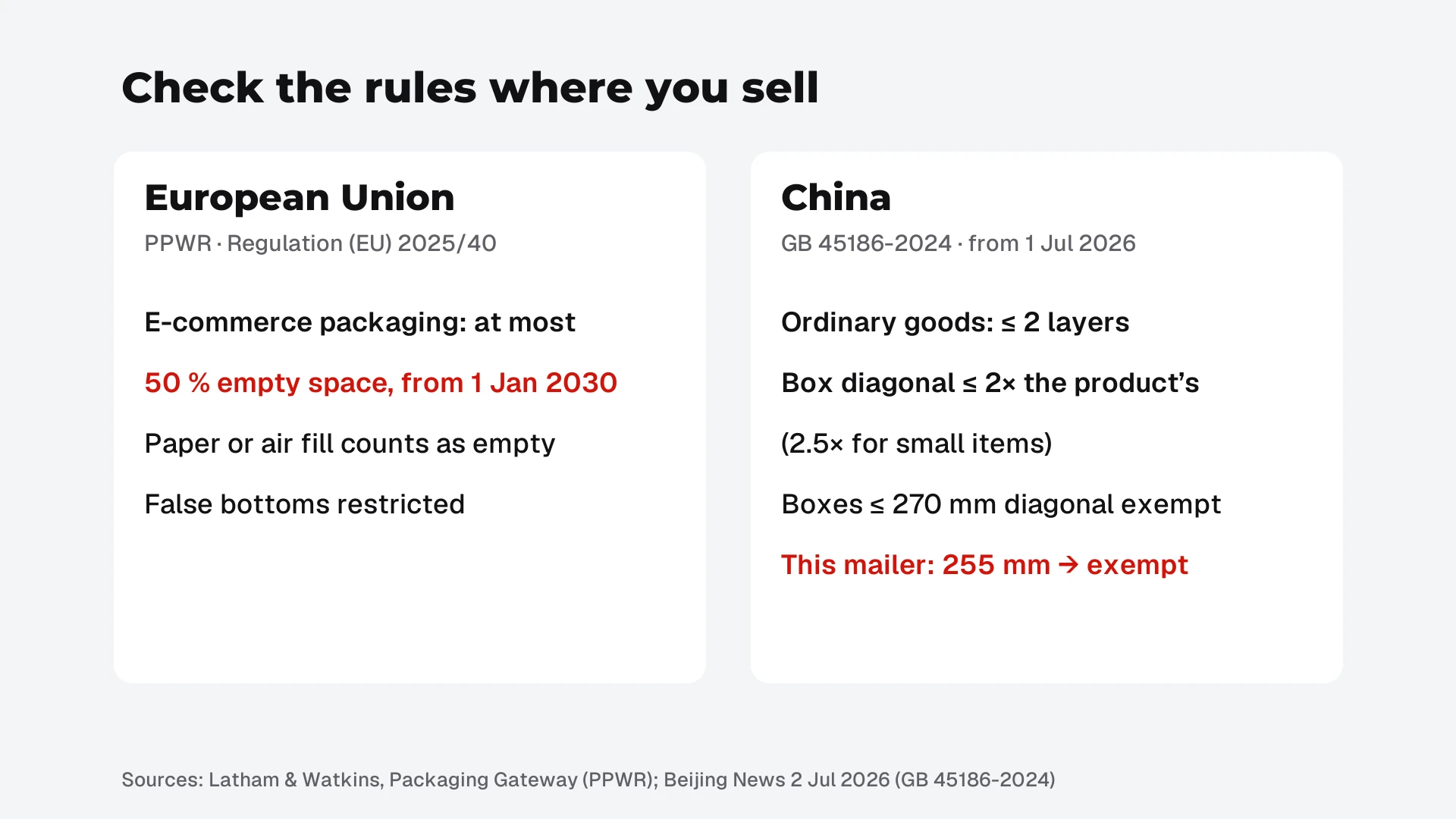
European Union. The Packaging and Packaging Waste Regulation (EU) 2025/40 (PPWR) applies from 12 August 2026. From 1 January 2030, grouped, transport and e-commerce packaging may have at most 50% empty space. Paper or air fill counts as empty space, and false bottoms are restricted.
China. The mandatory standard GB 45186-2024, Requirements for restricting excessive express packaging, applies from 1 July 2026. Ordinary goods ship in at most two packaging layers. For products of 150–500 mm, the box diagonal may be at most twice the product's. Boxes with a diagonal of 270 mm or less are exempt.
A 200 × 150 × 50 mm mailer has an inside diagonal of about 255 mm, so it is exempt. A 30 × 20 × 10 cm mailer, at about 374 mm, is not.
What this means for designers
- Size the mailer from the inside and let the die add the rolled walls; check crease and outside sizes before you quote a courier rate.
- Ask the board supplier what they mean by "E flute": a 1.2 mm flute height or 1.6 mm board.
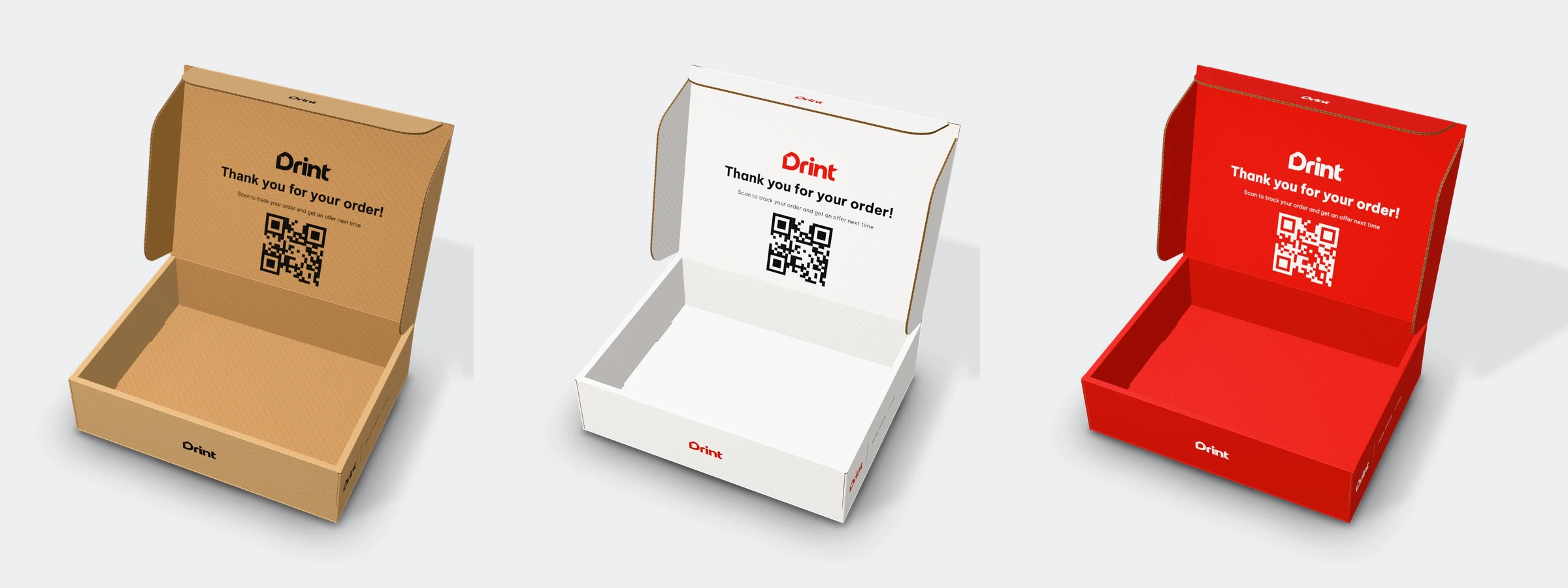
- Design for one colour on kraft, keep text 6 mm from every fold, and spend the upgrade on the inside of the lid.
Try it
Open the mailer box mockup D-11844 at your own size, or start from the FEFCO 0427 dieline. For the basic difference from a shipping carton, read FEFCO 0201 vs 0427.
Sources
- FEFCO, International Fibreboard Case Code, 11th edition, accessed 20 November 2026.
- Postpack, Custom size mailing boxes, accessed 20 November 2026.
- Newprint, Roll End Tuck Front box FAQ, accessed 20 November 2026.
- Amazon, Frustration-Free Packaging certification guidelines v10.3.pdf), 2021, accessed 20 November 2026.
- Packwire, How to design mailer boxes, Digital vs flexo printing and Packaging board chart, accessed 20 November 2026.
- Bureau of Indian Standards, IS 2771 (Part 1):1990 Corrugated fibreboard boxes, accessed 20 November 2026.
- THACO Industries, Carton for the electronics industry, accessed 20 November 2026.
- DS Smith, Customary units to SI units, accessed 20 November 2026.
- Smurfit Kappa, Fluted paper, accessed 20 November 2026.
- DHL Express, How do I calculate volumetric weight? and Measuring and weighing advice (UK), accessed 20 November 2026.
- DPD Romania, What is volumetric weight?, accessed 20 November 2026.
- Delhivery, Calculating volumetric weight, accessed 20 November 2026.
- India Post (CEPT training portal), Size measurement, accessed 20 November 2026.
- Catalpha, Litho-laminate vs digital printing, accessed 20 November 2026.
- EcoEnclose, Art specs and requirements: boxes, accessed 20 November 2026.
- Latham & Watkins, European Packaging and Packaging Waste Regulation: summary of provisions, accessed 20 November 2026.
- Packaging Gateway, EU sets 50% empty-space cap for e-commerce packaging, accessed 20 November 2026.
- Beijing News, GB 45186-2024 report, 2 July 2026, accessed 20 November 2026.
- Drint die generator and editor (FEFCO 0427 mailer, D-11844), measured 20 November 2026.
Frequently asked questions
Does a FEFCO 0427 mailer need glue?
No. The rolled side walls and locking tabs hold it together. Some marketplaces, such as Amazon, still ask for the locking tabs to be taped or glued for shipping.
How much smaller is the inside than the crease size?
On Drint's die, each rolled side wall takes three board thicknesses plus 0.5 mm: 5 mm per side in E flute and 9.5 mm in B flute.
Is 3-ply the same as single wall?
Yes. Three paper layers (two liners and one fluted medium) make one fluted wall. India's IS 2771 uses both names for the same board.
Can I convert ECT to burst strength?
No. Edge crush measures stacking strength and burst measures puncture resistance. Convert each to metric (kN/m, kPa), but not one into the other.
Is my mailer affected by China's express packaging rule?
Only if its diagonal is over 270 mm. Then the box diagonal may be at most twice the product's for items of 150–500 mm, and ordinary goods may use at most two layers.