Blog › Reverse vs Straight Tuck End
Reverse vs Straight Tuck End: Flap Sizes and Cartons per Sheet
By Nguyễn Thành Dân, founder of Drint ·
A reverse tuck end carton fit more copies on a press sheet than a straight tuck end in 11 of 36 tests by Drint on 21 November 2026, and never fewer. Across 12 carton sizes and 3 sheet sizes it placed 432 cartons against 407, or 6.1% more. The gain appeared only when copies were nested head to head, and only on cartons 80 mm wide or narrower.
Why it matters: the tuck style is chosen once, at the dieline stage. If it costs a few cartons per sheet, that cost repeats on every print run.
Key points
- Both styles are four panels in a tube, glued on one side seam, closed by a tuck flap at each end.
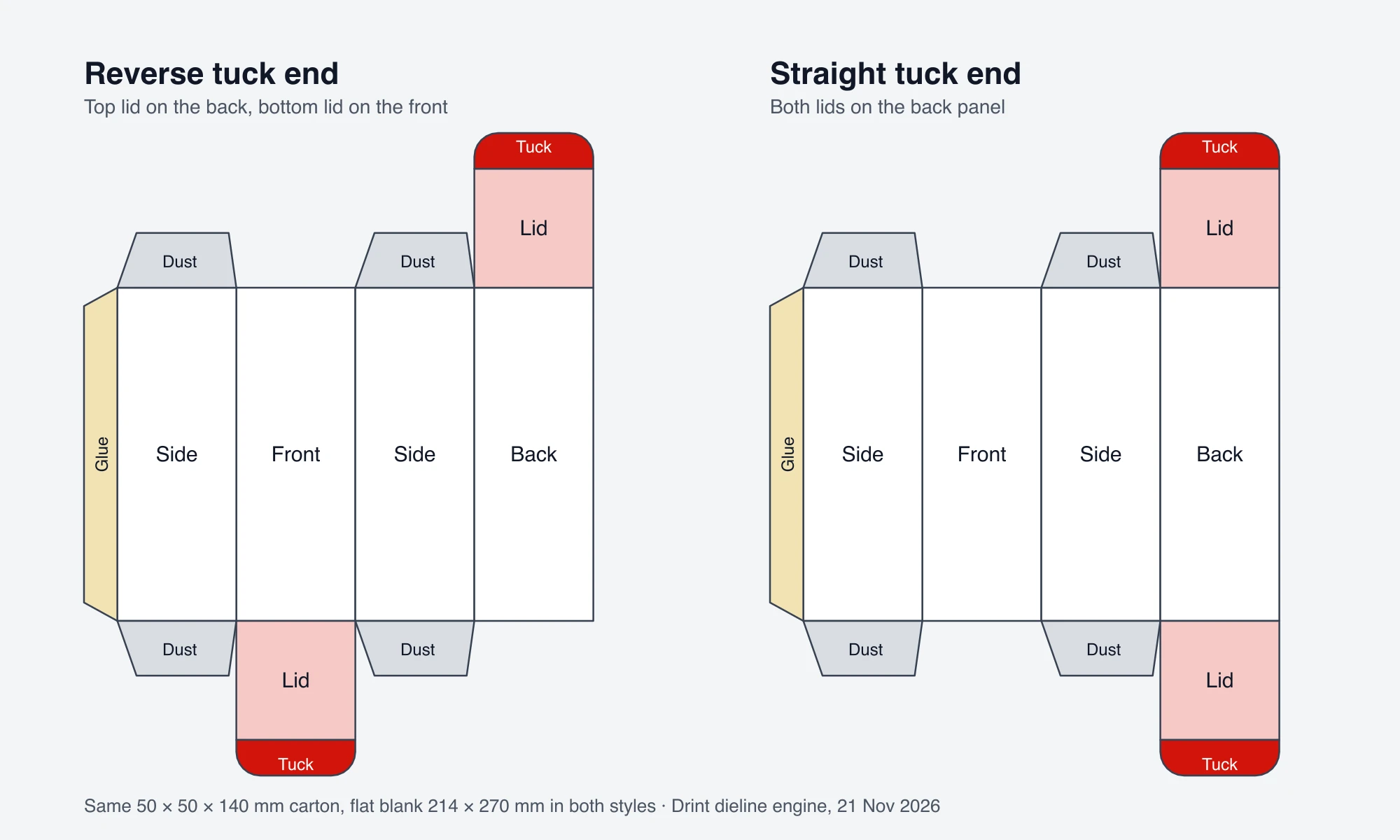
- Reverse tuck end (RTE), ECMA A20.20.03.01: the top lid is hinged on the back panel, the bottom lid on the front.
- Straight tuck end (STE): both lids are hinged on the same panel, so the front shows no lid edge.
- In Drint's test, without nesting, the two styles fit exactly the same count on every sheet: 355 each.
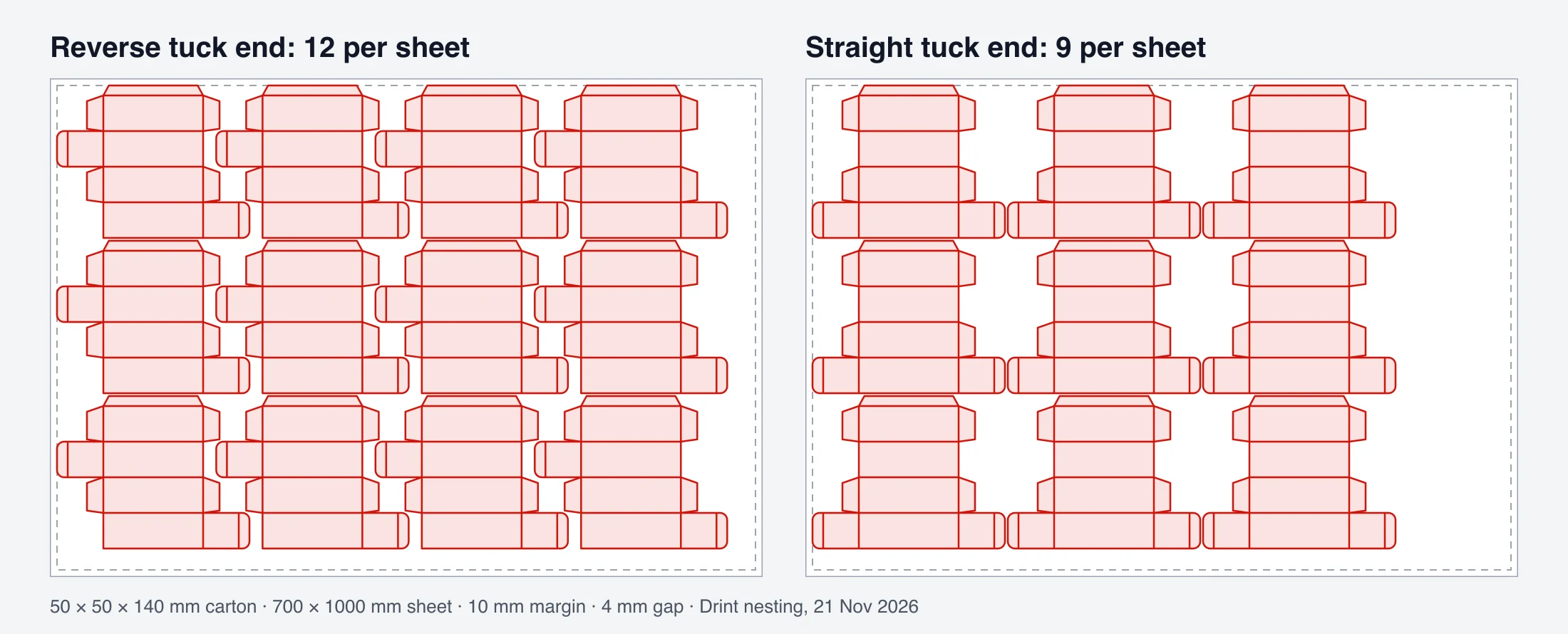
- With nesting, RTE gained up to 33%: 12 against 9 for a 50 × 50 × 140 mm carton on a 700 × 1000 mm sheet.
What is the difference between a reverse and a straight tuck end?
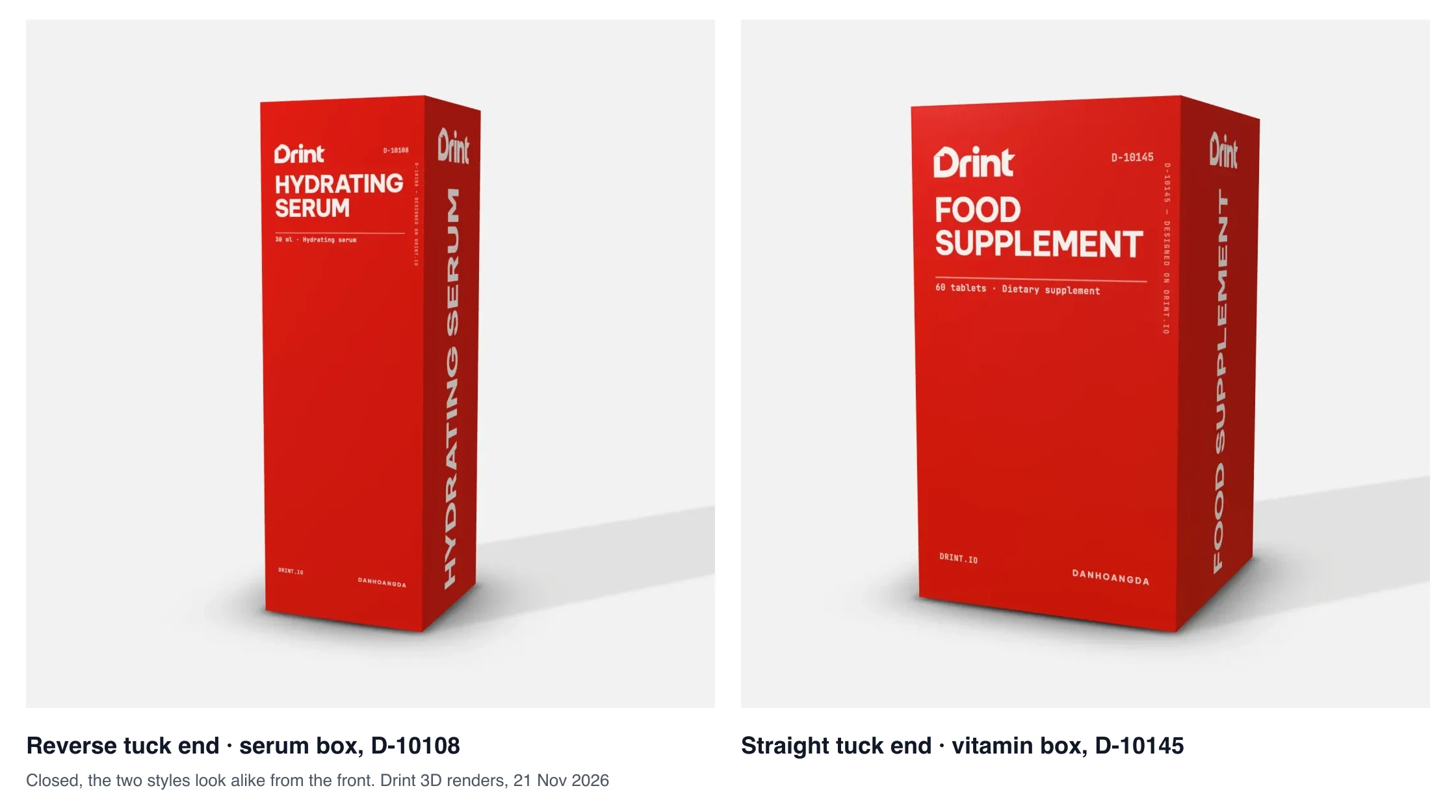
The European Carton Makers Association (ECMA) code list groups glued, rectangular folding cartons under the letter A. Tuck closures sit in the A20 family. Our explainer on how to make a packaging dieline covers how these codes are built.
In a reverse tuck end box, the two lids open toward opposite faces. The top lid swings from the back, the bottom lid from the front. In a straight tuck end box, both swing from the back. Each lid carries a tuck tongue that slides inside the box. Two dust flaps on the side panels close the corners under each lid.
Printers do not agree on which style costs less. Sttark, a US printer, says in its carton style guide (updated 19 December 2024) that straight tuck closures take less paper and are "a little cheaper". The guide gives no sheet layouts or counts, so we measured them.
How big are the flaps on a tuck end dieline?
These are the defaults Drint uses to draw both styles. They are starting points that a die-maker or a shop profile can change.
| Part | Default in Drint | Note |
|---|---|---|
| Glue flap | 14 mm | Along the side seam |
| Tuck tongue | 15 mm deep | Rounded corners, on the far edge of each lid |
| Lid | L × W | One at each end |
| Dust flap | 0.45 × L or 0.75 × W, whichever is smaller, at least 5 mm | Two at each end, on the side panels |
| Bleed | 3 mm | Outside the cut line |
From these, the flat blank of either style measures (2L + 2W + 14) wide × (H + 2W + 30) tall. A 50 × 50 × 140 mm carton opens flat to 214 × 270 mm. A dust flap on that carton is 23 mm deep.
Drint draws the panels at the size you type. If a shop has its own allowance for board thickness, found by a test cut, a shop profile adds it on top. Our guide to print-ready packaging files covers bleed and safe margins in detail.
How many cartons fit on a press sheet?
We generated both styles in Drint's dieline engine for 12 common carton sizes. Then we laid each one out on three standard sheets: 790 × 1090, 700 × 1000 and 650 × 860 mm. Every layout kept a 10 mm margin and a 4 mm gap between cut lines.
| Carton L × W × H (mm) | Flat blank (mm) | 790 × 1090 RTE / STE | 700 × 1000 RTE / STE | 650 × 860 RTE / STE |
|---|---|---|---|---|
| 30 × 30 × 90 | 134 × 180 | 35 / 32 | 28 / 26 | 24 / 22 |
| 35 × 35 × 110 | 154 × 210 | 24 / 24 | 20 / 18 | 16 / 15 |
| 40 × 40 × 120 | 174 × 230 | 20 / 18 | 15 / 15 | 12 / 12 |
| 50 × 50 × 140 | 214 × 270 | 12 / 12 | 12 / 9 | 6 / 6 |
| 60 × 30 × 180 | 194 × 270 | 15 / 15 | 9 / 9 | 9 / 9 |
| 60 × 60 × 60 | 254 × 210 | 18 / 15 | 12 / 12 | 10 / 10 |
| 70 × 25 × 120 | 204 × 200 | 20 / 18 | 15 / 12 | 12 / 12 |
| 80 × 50 × 140 | 274 × 270 | 9 / 9 | 8 / 6 | 6 / 6 |
| 90 × 30 × 150 | 254 × 240 | 12 / 12 | 9 / 9 | 6 / 6 |
| 100 × 100 × 100 | 414 × 330 | 4 / 4 | 4 / 4 | 4 / 4 |
| 120 × 40 × 200 | 334 × 310 | 6 / 6 | 6 / 6 | 4 / 4 |
| 150 × 50 × 220 | 414 × 350 | 4 / 4 | 4 / 4 | 2 / 2 |
Bold marks the cases where the reverse tuck end fit more. Totals: 432 reverse, 407 straight.
Why does the reverse tuck end nest better?
The flat blank of both styles has the same outer rectangle. The difference is where the lids stick out. On a reverse tuck end, the top lid sits on one panel and the bottom lid on another, so the blank steps like a Z. A second copy turned 180 degrees slides its lids into the empty corners of the first.
On a straight tuck end, both lids stand on the same panel, so the blank forms a C. Turned copies meet lid against lid and leave the corners empty. When we switched nesting off and placed copies on a plain grid, both styles fit exactly the same number in all 36 cases.
The flaps are a fixed size, while the panels grow with the carton. On small cartons the lids are a large share of the blank, so interlocking them saves a row or a column. Above 80 mm wide, the gain never reached a whole carton.
What this means for designers
- For small cartons such as serums, lip care, tea sticks or supplements, ask for a reverse tuck end unless the front must stay clean. On one sheet in our test that was up to three more cartons.
- For cartons wider than about 90 mm, choose on looks and handling. The sheet count is the same.
- Ask the printer which sheet size they run. The best style changed between sheets in our table: a 40 × 40 × 120 mm carton gained on 790 × 1090 but not on 700 × 1000.
- Our test turned copies by 90 degrees where that fit more. A printer may forbid that to keep the board grain running one way, so their count can be lower.
How we measured
Drint generated each dieline with its default flaps and no shop allowance. The nesting engine placed copies on each sheet, turning them by 90 or 180 degrees, and kept the higher of the nested count and the plain grid count. Counts may differ from a die-maker's hand layout and from layouts with shared cut lines. We did not test board grain, gripper margins or press-specific limits.
Sources
- Drint dieline and nesting engine, 12 carton sizes × 3 sheet sizes, run on 21 November 2026. Dieline pages: drint.io/dielines/reverse-tuck-end-box, drint.io/dielines/straight-tuck-end-box.
- European Carton Makers Association, ECMA Code of folding carton styles, ecma.org. Code structure checked against Labelprint24, "ECMA code: a code says more than a thousand words", labelprint24.com, accessed 4 November 2026.
- Sttark, "Folding carton styles", last updated 19 December 2024, sttark.helpscoutdocs.com, accessed 21 November 2026.
Try it
Open the reverse tuck end dieline, type your carton size, and see the flat blank and the 3D box before you design. Other folding carton styles are on the FEFCO and ECMA code list.
Frequently asked questions
Is a reverse tuck end cheaper than a straight tuck end?
On small cartons it often fits more copies per sheet, which lowers board use per carton. In our test it fit more in 11 of 36 cases and never fewer. On cartons wider than 90 mm there was no difference.
What is the ECMA code for a reverse tuck end box?
A20.20.03.01. The straight tuck end is in the same A20 tuck family.
How deep should the dust flaps be on a tuck end box?
Drint's default is 0.45 times the carton length or 0.75 times its width, whichever is smaller. Deeper flaps close the corners better but take sheet space.
Why choose a straight tuck end at all?
Both lids open from the back, so the front panel has no lid edge at either end. That suits a carton whose front must stay unbroken, such as a display face or a window.
Can I get a tuck end dieline at my own size?
Yes. Open the reverse tuck end or straight tuck end dieline in Drint, type your size, and check the box in 3D.