Blog › Label Law Check for 47 Countries, Live in Drint
Drint Now Checks Packaging Labels Against the Law of 47 Countries as You Design
 By Nguyễn Thành Dân, Founder of Drint ·
From 2 November 2026, the Drint editor checks a packaging label against the labelling law of the country it is sold in, for 47 countries, while the label is being designed. A chip under the dieline turns amber when a mandatory item or a required language is missing and green when every item is found. The check is free on every plan.
Why it matters: a label that is wrong for its market is often found only at the proof, or later by a buyer or a regulator. A reprint costs far more than fixing a line on screen.
Key points
- 47 countries, each with a list for food and one for other goods, read in local words such as "Ingrédients" or "賞味期限".
- Languages are checked too: English and French in Canada; Kazakh and Russian in Kazakhstan; Sinhala, Tamil and English in Sri Lanka.
- Country-specific lines include China's SC licence number, Brazil's "CONTÉM GLÚTEN" line and the MRP of India, Bangladesh and Nepal.
- The same check runs in Check before print, in the pack score and on every SKU of a product range.
How does the label-law check work?
The designer picks the country of sale and the type of goods once, from a chip under the 2D dieline. Each time the text changes, Drint compares the label with that country's list of mandatory particulars.
The chip shows the result in one line, for example "Canada label · 1 to fix". A click opens the list: each item ticked or crossed, with the law it comes from.
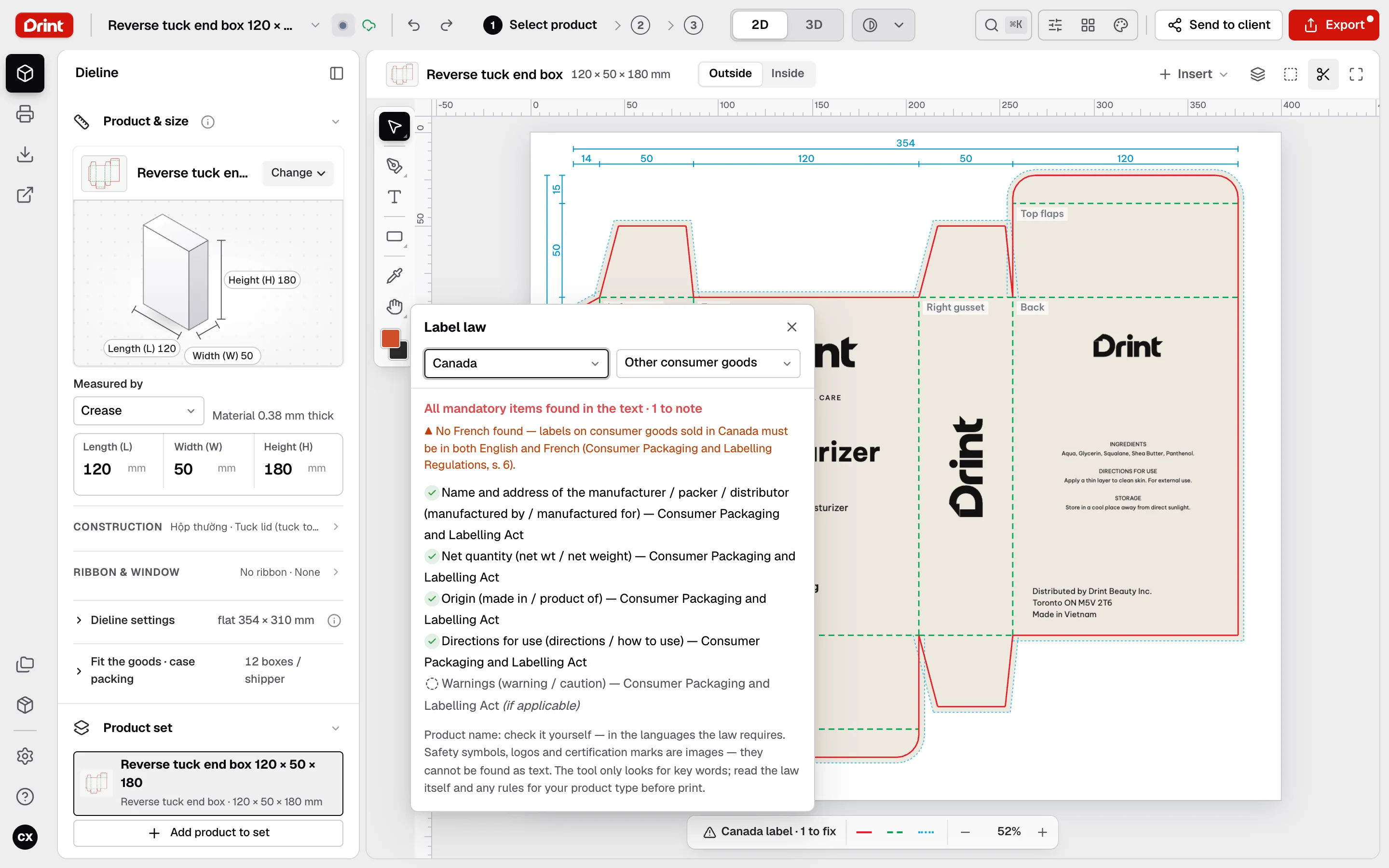
Above, a moisturiser box for Canada has every item, but only in English. Canada's Consumer Packaging and Labelling Regulations want them "in both official languages", except the dealer's name and address. So the chip reads "1 to fix" until the French is added.
Which laws does it follow?
Each list comes from the country's own law: for food, 21 CFR Part 101 in the United States and Regulation (EU) No 1169/2011 in the European Union. Other goods follow the goods law where it differs.
Each country has a page of label rules on Drint, for example the United States, the European Union, Canada and Japan. The index of label rules lists all 47.
What can it not check?
The check reads text. It cannot tell whether a claim is true. Symbols that are images, such as Mexico's warning octagons or halal logos, are listed in the panel to check by eye. It is a reminder, not legal advice.
What this means for designers
A designer selling into several markets no longer has to remember every label law. The editor warns while the layout is still open. For the rest of the print-ready file, see how to turn artwork into a print-ready packaging file.
Sources
- Consumer Packaging and Labelling Regulations (C.R.C., c. 417), section 6, Justice Laws Website, Government of Canada, accessed 2 November 2026
- Regulation (EU) No 1169/2011 on the provision of food information to consumers, Article 15, EUR-Lex, accessed 2 November 2026
- 21 CFR 101.15, Food; prominence of required statements, paragraph (c), Legal Information Institute, Cornell Law School, accessed 2 November 2026
- The Food Information Regulations 2014 (SI 2014/1855), legislation.gov.uk, accessed 2 November 2026
- Drint label rules by country, accessed 2 November 2026
Next step / Try it
Open the Drint editor, pick the country of sale from the chip under the dieline, and lay out your label.
Frequently asked questions
Is the label-law check free?
Yes. It runs in the Drint editor on every plan, including Free.
Does a green chip mean the label is legal?
No. It means every mandatory item was found as text. Read the law, and ask the authority or a lawyer when unsure.
Does it read text inside images?
No. Text in a placed image or flat artwork cannot be read; the panel says so.