Blog › Beer Bottle Screen Print Sizes
Beer and Wine Bottle Screen Print Sizes: Body, Neck and Cap Art in mm
 By Nguyễn Thành Dân, Founder of Drint ·
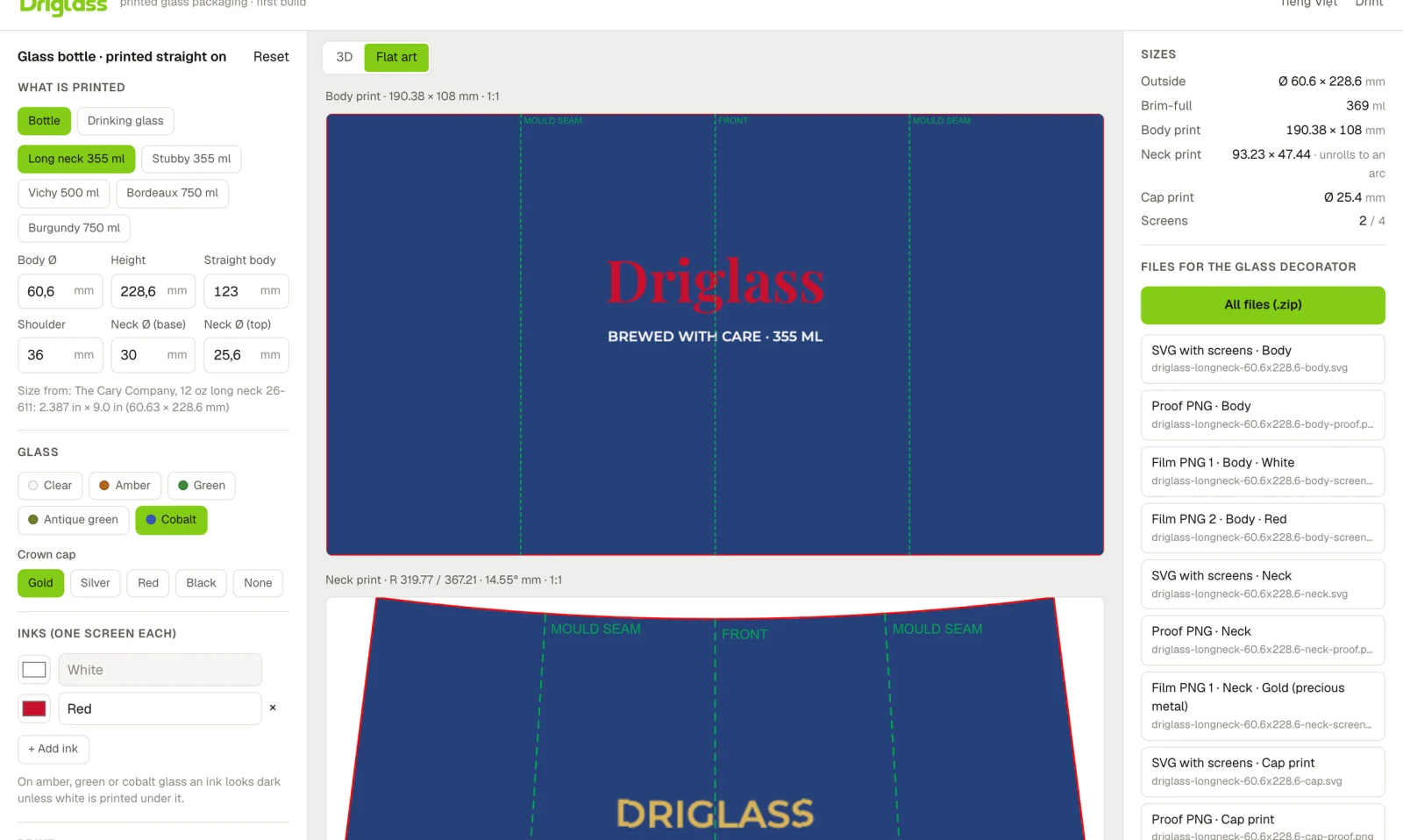
A 12 oz (355 ml) long neck beer bottle, 60.6 mm across, takes a body print 190.38 mm round and 108 mm high when the art is screened straight onto the glass. Its neck takes a 93.23 × 47.44 mm print that unrolls to an arc, not a rectangle. Drint measured these zones for five bottles on 24 November 2026, from makers' published drawings.
Why it matters: printing straight on glass (applied ceramic labelling, or ACL) has no label stock to trim. The art is the glass. A wrong width puts a gap or an overlap at the back, and a neck drawn as a rectangle prints crooked.
Key points
- Body art width is the bottle's outside circumference: π × diameter. A 60.6 mm long neck gives 190.38 mm.
- A conical neck unrolls to an arc. On the long neck it is a ring segment of radius 319.77–367.21 mm and 14.55°.
- Moulded bottles have two seams at ±90° from the front. The front panel between them is half the circumference: 95.19 mm on the long neck.
- A 26 mm crown cap has a Ø 25.4 mm print area on its top. The cap maker prints it, not the glass decorator.
- On amber, green or cobalt glass every colour needs white printed under it, so a 2-colour design takes 3 screens.
What size is the print area on a beer bottle?
The table lists the print zones Drint uses in Driglass, its editor for print on glass. Outside sizes come from the maker or distributor named in the last column. Heights are measured up from the base.
| Bottle | Outside Ø × height | Brim-full | Body zone (from base) | Body art (round × high) | Neck art | Source |
|---|---|---|---|---|---|---|
| 12 oz long neck, crown 26 mm | 60.6 × 228.6 mm | 369 ml | 12–120 mm | 190.38 × 108 mm | 93.23 × 47.44 mm, arc | The Cary Company, 26-611 |
| 12 oz stubby, crown 26 mm | 68 × 157.5 mm | 363 ml | 13–103 mm | 213.63 × 90 mm | none | The Cary Company size table |
| 500 ml Vichy, crown 26 mm | 66 × 259 mm | 513 ml | 13–145 mm | 207.35 × 132 mm | 96.26 × 50.85 mm, arc | The Cary Company size table |
| 750 ml Bordeaux, cork | 76 × 300 mm | 770 ml | 11–186 mm | 238.76 × 175 mm | none | Saverglass, Berlin Packaging |
| 750 ml Burgundy, cork | 82 × 300 mm | 782 ml | 11–120 mm | 257.61 × 109 mm | none | Berlin Packaging, Saverglass |
The body zone stops where the wall starts to curve into the shoulder. Above that, a flat screen no longer touches the glass evenly. The Burgundy zone is short for that reason: its shoulder begins low and slopes gently.
Brim-full volumes are Drint's figures from the modelled inside shape. They are not fill volumes. A 355 ml long neck holds 369 ml to the brim because the bottle needs headspace.
How do you lay out art on a bottle neck?
A bottle neck is a cone, and a cone does not unroll to a rectangle. Laid flat, it becomes a slice of a ring. Driglass stores each neck as that ring slice:
| Bottle | Neck zone (from base) | Inner radius | Outer radius | Angle | Bounding box |
|---|---|---|---|---|---|
| 12 oz long neck | 163–210.4 mm | 319.77 mm | 367.21 mm | 14.55° | 92.98 × 50.01 mm |
| 500 ml Vichy | 190–240.8 mm | 290.07 mm | 340.92 mm | 16.18° | 95.94 × 53.74 mm |
The apex of both arcs points up, towards the cap. Text set on a straight baseline and wrapped round this cone would tilt downward at both sides. Set it on the arc instead.
The arc is shallow, but it is not negligible. Over a 93 mm neck, the long neck's arc rises 2.6 mm from the ends to the middle (the gap between the 50.01 mm box and the 47.44 mm zone). That is enough to make a gold band look crooked.
For drinking glasses, which taper the other way, see why a pint glass print is an arc.
Where are the mould seams on a glass bottle?
Bottles made in a two-part mould carry two vertical seams, opposite each other. Driglass puts them at ±90° from the front, which is how decorators usually orient a bottle. The screen squeegee bumps over a seam and the print breaks up there.
So the widest unbroken front panel is half the circumference:
| Bottle | Circumference | Front panel between seams |
|---|---|---|
| 12 oz long neck | 190.38 mm | 95.19 mm |
| 12 oz stubby | 213.63 mm | 106.82 mm |
| 500 ml Vichy | 207.35 mm | 103.68 mm |
| 750 ml Bordeaux | 238.76 mm | 119.38 mm |
| 750 ml Burgundy | 257.61 mm | 128.81 mm |
Keep type and fine lines clear of the seam lines. How much clear space to leave depends on the glassworks and the decorator. Ask for it before drawing.
How many screens does a bottle print need?
ACL is screen printed with ceramic enamel and then fired. Each ink needs its own screen, so colours are spot colours, not CMYK. O.Berk, a US packaging distributor, describes the printed bottle passing through a lehr, a conveyor oven that fuses the enamel into the glass.
Driglass counts screens with three rules: one per ink, white under on coloured glass, and white behind any art meant to be read through clear glass.
| Design | Flint (clear) | Amber, green, cobalt |
|---|---|---|
| 1 colour | 1 screen | 2 screens (white + colour) |
| White only | 1 screen | 1 screen |
| 2 colours | 2 screens | 3 screens |
| 3 colours | 3 screens | 4 screens |
Two US glass decorators, Bergin Glass and CLS Deco, count the same colour printed on the neck and on the body as two screens. Count the neck separately when you price a design.
The crown cap is a separate job. The cap maker prints its Ø 25.4 mm top, and that print never counts towards the bottle's screens.
What this means for designers
Draw the body art at the exact circumference, to the hundredth of a millimetre. Draw the neck on the arc. Mark the seams. Then send one film per screen at 1:1.
Driglass does those steps for the five bottles above. Pick a bottle, place the art, check it in 3D glass, and download the separated SVG and one film per screen. The same numbers are open to AI assistants through the Driglass MCP server, and the brief for a paper-label version sits under beer packaging dielines.
Every size here is an outside size from a maker's sheet. Glass varies from mould to mould. Check each size against the glassworks' own drawing before screens are made.
Sources
- The Cary Company, 12 oz long neck amber beer bottle 26-611 and glass bottle size chart, accessed 23 November 2026: thecarycompany.com
- Saverglass, Bordelaise Tradition 75 cl and Bourgogne bottle sheets, accessed 23 November 2026: saverglass.com
- Berlin Packaging, 750 ml Bordeaux and Delilah Burgundy bottle sheets, accessed 23 November 2026: berlinpackaging.com
- O.Berk, "Applied Ceramic Labeling Guide", Packaging Crash Course, accessed 24 November 2026: oberk.com
- Drint, print zones and screen rules in Driglass, measured 23–24 November 2026: drint.io/driglass
- Bergin Glass, Design Center, accessed 24 November 2026: berginglass.com
- CLS Deco, Designer Resources, accessed 24 November 2026: clsdeco.com
Try it
See all eight print templates, or open the 12 oz long neck in Driglass, place your art and download the films.
Frequently asked questions
What is the print area on a 12 oz beer bottle?
On a 60.6 mm long neck, the body print is 190.38 mm round and 108 mm high, from 12 mm to 120 mm above the base. The neck takes a further 93.23 × 47.44 mm print on an arc.
Why is a bottle neck print curved?
The neck is a cone. A cone unrolls flat to a slice of a ring, so straight text wrapped round it would tilt. Lay the art on the arc: radius 319.77–367.21 mm and 14.55° on a 12 oz long neck.
Can I print CMYK straight on a glass bottle?
Not with ACL. Ceramic enamel is screened one colour at a time and fired, so each colour is a spot colour with its own screen. Photographic images go on glass by other methods, such as decals or digital printing.
Why does my colour look dark on an amber bottle?
Enamel is partly transparent and the brown glass shows through it. Print an opaque white first and the colour on top. That adds one screen.
Who prints the top of a crown cap?
The cap maker. A 26 mm crown cap has a Ø 25.4 mm top print. Send it as a separate file.