Drint Knowledge › Packaging glossary › Ventilated carton
Ventilated carton
A corrugated box with holes or slots cut into its walls so air can flow through, used for goods that need to breathe or cool down.
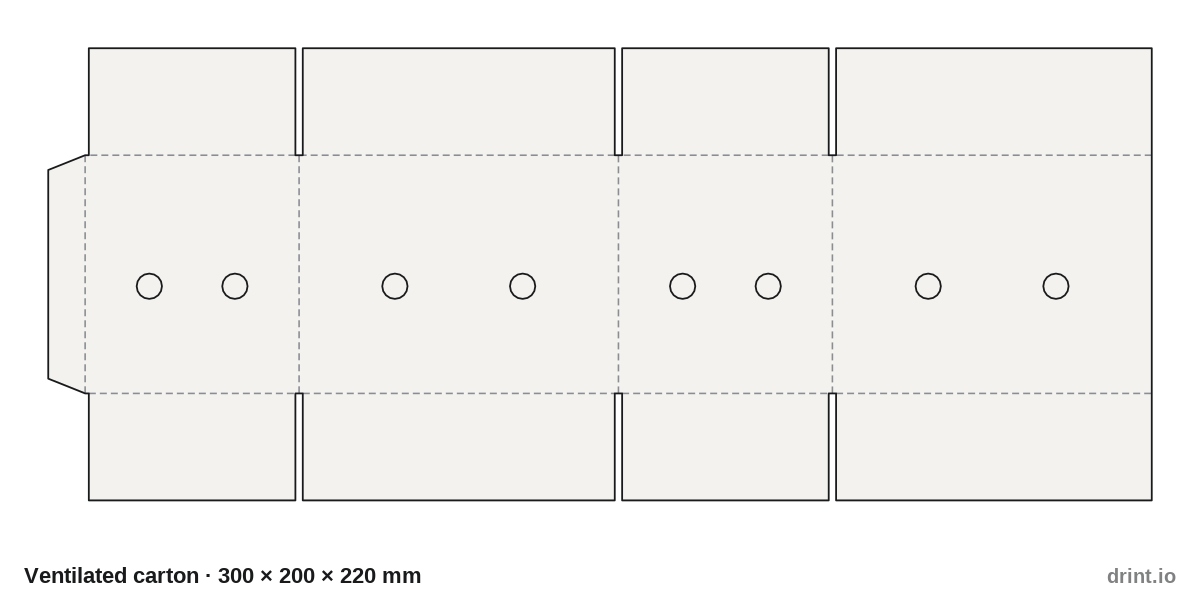
- Also called
- vented box, produce carton with vents
- Kind
- Pack styles
- Variants Drint draws
- 13
- Default size
- 300 × 200 × 220 mm
- Flat blank
- 1047 × 429 mm
- Blank area
- 0.437 m²
- Cutting rule
- 4.75 m
- Creasing rule
- 2.88 m
- Measured
The structure is a normal slotted box, with vent holes punched into each side panel during die-cutting. Hole size and position are chosen so that air can pass when boxes are stacked side by side, without cutting through the strongest areas near the corners.
Vented cartons are used for fruit, vegetables, flowers, eggs, bread and live plants, and for warm goods that would otherwise sweat. Every hole weakens the box slightly, so a stronger board is often chosen to keep stacking strength.
Questions
What is a ventilated carton?
A corrugated box with holes or slots cut into its walls so air can flow through, used for goods that need to breathe or cool down.
More terms
Cite this page: Drint (2026). “Ventilated carton”. Drint Knowledge. https://drint.io/glossary/ventilated-carton