Drint Knowledge › Packaging glossary › Folding carton
Folding carton
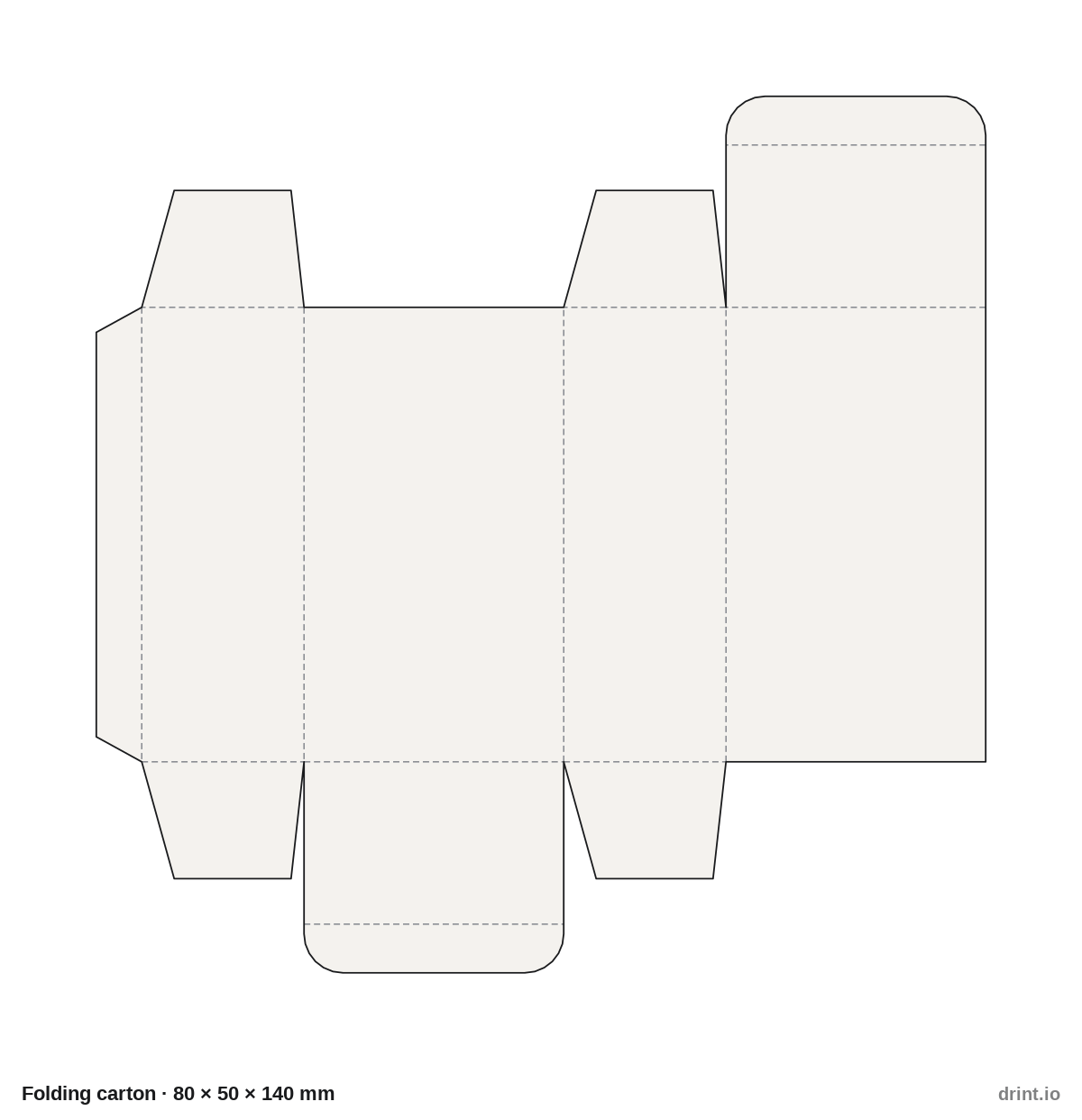
A box die-cut and creased from a single sheet of paperboard, shipped flat to the packer and folded into shape around the product.
- Also called
- paperboard box, carton box, ECMA carton
- Kind
- Pack styles
- Variants Drint draws
- 4
- Default size
- 80 × 50 × 140 mm
- Flat blank
- 274 × 270 mm
- Blank area
- 0.055 m²
- Cutting rule
- 1.29 m
- Creasing rule
- 1.08 m
- Measured
A folding carton starts as one printed blank: four body panels in a row, a glue flap that joins the last panel to the first, and closure flaps at both ends. The ECMA catalogue groups these boxes by how the top and bottom close, so the same body can carry tuck ends, a snap-lock bottom or a pre-glued auto bottom.
Folding cartons are the everyday retail box for cosmetics, medicine, food and small electronics because they print well, stack flat in storage and run on automatic gluers. Board weights in the region of 250–400 gsm are common; heavier or fluted board is used when the product is heavy or must survive shipping without an outer case.
Questions
What is a folding carton?
A box die-cut and creased from a single sheet of paperboard, shipped flat to the packer and folded into shape around the product.
What is the difference between a folding carton and a corrugated box?
A folding carton is made from solid paperboard and is mainly a retail display box; a corrugated box has a fluted middle layer between liners and is built to protect goods in transport.
More terms
Cite this page: Drint (2026). “Folding carton”. Drint Knowledge. https://drint.io/glossary/folding-carton