Drint Knowledge › Packaging glossary › Tuck end box
Tuck end box
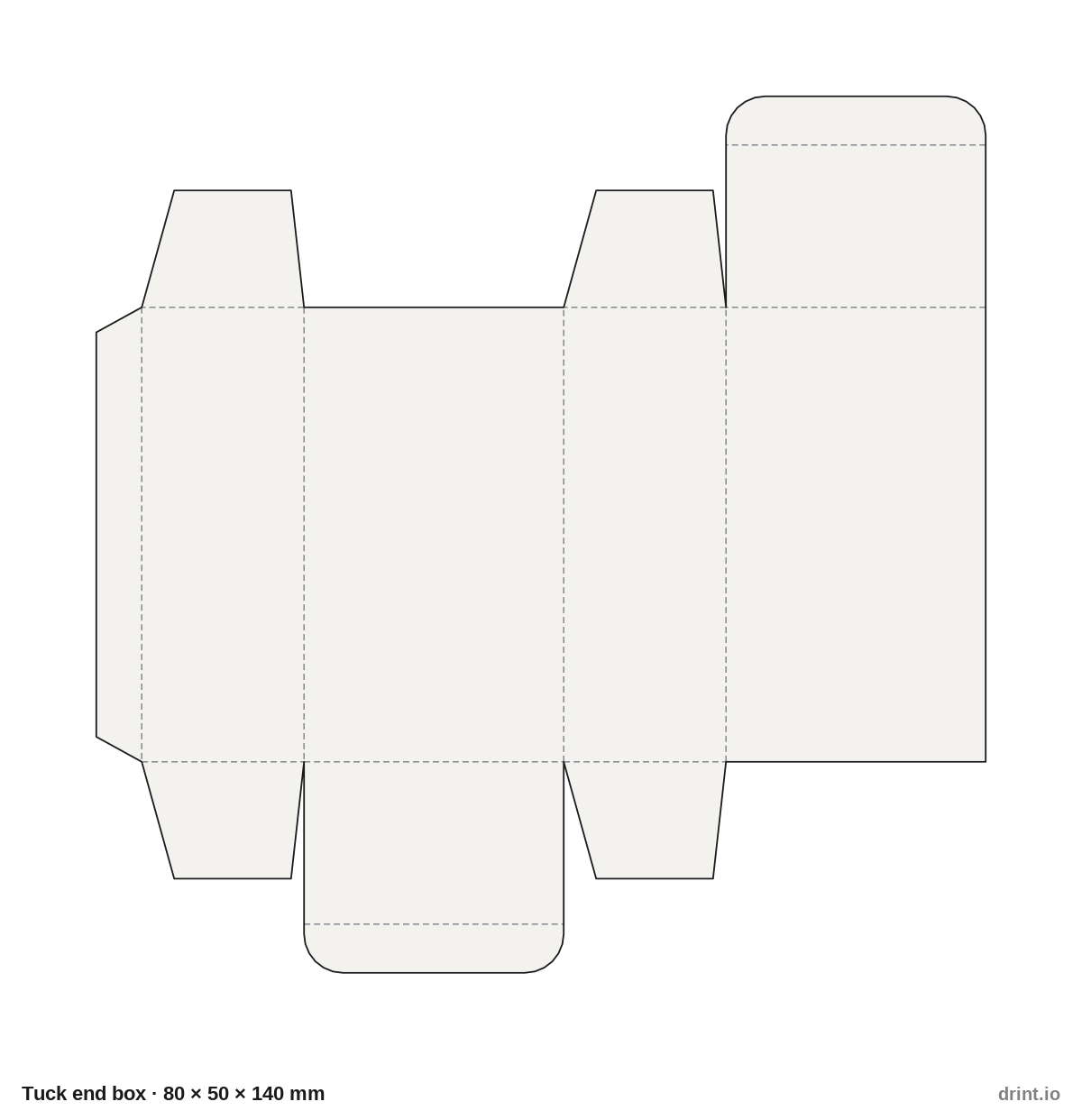
A folding carton whose ends close with a hinged panel carrying a tuck flap that slides inside the box, held by dust flaps and friction.
- Also called
- tuck top box, tuck flap box
- Kind
- Pack styles
- Variants Drint draws
- 4
- Default size
- 80 × 50 × 140 mm
- Flat blank
- 274 × 270 mm
- Blank area
- 0.055 m²
- Cutting rule
- 1.29 m
- Creasing rule
- 1.08 m
- Measured
Each end of a tuck end box has a closure panel hinged to one body panel, a tuck flap on its free edge and two dust flaps on the neighbouring panels. The dust flaps fold in first, then the closure panel swings over and the tuck slips down inside the wall, so the box can be opened and closed many times.
It is the most common and cheapest folding carton style, ideal for light products such as cosmetics, supplements and stationery. Small slits or locking cuts at the tuck shoulders help the lid stay shut; for heavy products a locked or glued bottom is safer than a tuck bottom.
Questions
What is a tuck end box?
A folding carton whose ends close with a hinged panel carrying a tuck flap that slides inside the box, held by dust flaps and friction.
More terms
Cite this page: Drint (2026). “Tuck end box”. Drint Knowledge. https://drint.io/glossary/tuck-end-box