Drint Knowledge › Packaging glossary › Hexagon box
Hexagon box
A folding carton with six equal side panels forming a hexagonal tube, closed at the ends by hexagonal lids or tuck closures.
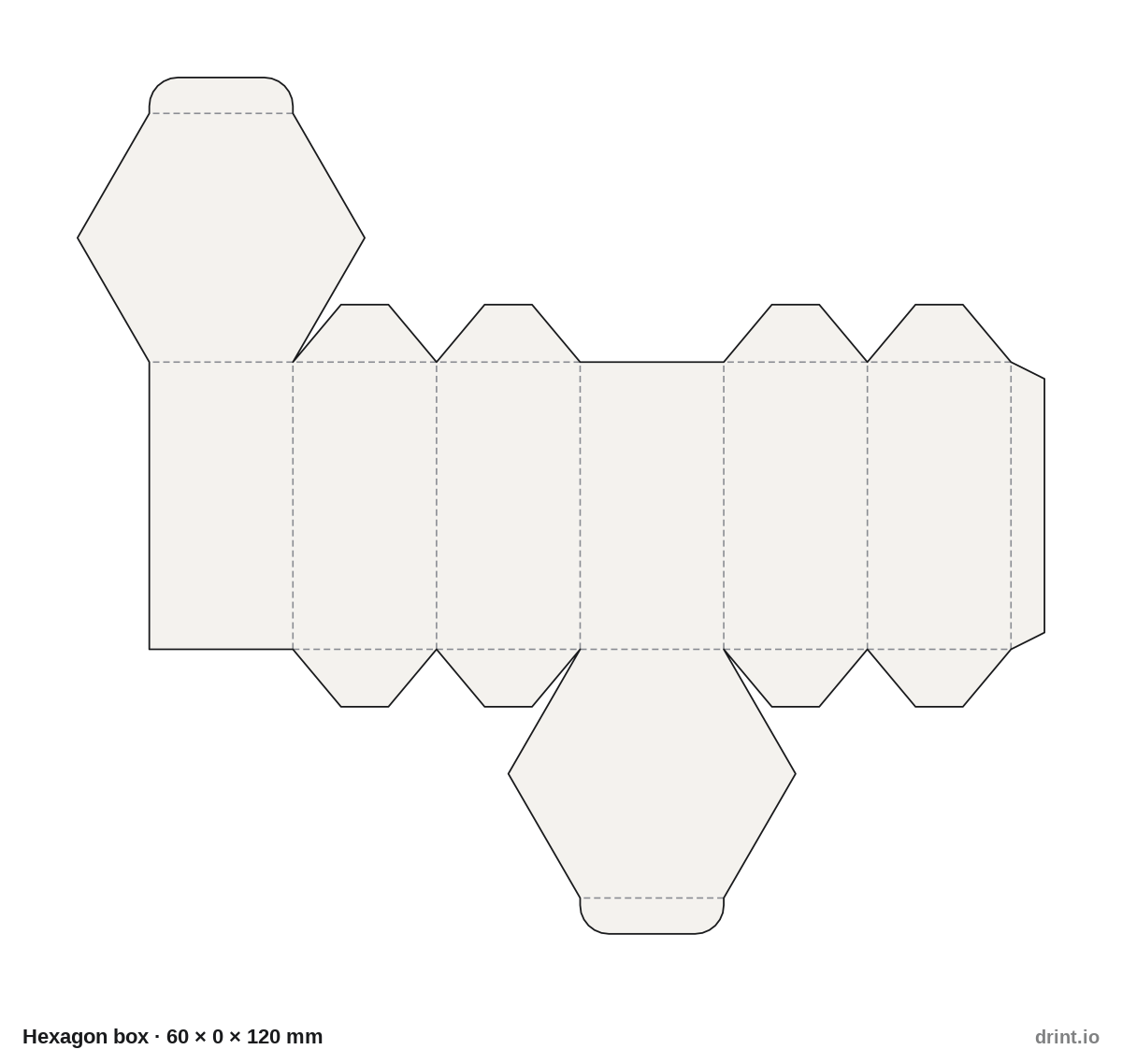
- Also called
- hexagonal box, six-sided box
- Kind
- Pack styles
- Variants Drint draws
- 1
- Default size
- 60 × 0 × 120 mm
- Flat blank
- 404 × 358 mm
- Blank area
- 0.073 m²
- Cutting rule
- 1.68 m
- Creasing rule
- 1.44 m
- Measured
The blank is a row of six body panels joined by a glue flap, with a top closure that carries a tuck flap and a bottom that closes with its own panel. Dust flaps on the side panels fill the corners so the lid sits level, and the extra creases make the tube stiffer than a square box of the same board.
Hexagon boxes stand out on shelves and are popular for candles, tea, confectionery and gift items. Because each face is narrow, artwork works best when it wraps around several panels; also allow for the wider footprint when planning cases and pallets.
Questions
What is a hexagon box?
A folding carton with six equal side panels forming a hexagonal tube, closed at the ends by hexagonal lids or tuck closures.
More terms
Cite this page: Drint (2026). “Hexagon box”. Drint Knowledge. https://drint.io/glossary/hexagon-box