Drint Knowledge › Packaging glossary › Reverse tuck end box
Reverse tuck end box
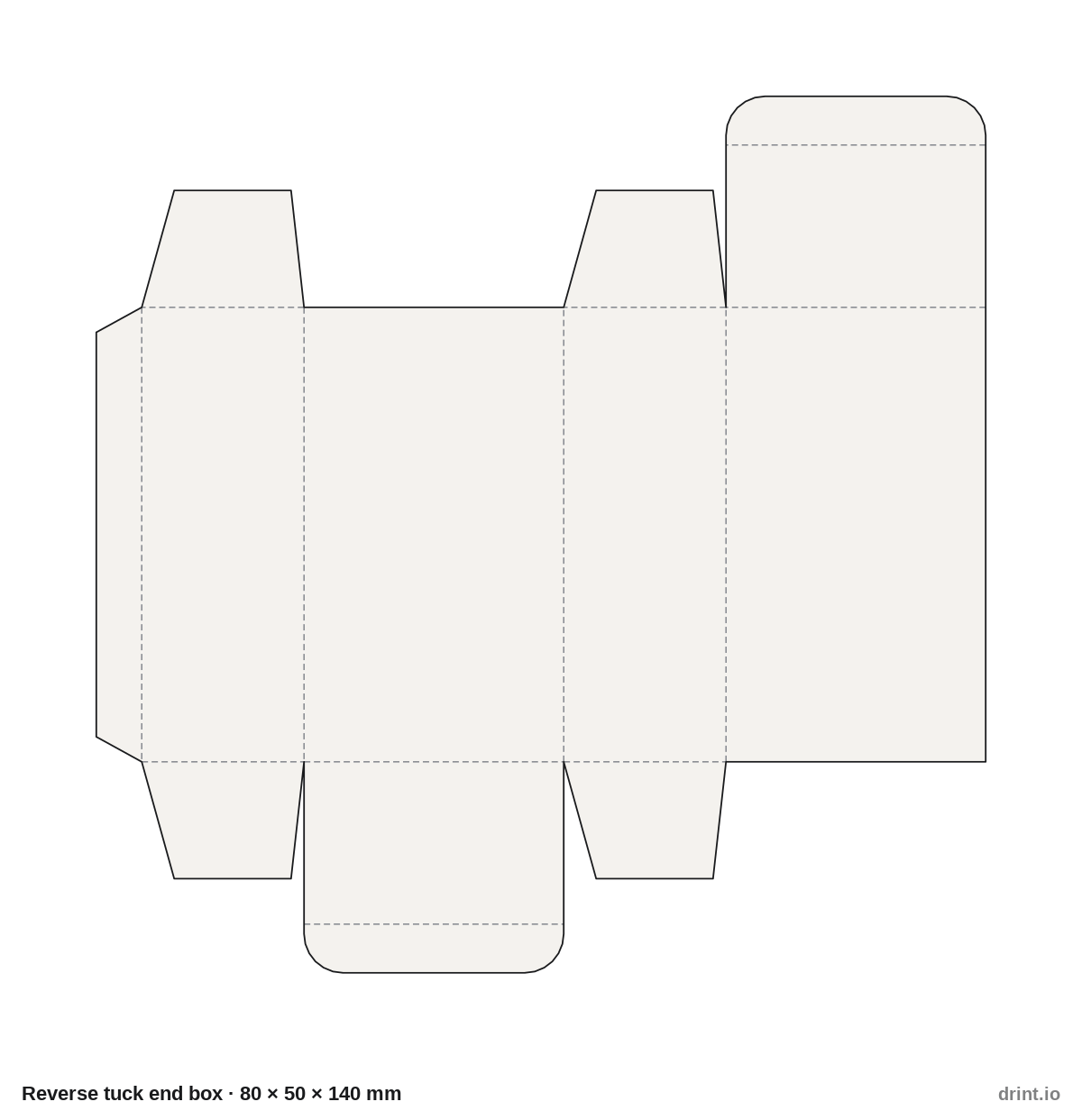
A tuck end folding carton whose top closure hinges from one face and whose bottom closure hinges from the opposite face, so the two tucks point in opposite directions.
- Also called
- RTE box, reverse tuck carton
- Kind
- Pack styles
- Variants Drint draws
- 4
- Default size
- 80 × 50 × 140 mm
- Flat blank
- 274 × 270 mm
- Blank area
- 0.055 m²
- Cutting rule
- 1.29 m
- Creasing rule
- 1.08 m
- Measured
On the flat blank the top closure panel and the bottom closure panel sit on different body panels, one on the front side and one on the back. This staggered layout lets neighbouring blanks interlock on the press sheet, which usually wastes less board than a straight tuck layout.
Because the top flap opens from the back edge, the front face shows a clean upper edge with no visible tuck line, which suits retail display. It is a default choice for cosmetics, pharmacy and small consumer goods; when designing, remember that artwork on the bottom closure reads upside down compared with the top.
Questions
What is a reverse tuck end box?
A tuck end folding carton whose top closure hinges from one face and whose bottom closure hinges from the opposite face, so the two tucks point in opposite directions.
Is a reverse tuck end box cheaper than a straight tuck end box?
Often slightly, because the blanks nest more tightly on the sheet, but the real difference depends on box size and the sheet format the printer uses.
More terms
Cite this page: Drint (2026). “Reverse tuck end box”. Drint Knowledge. https://drint.io/glossary/reverse-tuck-end-box