Drint Knowledge › Packaging glossary › Tuck top snap lock bottom box
Tuck top snap lock bottom box
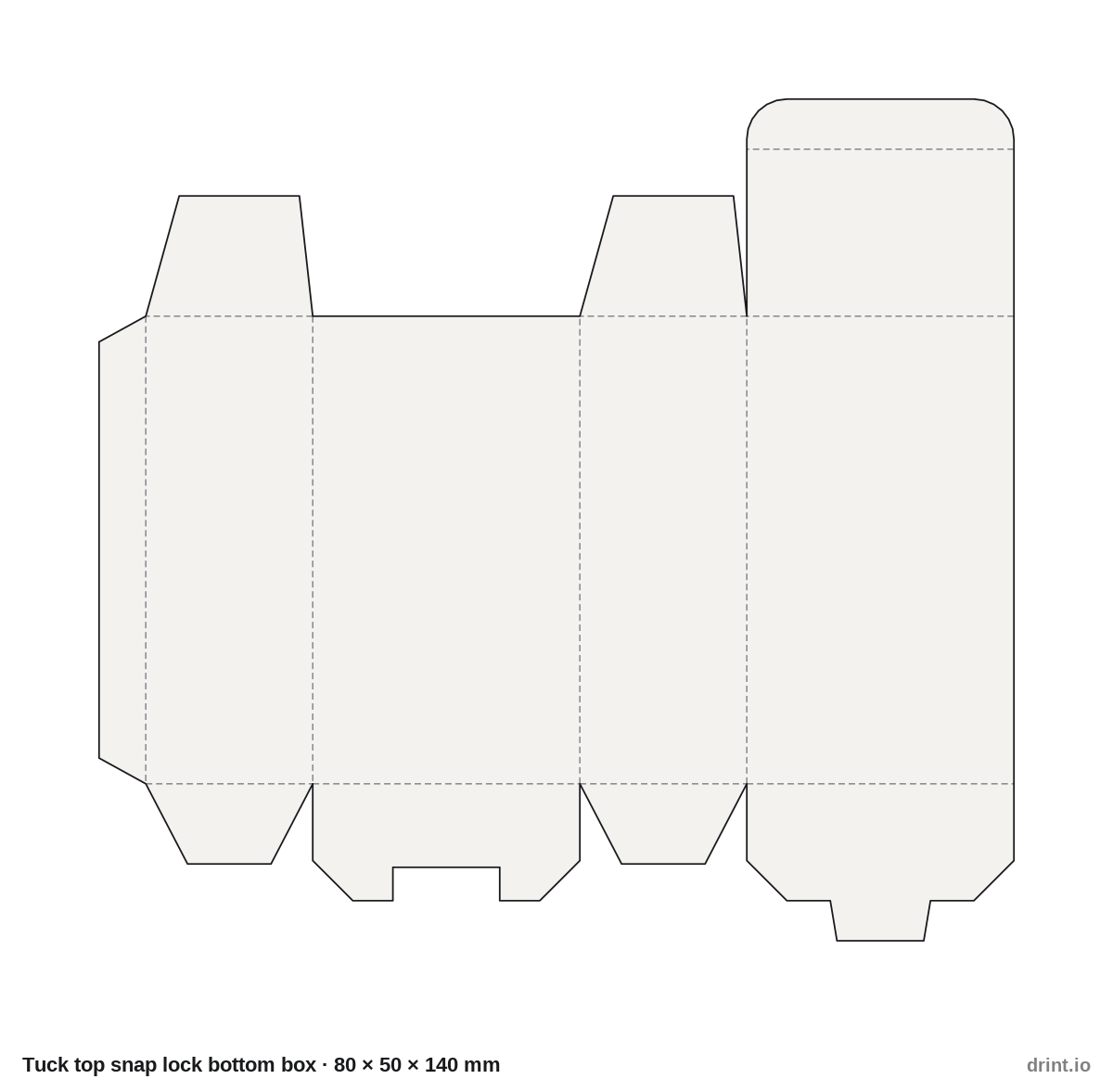
A folding carton with a tuck closure on top and a bottom of four shaped flaps that hook into each other in sequence when folded by hand.
- Also called
- 1-2-3 bottom box, lock bottom carton, snap bottom box
- Kind
- Pack styles
- Variants Drint draws
- 4
- Default size
- 80 × 50 × 140 mm
- Flat blank
- 274 × 252 mm
- Blank area
- 0.054 m²
- Cutting rule
- 1.27 m
- Creasing rule
- 1.08 m
- Measured
The bottom flaps are cut so that the first two fold in, the third locks over them and the fourth tucks into a slot, which is why printers often call it a 1-2-3 bottom. No glue is needed at the bottom, so the blank still ships flat with only the side seam glued.
The locked bottom carries more weight than a tuck bottom, making this style common for jars, bottles and heavier cosmetics. It takes a few seconds longer to erect than an auto bottom, so it fits short and medium runs that are packed by hand.
Questions
What is a tuck top snap lock bottom box?
A folding carton with a tuck closure on top and a bottom of four shaped flaps that hook into each other in sequence when folded by hand.
When should I choose a snap lock bottom instead of an auto bottom?
Choose snap lock for hand-packed, shorter runs where gluing cost matters; choose an auto bottom when packing speed matters more than the extra gluing step.
More terms
Cite this page: Drint (2026). “Tuck top snap lock bottom box”. Drint Knowledge. https://drint.io/glossary/tuck-top-snap-lock-bottom-box