Drint Knowledge › Packaging glossary › Self-locking tray
Self-locking tray
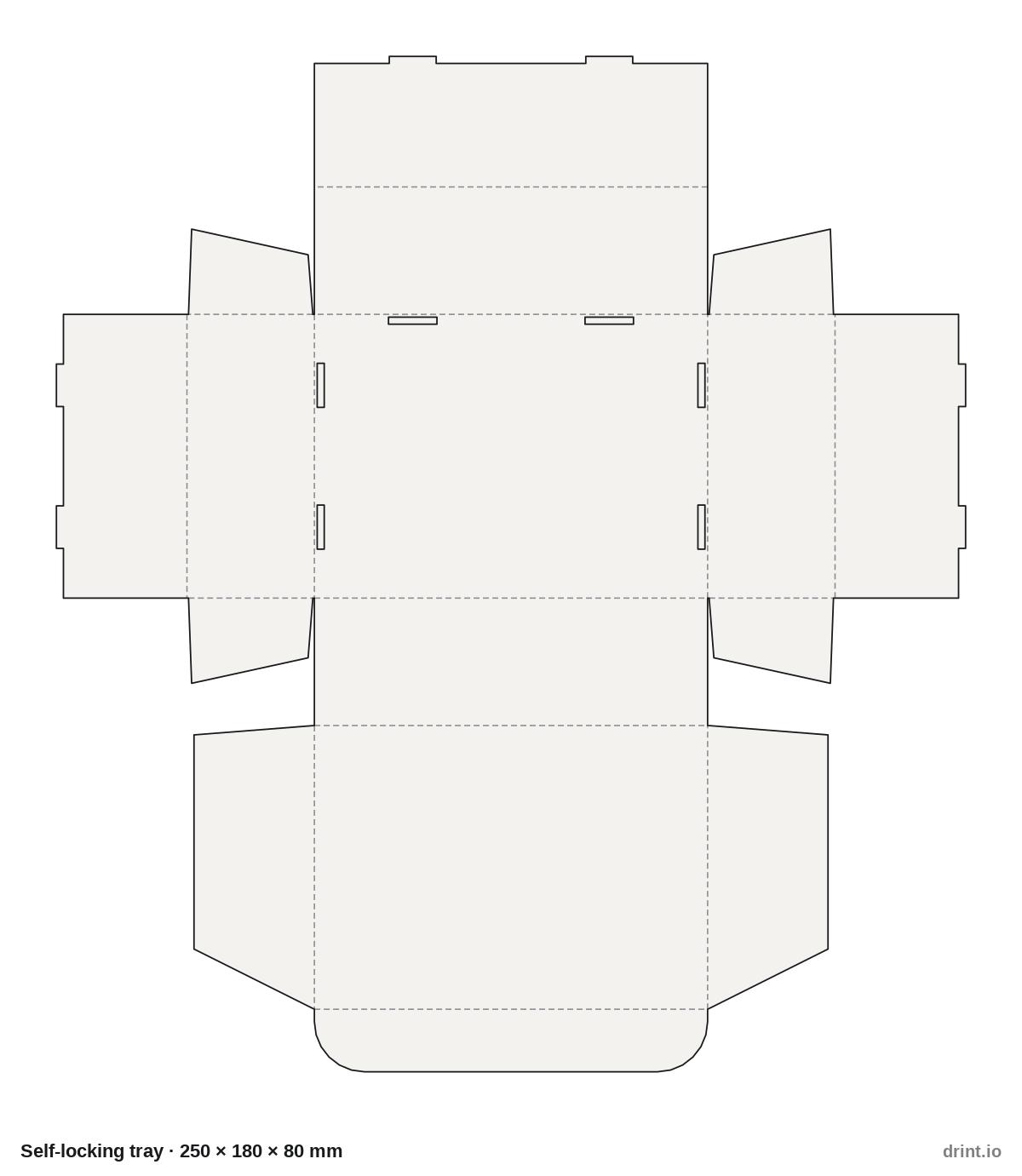
An open corrugated tray whose walls fold up from a single blank and are held square by locking tabs or folded-over end walls instead of glue.
- Also called
- lock corner tray, glueless corrugated tray
- Kind
- Pack styles
- Variants Drint draws
- 1
- Default size
- 250 × 180 × 80 mm
- Flat blank
- 582 × 650 mm
- Blank area
- 0.260 m²
- Cutting rule
- 3.46 m
- Creasing rule
- 2.67 m
- Measured
The base is the centre panel, the long walls fold up, and the end walls fold over to trap corner tabs or slide tabs into slots in the base. Doubling the walls gives a thick rim that resists bending and makes the tray comfortable to handle.
Self-locking trays are erected by hand or by simple machines at the packing point and are used for fruit, vegetables, bakery, printed matter and as display bases. Since there is no glue, the trays can be stored flat in large numbers and recycled easily.
Questions
What is a self-locking tray?
An open corrugated tray whose walls fold up from a single blank and are held square by locking tabs or folded-over end walls instead of glue.
More terms
Cite this page: Drint (2026). “Self-locking tray”. Drint Knowledge. https://drint.io/glossary/self-locking-tray