Drint Knowledge › Packaging glossary › Envelope
Envelope
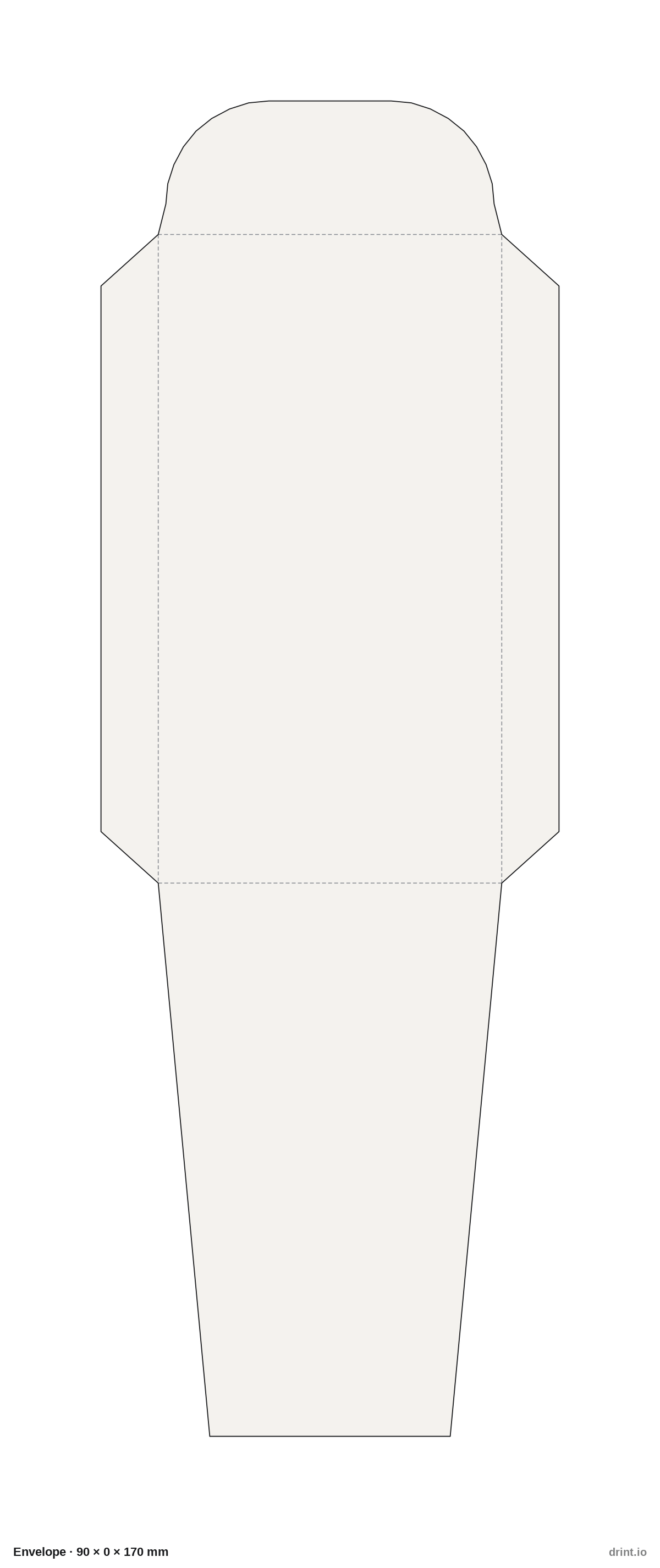
A flat paper wrapper made from one die-cut sheet whose side and bottom flaps are glued to form a pocket, closed by a top flap.
- Also called
- paper envelope, printed envelope
- Kind
- Pack styles
- Variants Drint draws
- 11
- Default size
- 90 × 0 × 170 mm
- Flat blank
- 120 × 350 mm
- Blank area
- 0.034 m²
- Cutting rule
- 0.85 m
- Creasing rule
- 0.52 m
- Measured
The blank is a front panel with two side flaps, a bottom flap that forms the back, and a top flap. Side flaps fold in first, the bottom flap is glued over them, and the top flap is left free to seal with gum, peel-and-seal strip, a tuck or a sticker.
Envelopes carry letters, invitations, cards, cash gifts, vouchers and samples. Flap shape changes both the look and the folding method, and print near the folds should allow for slight shifts during converting.
Questions
What is a envelope?
A flat paper wrapper made from one die-cut sheet whose side and bottom flaps are glued to form a pocket, closed by a top flap.
More terms
Cite this page: Drint (2026). “Envelope”. Drint Knowledge. https://drint.io/glossary/envelope