Drint Knowledge › Packaging glossary › Regular slotted container
Regular slotted container
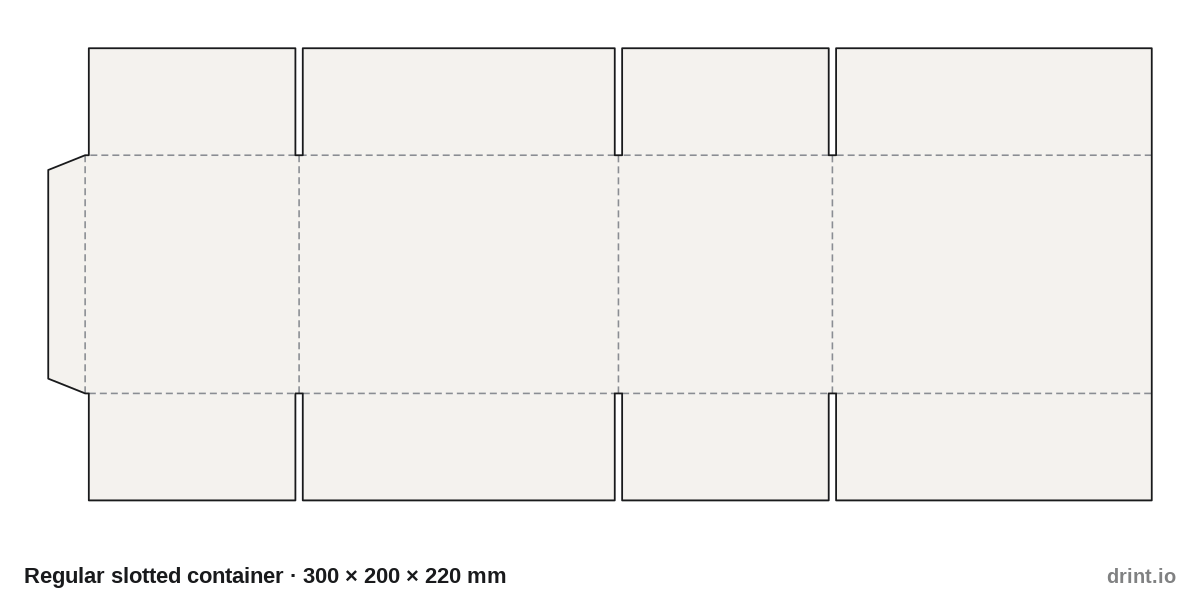
The standard corrugated shipping box: four side panels joined by a manufacturer’s joint, with top and bottom flaps of equal length whose outer flaps meet in the middle.
- Also called
- RSC, FEFCO 0201, standard shipping carton, four-flap box
- Kind
- Pack styles
- Variants Drint draws
- 13
- Default size
- 300 × 200 × 220 mm
- Flat blank
- 1047 × 429 mm
- Blank area
- 0.437 m²
- Cutting rule
- 4.15 m
- Creasing rule
- 2.88 m
- Measured
The blank is four panels in a row with a glue or stitch flap, and slots cut between the flaps at both ends. All flaps are the same depth, usually half the box width, so the long outer flaps meet at the centre line while the short inner flaps leave a gap.
It is the most widely used box in logistics because it wastes almost no board and runs on any converting line. Taping along the centre seam closes it, and a double-wall board is chosen when contents are heavy or stacked high.
Questions
What is a regular slotted container?
The standard corrugated shipping box: four side panels joined by a manufacturer’s joint, with top and bottom flaps of equal length whose outer flaps meet in the middle.
Why do the inner flaps not meet in an RSC?
All four flaps share one depth, half the width of the box, so only the longer outer flaps reach the centre; the shorter inner flaps leave a gap that the outer flaps cover.
More terms
Cite this page: Drint (2026). “Regular slotted container”. Drint Knowledge. https://drint.io/glossary/regular-slotted-container