Drint Knowledge › Packaging glossary › Rigid box
Rigid box
A non-folding box built from thick greyboard and wrapped in printed or textured paper, delivered already assembled and strong enough to keep its shape.
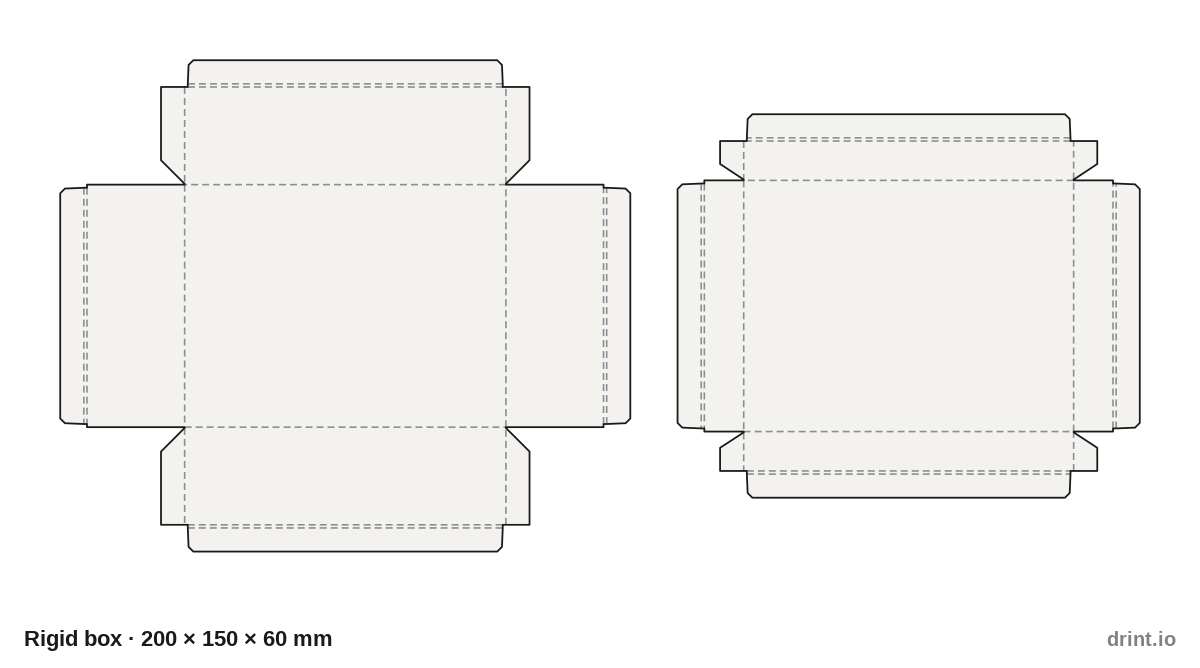
- Also called
- set-up box, luxury box, chipboard box
- Kind
- Pack styles
- Variants Drint draws
- 4
- Default size
- 200 × 150 × 60 mm
- Flat blank
- 686 × 312 mm
- Blank area
- 0.156 m²
- Cutting rule
- 2.56 m
- Creasing rule
- 4.64 m
- Measured
Each part is made by cutting greyboard, often around 1.5–3 mm thick, scoring or V-grooving it and taping the corners into a tray. A printed wrap is then glued over the outside and turned in over the rim, with corner wraps covering the joins.
Rigid boxes are used for jewellery, watches, electronics, cosmetics sets, spirits and corporate gifts, where the box is kept after opening. They cost much more than folding cartons and ship assembled, so they take more freight and storage space.
Questions
What is a rigid box?
A non-folding box built from thick greyboard and wrapped in printed or textured paper, delivered already assembled and strong enough to keep its shape.
What is the difference between a rigid box and a folding carton?
A rigid box is made of thick board wrapped in paper and arrives assembled; a folding carton is a single printed sheet of thinner board that ships flat and is folded when packing.
More terms
Cite this page: Drint (2026). “Rigid box”. Drint Knowledge. https://drint.io/glossary/rigid-box