Drint Knowledge › Packaging glossary › Dust flap
Dust flap
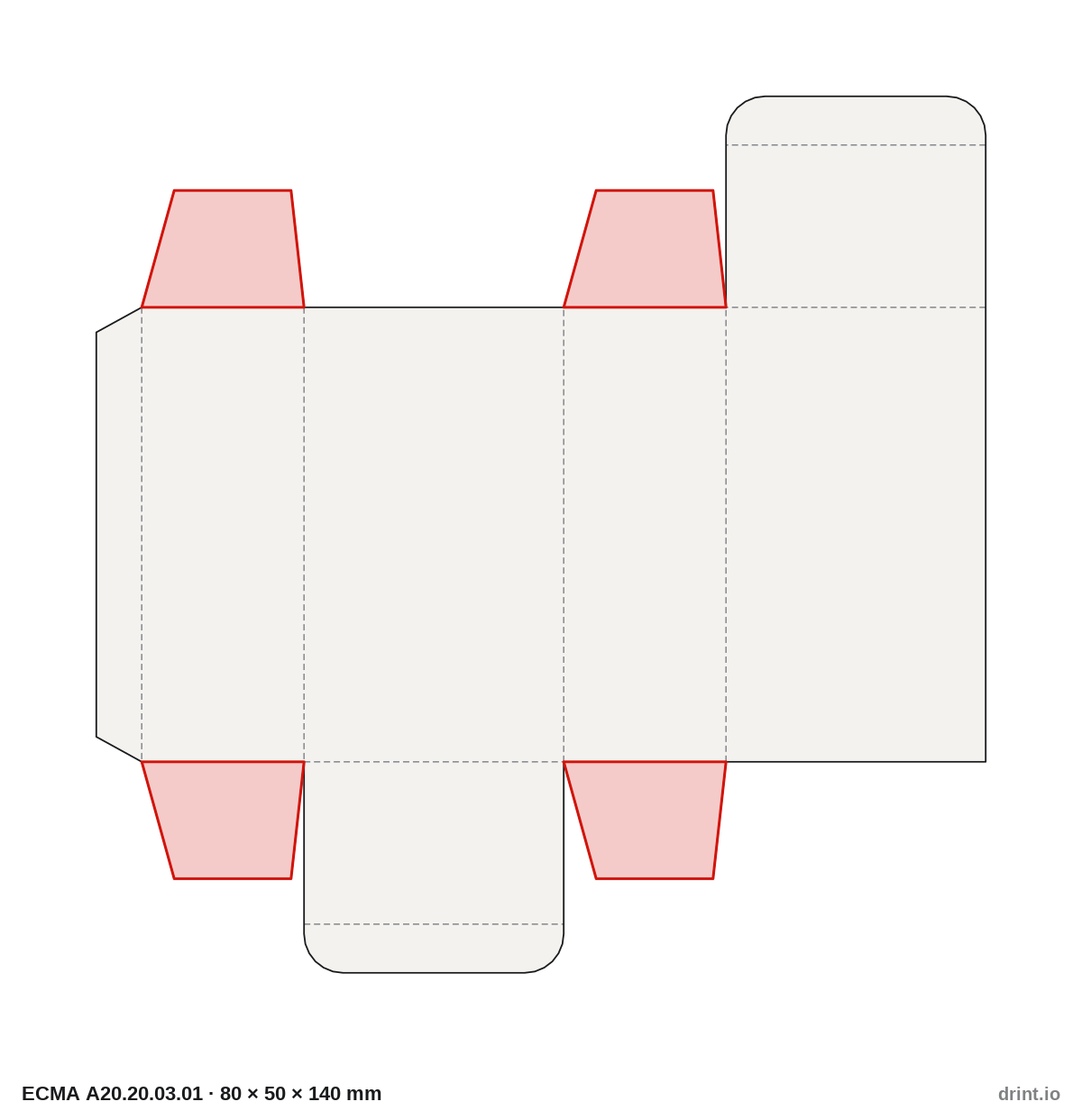
The small flaps on the side panels of a tuck end carton that fold in under the lid to close the corners and keep dust out.
- Also called
- dust flaps, side flaps
- Kind
- Parts of a pack
- Where Drint finds it
- 730 of the 1011 FEFCO / ECMA codes Drint draws
43 of the 292 product dies Drint draws - Drawn on
- ECMA A20.20.03.01
- Share of the ECMA A20.20.03.01 blank
- 11.3%
- Measured
On a tuck end box each end has three pieces: the lid with its tuck, and two dust flaps on the narrow side panels. The dust flaps fold in first, the lid folds over them and the tuck slides in behind the front panel.
Dust flaps are often cut with a rounded or angled outer corner and a small step near the crease so they lock under the tuck. Their depth is usually a little less than half the box width so the two flaps do not overlap.
Open ECMA A20.20.03.01 in the studio
Codes with a dust flap
Questions
What is a dust flap?
The small flaps on the side panels of a tuck end carton that fold in under the lid to close the corners and keep dust out.
How many standard box styles have a dust flap?
Of the 1011 FEFCO and ECMA codes Drint draws, 730 have a dust flap, and so do 43 of its 292 product dies (bags, displays, pouches, rigid boxes…) — counted by Drint’s die engine, 2026-11-28.
Why do dust flaps have a notch?
The small step cut near the crease holds the tuck flap once it is pushed in, so the lid does not spring open.
More terms
Cite this page: Drint (2026). “Dust flap”. Drint Knowledge. https://drint.io/glossary/dust-flap