Drint Knowledge › Packaging glossary › Turn-in
Turn-in
The strip of wrapping paper that runs past the top edge of a rigid box wall and is folded down and glued onto the inside of the wall.
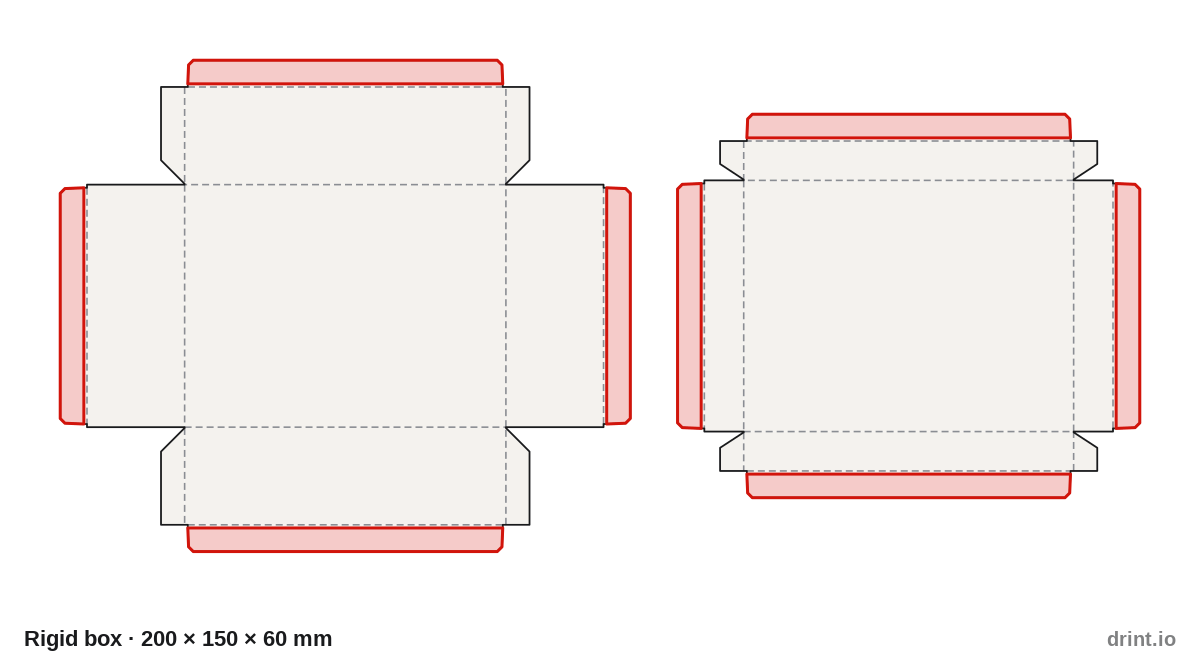
- Also called
- wrap turn-in, inside fold-over
- Kind
- Parts of a pack
- Where Drint finds it
- 10 of the 292 product dies Drint draws
- Drawn on
- Rigid box
- Share of the Rigid box blank
- 13.6%
- Measured
The turn-in hides the raw grey board at the mouth of a rigid box and locks the wrap in place so it cannot peel back. It is cut as an extension of the wrap above each wall, pressed over the board edge and smoothed down on the inside before any liner goes in.
Carry the outside colour or pattern into the turn-in, because it is the first thing seen when the lid comes off. Keep small text and fine lines out of it, since the depth it reaches inside varies slightly from box to box on hand or machine wrapping.
Questions
What is a turn-in?
The strip of wrapping paper that runs past the top edge of a rigid box wall and is folded down and glued onto the inside of the wall.
How many standard box styles have a turn-in?
Of the 1011 FEFCO and ECMA codes Drint draws, 0 have a turn-in, and so do 10 of its 292 product dies (bags, displays, pouches, rigid boxes…) — counted by Drint’s die engine, 2026-11-28.
Why does the turn-in need its own artwork?
Because it shows on the inside of the mouth; if it is left blank or cut short, white paper or grey board shows when the box is opened.
More terms
Cite this page: Drint (2026). “Turn-in”. Drint Knowledge. https://drint.io/glossary/turn-in