Drint Knowledge › Packaging glossary › Crash-lock bottom
Crash-lock bottom
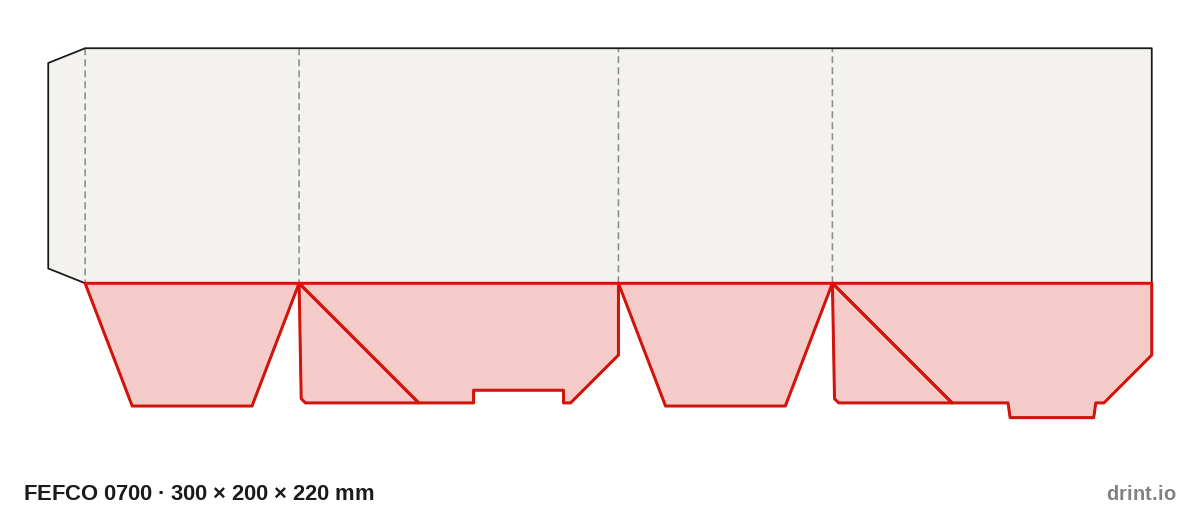
A pre-glued carton bottom that pops open and locks by itself when the flat carton is squared up.
- Also called
- auto-lock bottom, auto bottom, crash bottom
- Kind
- Parts of a pack
- Where Drint finds it
- 38 of the 1011 FEFCO / ECMA codes Drint draws
12 of the 292 product dies Drint draws - Drawn on
- FEFCO 0700
- Share of the FEFCO 0700 blank
- 30.8%
- Measured
The bottom flaps are glued to each other at the factory together with the side seam, so the carton ships flat and its bottom forms in one move. That saves packing time and holds heavier products than a tuck bottom.
It costs a more complex glue line (four or six glue points instead of one) and slightly more board than a tuck end. It is the common choice for bottles, jars and heavy cosmetics.
Codes with a crash-lock bottom
Questions
What is a crash-lock bottom?
A pre-glued carton bottom that pops open and locks by itself when the flat carton is squared up.
How many standard box styles have a crash-lock bottom?
Of the 1011 FEFCO and ECMA codes Drint draws, 38 have a crash-lock bottom, and so do 12 of its 292 product dies (bags, displays, pouches, rigid boxes…) — counted by Drint’s die engine, 2026-11-28.
Is crash-lock the same as auto-lock?
Yes — both names mean the pre-glued bottom that sets up by itself. A 1-2-3 (snap-lock) bottom is different: it is folded by hand and not glued.
More terms
Cite this page: Drint (2026). “Crash-lock bottom”. Drint Knowledge. https://drint.io/glossary/crash-lock-bottom