Dielines › Dielines by standard code › ECMA A60.40.00.02
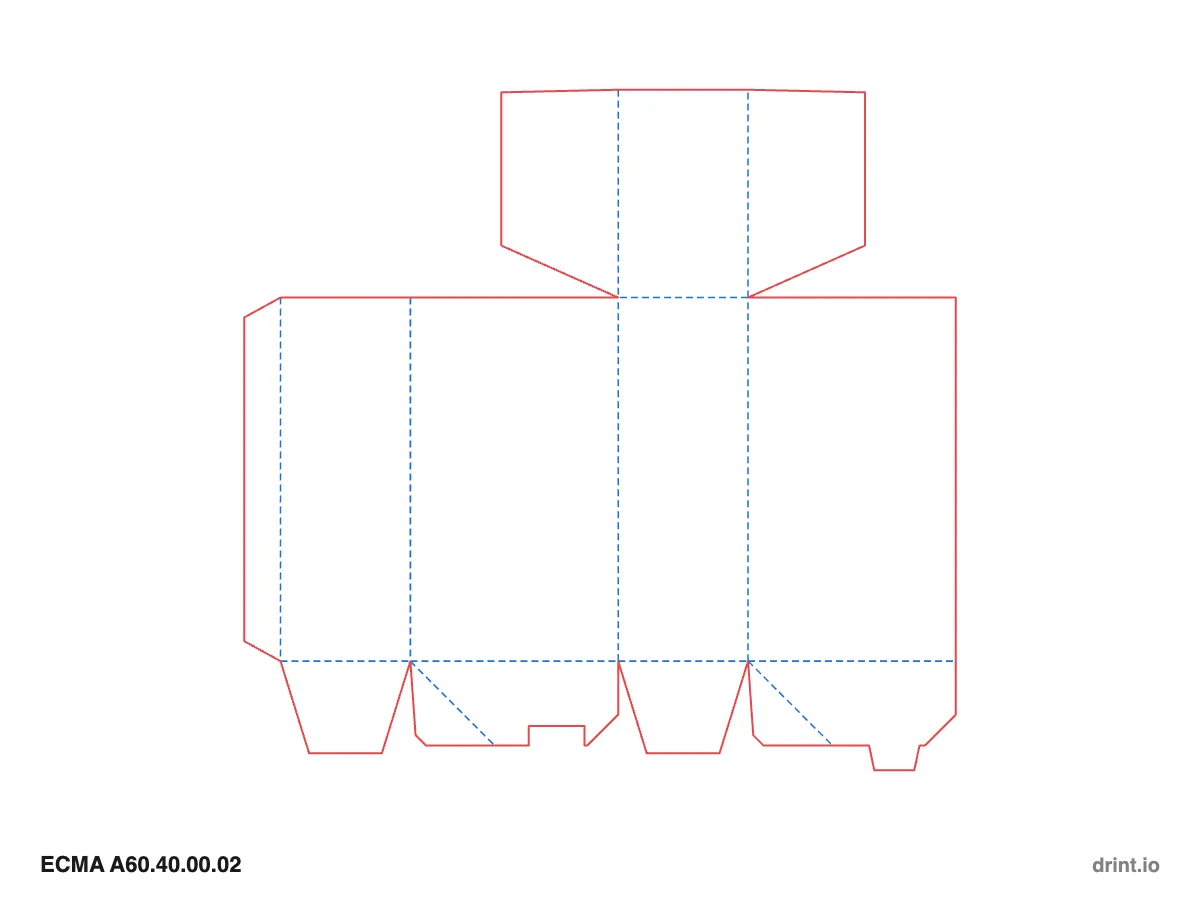
ECMA A60.40.00.02 — Winged tuck top · crash lock (auto) bottom · top on right side panel
ECMA A60.40.00.02 is a folding carton (ECMA A-series) whose top is a tuck with winged side flaps and whose bottom is a crash lock (auto bottom). The crash lock bottom is pre-glued: the carton pops open with its bottom already locked, so it is the fastest to pack and carries heavier products. Drint draws a free ECMA A60.40.00.02 dieline at any size: type the length, width and height and design on it, or download it as PDF or SVG with Pro.
- Code
- ECMA A60.40.00.02
- Standard
- ECMA — folding carton
- Group
- ECMA A60 · Crash lock (auto) bottom
- Drawn at
- 80 × 50 × 140 mm
- Flat sheet
- 274 × 262 mm
- Drawing
- Follows the code’s drawing
In Claude or ChatGPT, add the Drint connector (drint.io/mcp) and ask: “ECMA A60.40.00.02 dieline, 300 × 200 × 100 mm, PDF”.
How it folds
In A60.40.00.02 the bottom is a crash lock (auto bottom), pre-glued on the gluing line so the carton pops open with the bottom already locked; it hangs on no single panel (00). The top is a winged tuck hinged on the right side panel: the lid is L deep because it hinges along W, and a wing on each side tucks down inside the front and back walls, with no dust flaps. Hanging the top on the right side panel means it opens side-to-side across the carton rather than front-to-back. On the right side panel (02) the hinge sits beside the back, away from the glue seam; the 04 version is its mirror image.
What it is used for
The wings hold the lid square and shut better than a plain tongue, for light goods that are opened often but do not need dust protection: soap bars, stationery, gift items and samples. The auto bottom is the fastest to erect and carries heavier goods, so it suits high-volume packing of bottles, jars, food and household products. Hinging the top on a side panel keeps the front free of hinge lines and suits long, narrow products slid in end-first or cartons displayed end-on.
Blank size by box size
The flat sheet a ECMA A60.40.00.02 needs at each box size, measured on Drint’s own dieline with the board’s thickness allowed for. Add your press’s trim and gripper margin. Each size opens the die in the studio.
| Box, L × W × H | Flat sheet | Sheet area |
|---|---|---|
| 40 × 25 × 70 mm | 144 × 132 mm | 0.02 m² |
| 55 × 35 × 100 mm | 194 × 185 mm | 0.04 m² |
| 80 × 50 × 140 mm | 274 × 262 mm | 0.07 m² |
| 105 × 65 × 180 mm | 354 × 339 mm | 0.12 m² |
| 130 × 80 × 225 mm | 434 × 421 mm | 0.18 m² |
| 160 × 100 × 280 mm | 534 × 516 mm | 0.28 m² |
Measured by Drint’s die engine
These numbers are measured on the ECMA A60.40.00.02 die at 80 × 50 × 140 mm, drawn by the same engine as the studio — not copied from a catalogue.
| Cutting rule | 1.37 m |
|---|---|
| Creasing rule | 1.12 m |
| Total rule per copy | 2.49 m |
| Blank area (board in the box) | 0.056 m² |
| Share of the bounding box used | 78.4% |
| Board per 1,000 blanks (bounding box) | 72 m² |
| Best press sheet | 60 × 84 cm: 6 up, 67.0% of the sheet used |
Parts of this die: Glue flap · Closure panel · Crash-lock bottom · Lid wing · Front panel · Side panel · Back panel
Board
Use folding boxboard of 300–400 gsm or E-flute for heavy fills, and keep the crash-lock glue pads free of varnish and lamination. The wings bend against the walls on every close, so crease quality matters more than weight; 250–350 gsm folding boxboard with clean, well-matched creases. The cost is a flap L deep instead of W, so more board and a longer sheet than the same top on a wide panel.
Printing and die notes
Without dust flaps the inside of the carton is visible when the lid opens, so consider a white or printed reverse; keep heavy coatings off the wing edges that slide against the walls. Since the top opens across the width, an opening cue belongs on the free edge facing the left side panel.
Common mistakes
- Varnishing or laminating the crash-lock glue pads, so the bottom of A60.40.00.02 opens flat instead of locking when the carton is erected.
- Packing powders or loose small parts, which work out through the open corners because there are no dust flaps.
- Sizing the top flap of A60.40.00.02 to W as if it hung on a wide panel; on the right side panel it must be L deep, or the end is left partly open.
Questions
What is ECMA A60.40.00.02?
ECMA A60.40.00.02 is a folding carton (ECMA A-series) whose top is a tuck with winged side flaps and whose bottom is a crash lock (auto bottom). The crash lock bottom is pre-glued: the carton pops open with its bottom already locked, so it is the fastest to pack and carries heavier products.
How does the winged tuck on A60.40.00.02 differ from a plain tuck?
Instead of a tongue over dust flaps, the lid has wings that tuck inside the walls; it closes squarer and quicker but leaves the corners unprotected from dust.
Why does the top of A60.40.00.02 open side to side?
The top closure hangs on the right side panel (the last two digits 02), so it hinges along the width W and is L deep; the front stays clear of the hinge, at the cost of a deeper flap and a longer blank.
What size sheet does a 80 × 50 × 140 mm ECMA A60.40.00.02 need?
A ECMA A60.40.00.02 of 80 × 50 × 140 mm unfolds to a flat sheet of 274 × 262 mm (0.07 m²) on Drint’s dieline, before trim and gripper margins. The table on this page gives the sheet for other sizes; in the studio, type any length, width and height and the sheet is measured again.
How do I get a ECMA A60.40.00.02 dieline at my size?
Open it in Drint and type your length, width and height — inside, on the crease or outside. The die is redrawn at that size with the board’s thickness allowed for, and you design straight on it. In Claude or ChatGPT with the Drint connector, ask for “ECMA A60.40.00.02 dieline” and your size.
What board is ECMA A60.40.00.02 made from?
Use folding boxboard of 300–400 gsm or E-flute for heavy fills, and keep the crash-lock glue pads free of varnish and lamination. The wings bend against the walls on every close, so crease quality matters more than weight; 250–350 gsm folding boxboard with clean, well-matched creases. The cost is a flap L deep instead of W, so more board and a longer sheet than the same top on a wide panel.
Is the ECMA A60.40.00.02 dieline free?
Designing on the die, the 3D fold and preflight are free in the browser. Downloading the dieline (SVG, PDF / AI, or DXF and CF2 for the die-maker) and the CMYK print PDF needs Pro.