Drint Knowledge › Packaging glossary › Tuck flap
Tuck flap
The tongue at the edge of a carton lid that slides inside the box to hold the lid shut by friction.
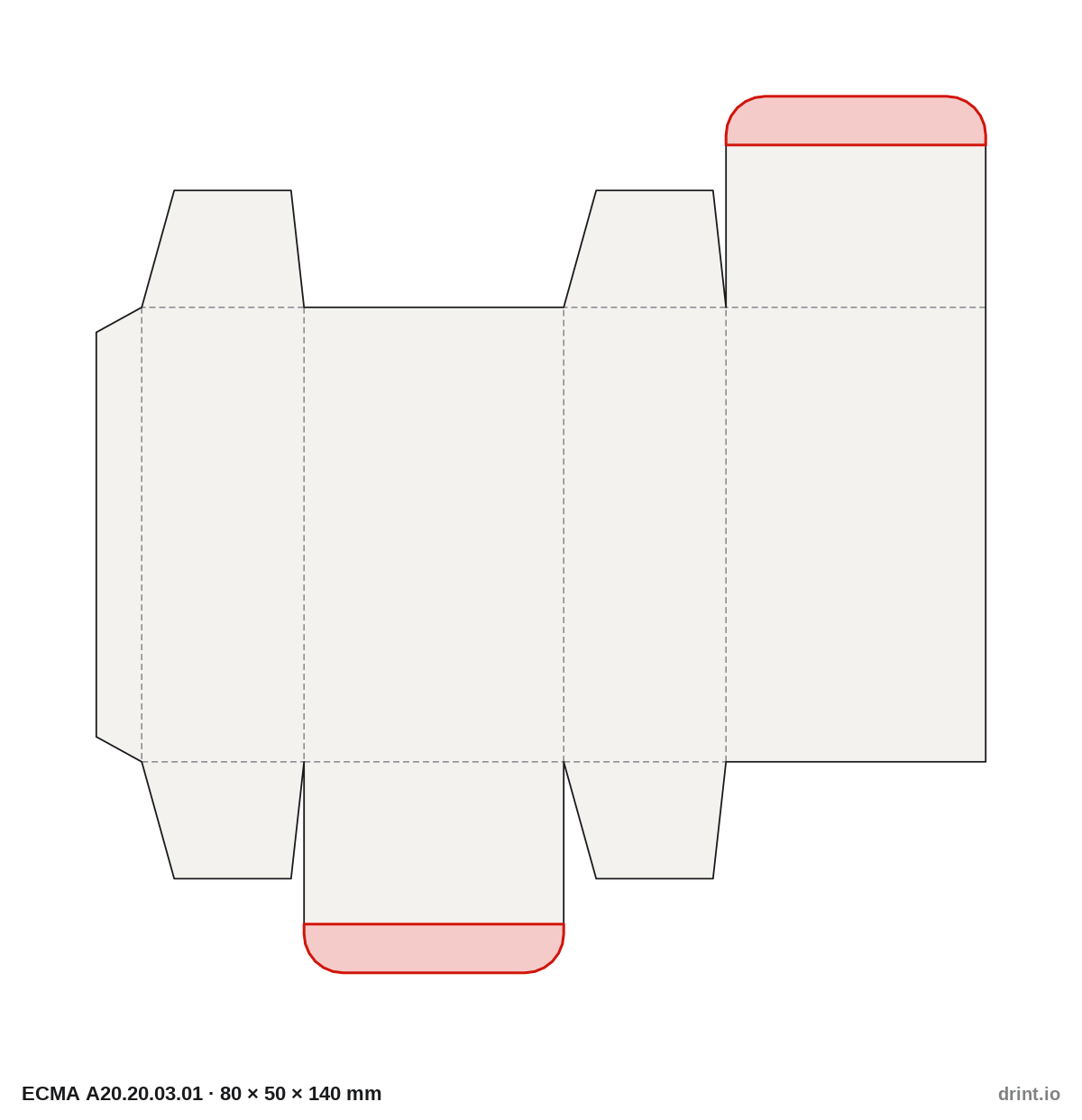
- Also called
- tuck, tuck-in flap, tongue
- Kind
- Parts of a pack
- Where Drint finds it
- 335 of the 1011 FEFCO / ECMA codes Drint draws
66 of the 292 product dies Drint draws - Drawn on
- ECMA A20.20.03.01
- Share of the ECMA A20.20.03.01 blank
- 4.2%
- Measured
The tuck flap is the reason a tuck end box closes without glue. It is cut with rounded or tapered corners so it finds its way in, and it is usually 12–20 mm deep on cartons for cosmetics, food and pharma.
A tuck that is too shallow springs open; one that is too deep crushes the product or is hard to pull out. Slit locks — two short cuts at the ends of the lid crease — make the tuck click into place for a firmer close.
Open ECMA A20.20.03.01 in the studio
Codes with a tuck flap
Questions
What is a tuck flap?
The tongue at the edge of a carton lid that slides inside the box to hold the lid shut by friction.
How many standard box styles have a tuck flap?
Of the 1011 FEFCO and ECMA codes Drint draws, 335 have a tuck flap, and so do 66 of its 292 product dies (bags, displays, pouches, rigid boxes…) — counted by Drint’s die engine, 2026-11-28.
What is the difference between a reverse and a straight tuck end?
On a straight tuck end both tucks are on the same panel side; on a reverse tuck end the top tuck is hinged at the back and the bottom tuck at the front, which nests better on the press sheet.
More terms
Cite this page: Drint (2026). “Tuck flap”. Drint Knowledge. https://drint.io/glossary/tuck-flap