Dielines › Dielines by standard code › FEFCO 0607
FEFCO 0607 — Rigid-type box with tuck-in lid, separate ends
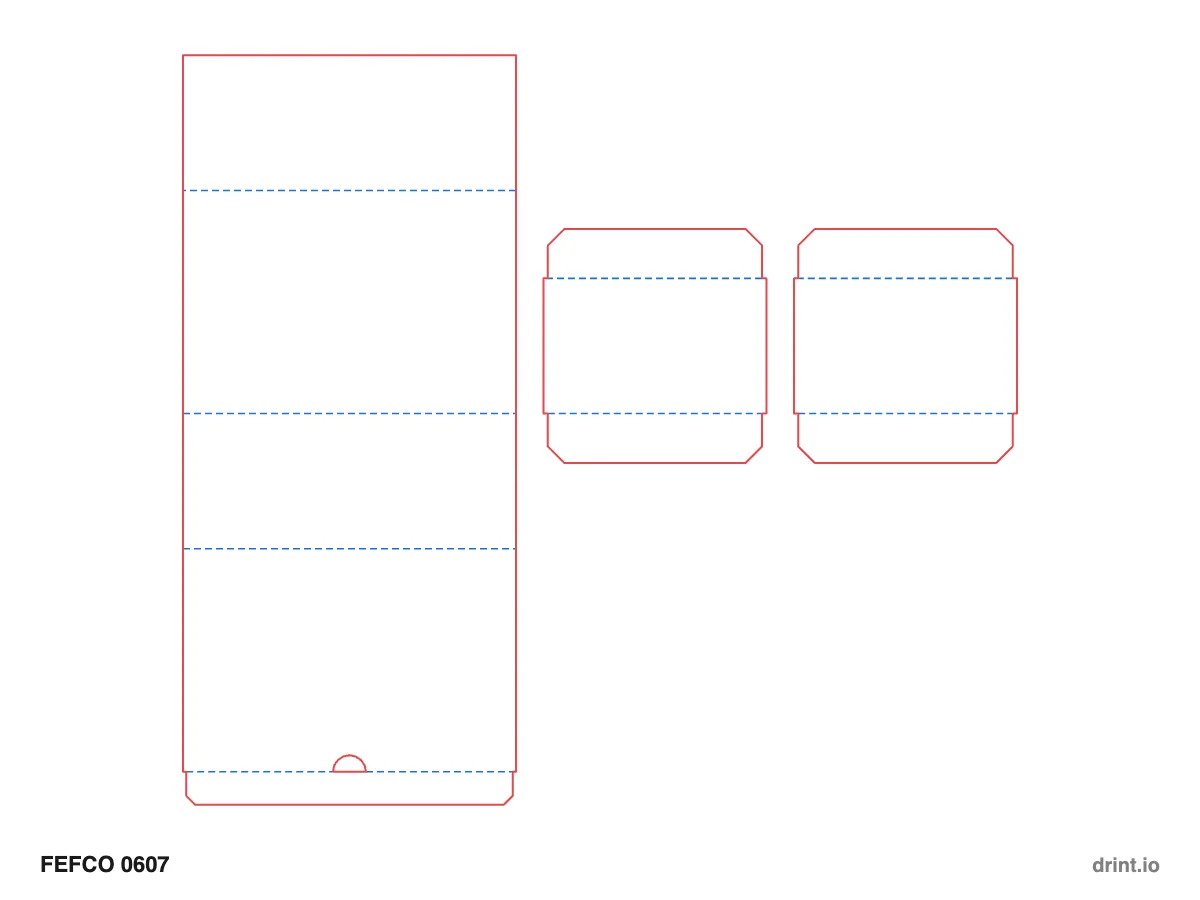
FEFCO 0607 is a rigid-type corrugated box whose hinged lid ends in a tuck flap that slides down inside the front wall, with two separate end pieces fixed by top and bottom flaps. It recloses without tape. Drint draws it close to the FEFCO drawing. Drint draws a free FEFCO 0607 dieline at any size: type the length, width and height and design on it, or download it as PDF or SVG with Pro.
- Code
- FEFCO 0607
- Standard
- FEFCO — corrugated board
- Group
- FEFCO 06 · Rigid-type boxes
- Drawn at
- 300 × 200 × 120 mm
- Flat sheet
- 759 × 682 mm
- Also written
- FEFCO 607
- Drawing
- Close to the code’s drawing, not exact
In Claude or ChatGPT, add the Drint connector (drint.io/mcp) and ask: “FEFCO 0607 dieline, 300 × 200 × 100 mm, PDF”.
How it folds
FEFCO 0607 in Drint's drawing has a five-panel body: front, bottom, back, lid and a tuck flap on the lid's free edge. Two end pieces with bottom and top flaps close the sides. The lid folds over the top flaps of the ends and its tuck flap pushes down behind the front wall, where friction holds it. That tuck closure, where the 0605 has a plain lid edge, makes this the reclosable member of the group. The sample is smaller than its neighbours: 300 × 200 × 120 mm on a 759 × 682 mm layout.
What it is used for
It is a storage and dispatch box for goods taken out a few at a time: spare parts, tools, files, samples, craft supplies and boxed sets sold to trade customers. The solid ends give stacking strength on a shelf, and the tuck lid can be opened and shut daily without any tape.
Blank size by box size
The flat sheet a FEFCO 0607 needs at each box size, measured on Drint’s own dieline with the board’s thickness allowed for. Add your press’s trim and gripper margin. Each size opens the die in the studio.
| Box, L × W × H | Flat sheet | Sheet area |
|---|---|---|
| 150 × 100 × 60 mm | 409 × 362 mm | 0.15 m² |
| 210 × 140 × 85 mm | 549 × 492 mm | 0.27 m² |
| 300 × 200 × 120 mm | 759 × 682 mm | 0.52 m² |
| 390 × 260 × 155 mm | 969 × 872 mm | 0.84 m² |
| 480 × 320 × 190 mm | 1179 × 1062 mm | 1.25 m² |
| 600 × 400 × 240 mm | 1459 × 1322 mm | 1.93 m² |
Board
B flute or E flute single wall keeps the tuck flap easy to insert; double wall makes the lid crease and tuck crease so stiff that the lid springs up. If double wall is needed for the load, lengthen the tuck flap and score its crease deeply so it stays down.
Printing and die notes
Front, lid and back print together on the body, so a design can run from the front wall over the lid. The tuck flap hides behind the front wall when closed and shows only at opening. Keep solids away from the lid hinge and tuck crease, which are flexed repeatedly and crack first.
Common mistakes
- Drawing the tuck flap as wide as the lid, so it collides with the end pieces' top flaps and cannot enter behind the front wall.
- Using a short tuck flap on stiff board, so the lid pops open as soon as the box is moved.
- Gluing the lid to the end flaps out of habit from other rigid-type styles, which defeats the reclosable tuck.
Mockups on this dieline
Questions
What is FEFCO 0607?
FEFCO 0607 is a rigid-type corrugated box whose hinged lid ends in a tuck flap that slides down inside the front wall, with two separate end pieces fixed by top and bottom flaps. It recloses without tape. Drint draws it close to the FEFCO drawing.
Does the tuck lid of a FEFCO 0607 stay closed in transit?
It holds by friction, which is enough for storage, shelf use and hand delivery. For parcel networks or heavy contents, add a tape strip, a label seal or a strap over the lid. The tuck is there mainly for convenient reopening, not as a transit lock.
Why does the tuck flap need to be narrower than the lid?
The end pieces have top flaps folded in under the lid at both ends. A tuck flap as long as the lid would hit them at the front corners. Tapering or shortening the tuck flap at each end by at least the board thickness lets it slide past cleanly.
What size sheet does a 300 × 200 × 120 mm FEFCO 0607 need?
A FEFCO 0607 of 300 × 200 × 120 mm unfolds to a flat sheet of 759 × 682 mm (0.52 m²) on Drint’s dieline, before trim and gripper margins. The table on this page gives the sheet for other sizes; in the studio, type any length, width and height and the sheet is measured again.
How do I get a FEFCO 0607 dieline at my size?
Open it in Drint and type your length, width and height — inside, on the crease or outside. The die is redrawn at that size with the board’s thickness allowed for, and you design straight on it. In Claude or ChatGPT with the Drint connector, ask for “FEFCO 0607 dieline” and your size.
What board is FEFCO 0607 made from?
B flute or E flute single wall keeps the tuck flap easy to insert; double wall makes the lid crease and tuck crease so stiff that the lid springs up. If double wall is needed for the load, lengthen the tuck flap and score its crease deeply so it stays down.
Is the FEFCO 0607 dieline free?
Designing on the die, the 3D fold and preflight are free in the browser. Downloading the dieline (SVG, PDF / AI, or DXF and CF2 for the die-maker) and the CMYK print PDF needs Pro.
Is Drint’s FEFCO 0607 exactly the FEFCO drawing?
Not exactly: Drint draws this code close to the FEFCO drawing. Check the die with your die-maker before production.