Dielines › Dielines by standard code › FEFCO 0608
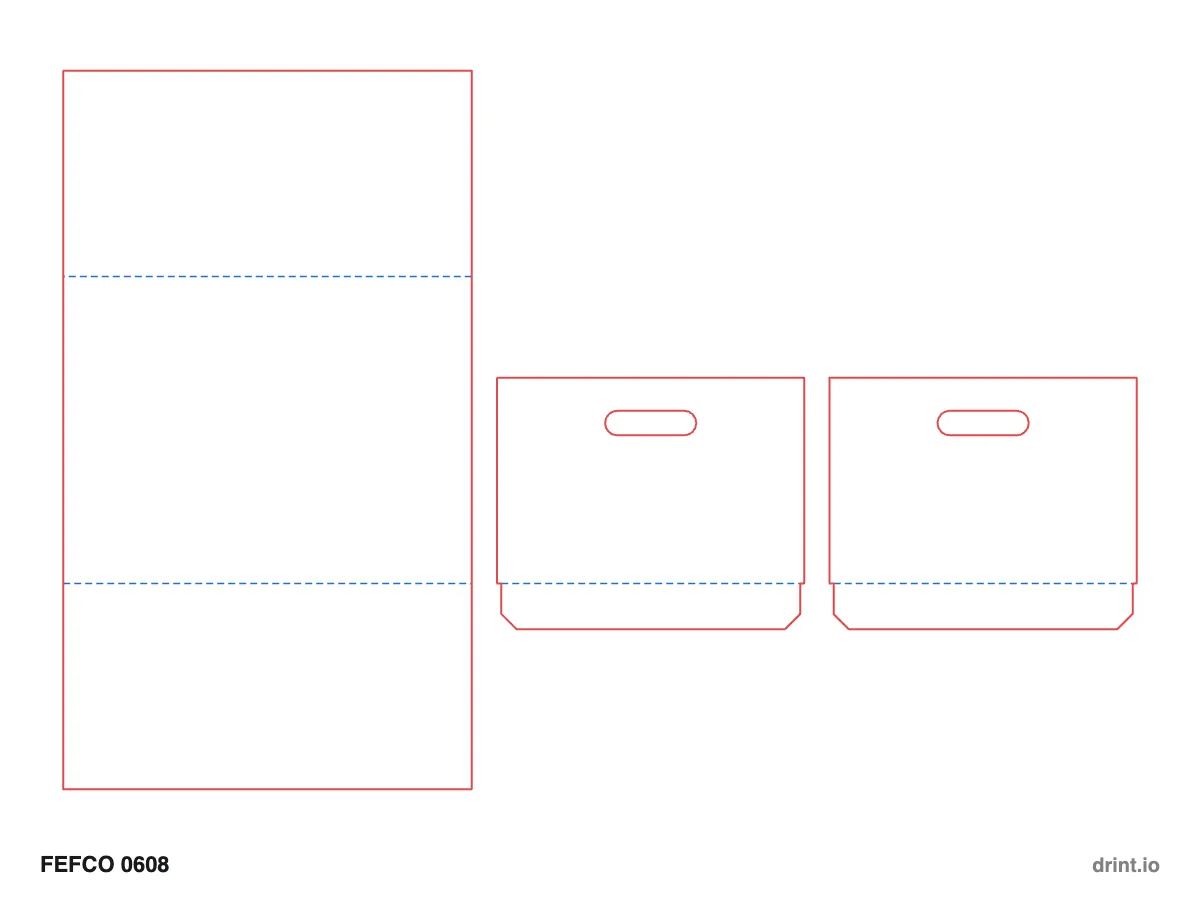
FEFCO 0608 — Rigid-type open tray with hand holes in the ends
FEFCO 0608 is a three-piece open corrugated tray made of a U-shaped body and two separate end pieces, each end cut with a hand hole for carrying. It is used for heavy crates of produce, bottles and parts. Drint draws it close to the FEFCO drawing. Drint draws a free FEFCO 0608 dieline at any size: type the length, width and height and design on it, or download it as PDF or SVG with Pro.
- Code
- FEFCO 0608
- Standard
- FEFCO — corrugated board
- Group
- FEFCO 06 · Rigid-type boxes
- Drawn at
- 400 × 300 × 200 mm
- Flat sheet
- 1059 × 709 mm
- Also written
- FEFCO 608
- Drawing
- Close to the code’s drawing, not exact
In Claude or ChatGPT, add the Drint connector (drint.io/mcp) and ask: “FEFCO 0608 dieline, 300 × 200 × 100 mm, PDF”.
How it folds
FEFCO 0608 follows the layout of the 0601: a body creased into bottom, front and back, plus two end pieces each fixed by one bottom flap. What it adds is a hand hole die-cut near the top of each end piece, and Drint's sample is deeper to make room for it: 400 × 300 × 200 mm on a 1059 × 709 mm layout. The holes are in the separate ends, the pieces with upright flutes and uncut edges, so the board above each hole carries the lifting load.
What it is used for
It works as a carry crate: fruit and vegetables from field to packhouse, bottles and jars, bakery trays, components moved between workstations and goods picked in a warehouse. Open tops let air through and make the contents visible, and the two hand holes allow a safe two-handed lift.
Blank size by box size
The flat sheet a FEFCO 0608 needs at each box size, measured on Drint’s own dieline with the board’s thickness allowed for. Add your press’s trim and gripper margin. Each size opens the die in the studio.
| Box, L × W × H | Flat sheet | Sheet area |
|---|---|---|
| 200 × 150 × 100 mm | 559 × 359 mm | 0.20 m² |
| 280 × 210 × 140 mm | 759 × 499 mm | 0.38 m² |
| 400 × 300 × 200 mm | 1059 × 709 mm | 0.75 m² |
| 520 × 390 × 260 mm | 1359 × 919 mm | 1.25 m² |
| 640 × 480 × 320 mm | 1659 × 1129 mm | 1.87 m² |
| 800 × 600 × 400 mm | 2059 × 1409 mm | 2.90 m² |
Board
Use double wall or heavy C flute in the ends at least; this is where separate ends pay off, because the body can stay lighter. Leave a generous band of board between the hand hole and the top edge, and consider a fold-in flap on the hole instead of a clean cut-out to spread the load on the fingers.
Printing and die notes
The hand holes sit in the upper part of each end, so place logos and variety or grade marks below them or on the long walls. Flexo direct is standard. For produce, choose inks and board suited to damp conditions, and keep the bottom flap joints free of ink where they are glued.
Common mistakes
- Cutting the hand hole too close to the top edge, so the strip above it tears out on the first heavy lift.
- Placing the hand hole so low that fingers press against the product, or that small items fall out through it.
- Orienting the end pieces with flutes horizontal, which weakens both the handle strip and the stacking strength.
Mockups on this dieline
Questions
What is FEFCO 0608?
FEFCO 0608 is a three-piece open corrugated tray made of a U-shaped body and two separate end pieces, each end cut with a hand hole for carrying. It is used for heavy crates of produce, bottles and parts. Drint draws it close to the FEFCO drawing.
How much weight can the hand holes of a FEFCO 0608 take?
It depends on the board grade, the flute direction and the width of board left above the hole, so it has to be tested for each design. As a rule, stronger end pieces, upright flutes, rounded hole corners and a fold-in hand flap all raise the safe load.
Should the hand hole be a full cut-out or a push-in flap?
A push-in flap, cut on three sides and creased at the top, folds inwards to double the board under the fingers and keeps dust out until first use. A full cut-out is simpler and ventilates better. Heavy loads generally favour the flap.
What size sheet does a 400 × 300 × 200 mm FEFCO 0608 need?
A FEFCO 0608 of 400 × 300 × 200 mm unfolds to a flat sheet of 1059 × 709 mm (0.75 m²) on Drint’s dieline, before trim and gripper margins. The table on this page gives the sheet for other sizes; in the studio, type any length, width and height and the sheet is measured again.
How do I get a FEFCO 0608 dieline at my size?
Open it in Drint and type your length, width and height — inside, on the crease or outside. The die is redrawn at that size with the board’s thickness allowed for, and you design straight on it. In Claude or ChatGPT with the Drint connector, ask for “FEFCO 0608 dieline” and your size.
What board is FEFCO 0608 made from?
Use double wall or heavy C flute in the ends at least; this is where separate ends pay off, because the body can stay lighter. Leave a generous band of board between the hand hole and the top edge, and consider a fold-in flap on the hole instead of a clean cut-out to spread the load on the fingers.
Is the FEFCO 0608 dieline free?
Designing on the die, the 3D fold and preflight are free in the browser. Downloading the dieline (SVG, PDF / AI, or DXF and CF2 for the die-maker) and the CMYK print PDF needs Pro.
Is Drint’s FEFCO 0608 exactly the FEFCO drawing?
Not exactly: Drint draws this code close to the FEFCO drawing. Check the die with your die-maker before production.