Drint Knowledge › Packaging glossary › Flat-bottom pouch
Flat-bottom pouch
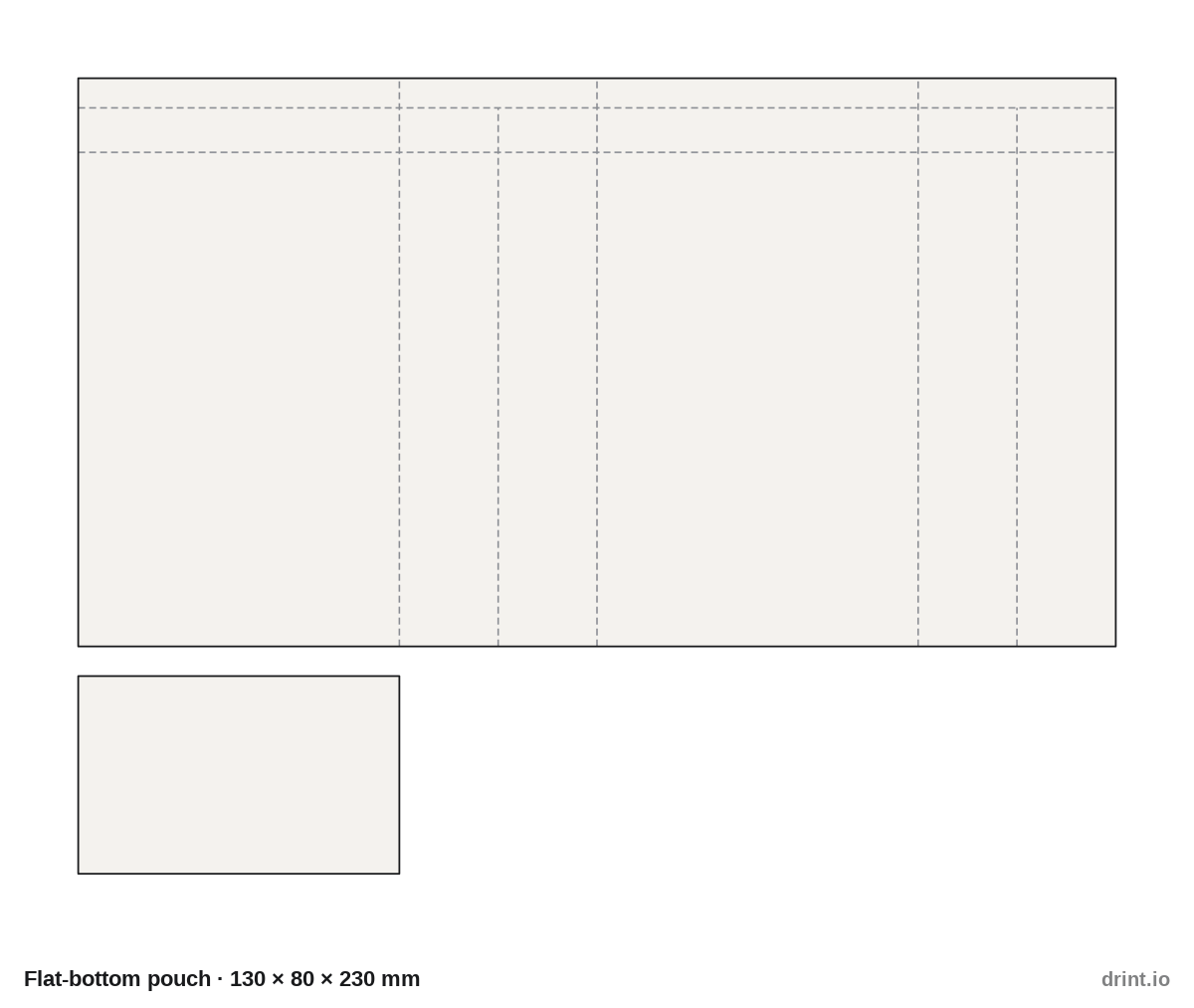
A flexible pouch with a flat rectangular base and two side gussets, so it stands like a box with five printable faces.
- Also called
- box pouch, block-bottom pouch, eight-side seal pouch
- Kind
- Pack styles
- Variants Drint draws
- 1
- Default size
- 130 × 80 × 230 mm
- Flat blank
- 420 × 322 mm
- Blank area
- 0.107 m²
- Cutting rule
- 1.72 m
- Creasing rule
- 1.97 m
- Measured
Front, back and two side gussets are joined by vertical seals at the four corners, and a separate bottom panel is sealed in to make a square base; counting edges gives the trade name eight-side seal. A zip and a valve are often added near the top.
It holds its shape better than a stand-up pouch and gives a printable base and sides, which suits premium coffee, pet food and nuts. It costs more and needs more careful filling, so it is chosen when shelf presence matters more than unit price.
Questions
What is a flat-bottom pouch?
A flexible pouch with a flat rectangular base and two side gussets, so it stands like a box with five printable faces.
Flat-bottom or stand-up pouch?
A flat-bottom pouch stands squarer, shows more print and holds more for its footprint; a stand-up pouch is cheaper and simpler to make and fill.
More terms
Cite this page: Drint (2026). “Flat-bottom pouch”. Drint Knowledge. https://drint.io/glossary/flat-bottom-pouch