Drint Knowledge › Packaging glossary › Squeeze tube
Squeeze tube
A soft cylindrical container that is squeezed to dispense its content through a shoulder and cap at one end, with a flat seal at the other.
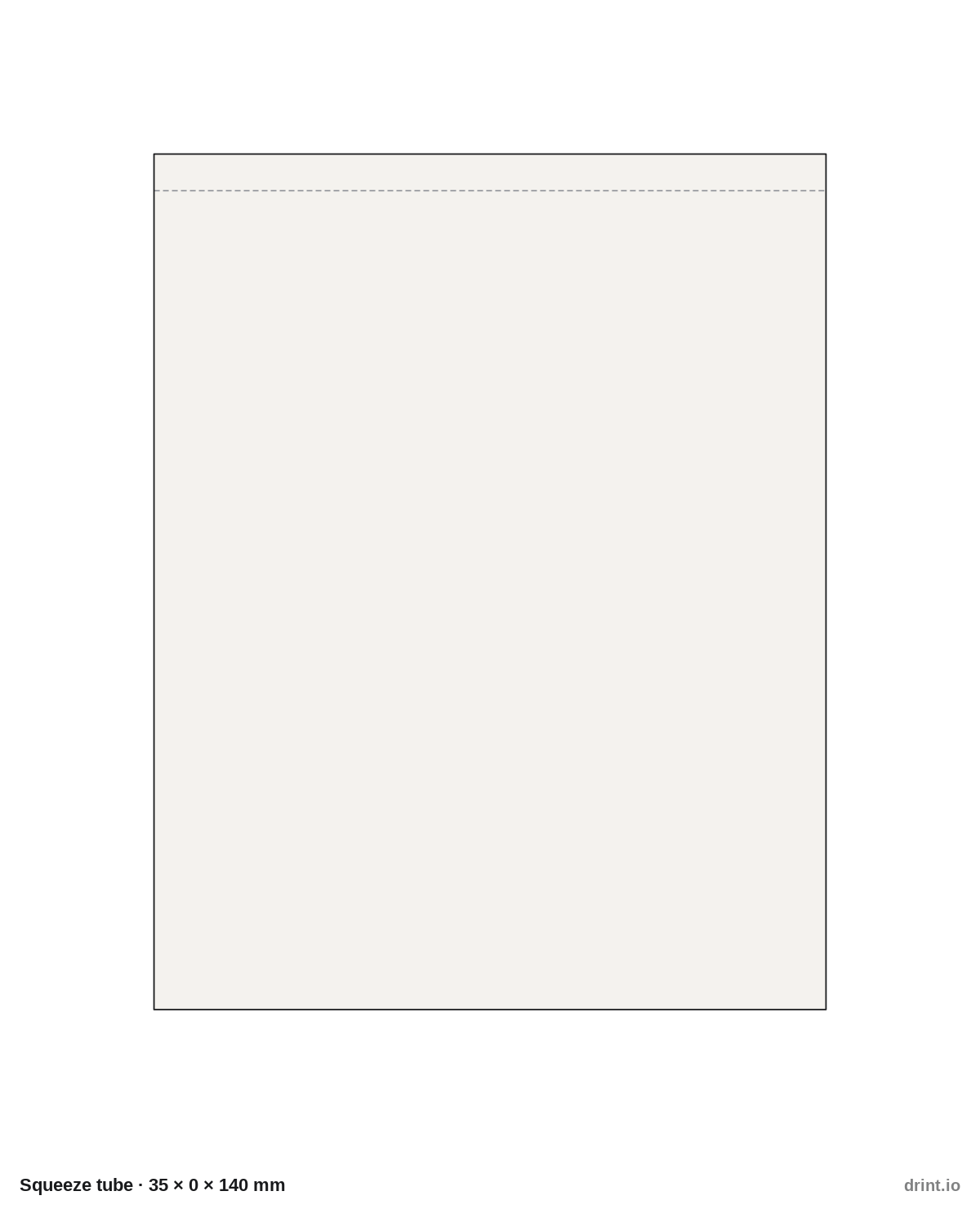
- Also called
- cosmetic tube, laminate tube, collapsible tube
- Kind
- Pack styles
- Variants Drint draws
- 5
- Default size
- 35 × 0 × 140 mm
- Flat blank
- 110 × 140 mm
- Blank area
- 0.015 m²
- Cutting rule
- 0.50 m
- Creasing rule
- 0.11 m
- Measured
The body is a printed sleeve of laminate or extruded plastic joined to a moulded shoulder and neck; the tube is filled from the open tail, which is then crimped and sealed flat. The finished body is flat at the seal and round at the shoulder, so artwork bends from one shape to the other.
Tubes are used for creams, toothpaste, ointment, sauces and gels. Keep the main design in the middle of the body, away from the shoulder and the crimp, and leave the seal area for the printed batch or date code.
Questions
What is a squeeze tube?
A soft cylindrical container that is squeezed to dispense its content through a shoulder and cap at one end, with a flat seal at the other.
What is the difference between a laminate and an extruded tube?
A laminate tube is made from a flat printed multi-layer sheet rolled and seamed, so it shows a side seam; an extruded tube is a seamless plastic sleeve printed after forming.
More terms
Cite this page: Drint (2026). “Squeeze tube”. Drint Knowledge. https://drint.io/glossary/squeeze-tube