Drint Knowledge › Packaging glossary › Washi paper
Washi paper
A traditional Japanese paper made mainly from long kozo (paper mulberry) fibres, strong for its weight and softly textured.
- Also called
- Japanese paper, kozo paper
- Kind
- Board & materials
- Weights in Drint
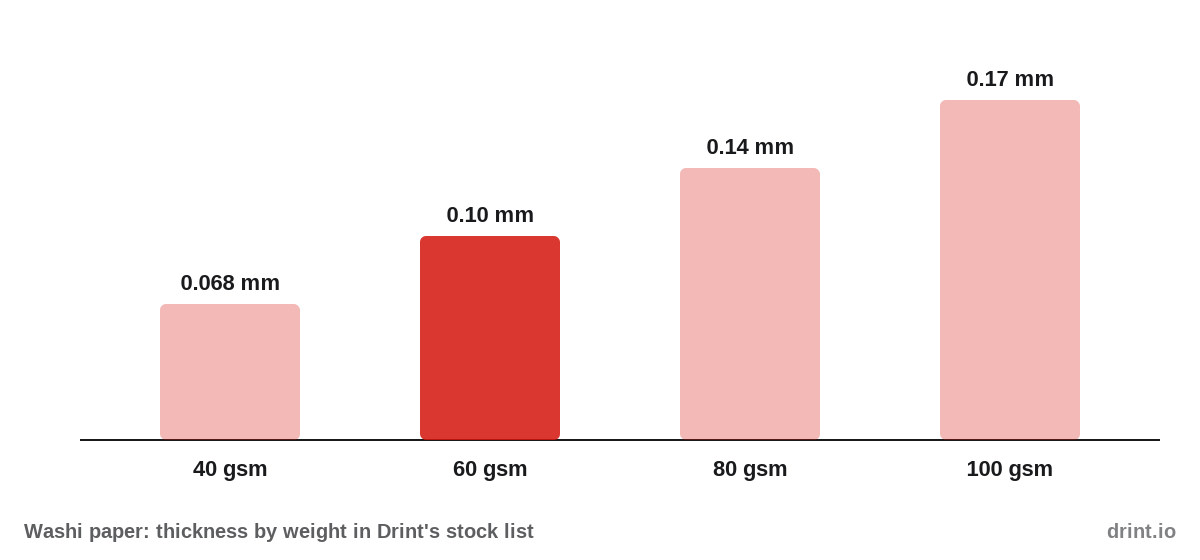
- 40 gsm → 0.068 mm
60 gsm → 0.102 mm
80 gsm → 0.136 mm
100 gsm → 0.17 mm - Measured
Washi is made from inner bark fibres such as kozo, mitsumata or gampi, which are long and interlock into a thin yet strong sheet. Hand- and machine-made grades exist, with visible fibres, soft deckled edges and slight translucency.
It suits gift wraps, labels for sake, tea and sweets, belly bands and luxury box covers. Its absorbent surface softens fine print, so test inks first, and simple one-colour artwork, letterpress or hot foil often show its character better than full colour.
Caliper = weight × 1.7 ÷ 1,000: the thickness Drint’s die engine allows at every fold for this stock.
Questions
What is a washi paper?
A traditional Japanese paper made mainly from long kozo (paper mulberry) fibres, strong for its weight and softly textured.
More terms
Cite this page: Drint (2026). “Washi paper”. Drint Knowledge. https://drint.io/glossary/washi-paper