Drint Knowledge › Packaging glossary › Caliper
Caliper
The thickness of a single sheet of paper or board, usually given in microns (µm) or millimetres, or in points in North America.
- Also called
- board thickness, paper thickness, microns, pt
- Kind
- Board & materials
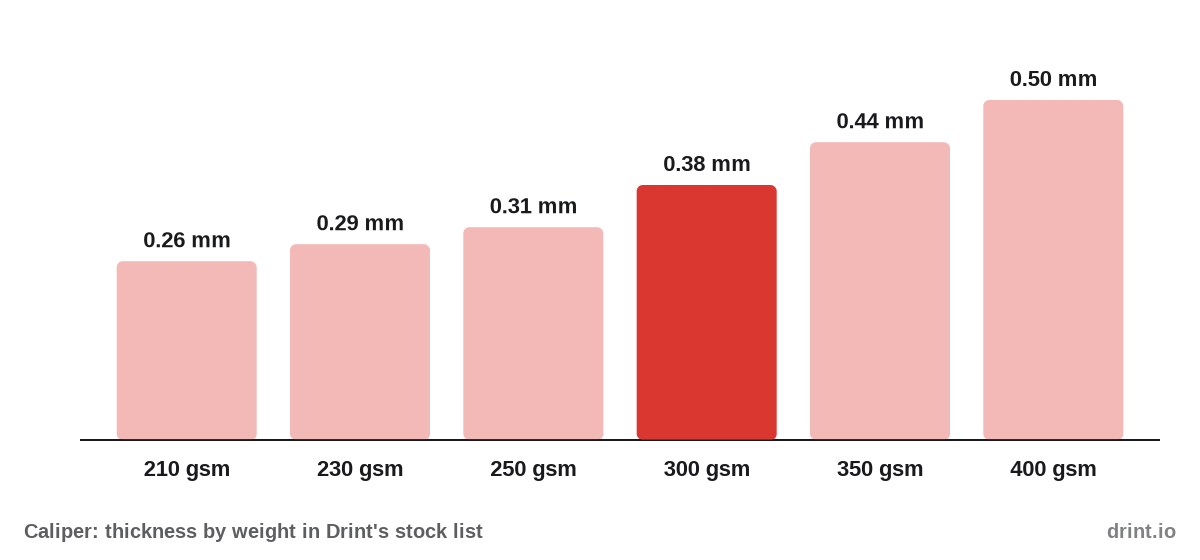
- Weights in Drint
- 210 gsm → 0.263 mm
230 gsm → 0.288 mm
250 gsm → 0.313 mm
300 gsm → 0.375 mm
350 gsm → 0.438 mm
400 gsm → 0.5 mm - Product types that start on it
- 22
- Measured
Caliper is measured with a micrometer under a set pressure and depends on grammage and bulk together. Thickness affects stiffness strongly, so a slightly thicker board can make a box feel much sturdier.
In a dieline, caliper is what the folding allowances are based on: panels that wrap around others, tuck flaps and glue flaps are offset by roughly the board thickness so the box closes square. When you change stock or weight, the die should be recalculated for the new caliper rather than reused unchanged.
Caliper = weight × 1.25 ÷ 1,000: the thickness Drint’s die engine allows at every fold for this stock.
Questions
What is a caliper?
The thickness of a single sheet of paper or board, usually given in microns (µm) or millimetres, or in points in North America.
Why does my box not close after changing paper?
A thicker board needs larger fold allowances; a die drawn for a thinner caliper makes flaps too tight, so recalculate the die for the new stock.
More terms
Cite this page: Drint (2026). “Caliper”. Drint Knowledge. https://drint.io/glossary/caliper