Drint Knowledge › Packaging glossary › Grammage (GSM)
Grammage (GSM)
The weight of paper or board per square metre, written in grams per square metre (gsm, g/m²).
- Also called
- gsm, g/m², basis weight, paper weight
- Kind
- Board & materials
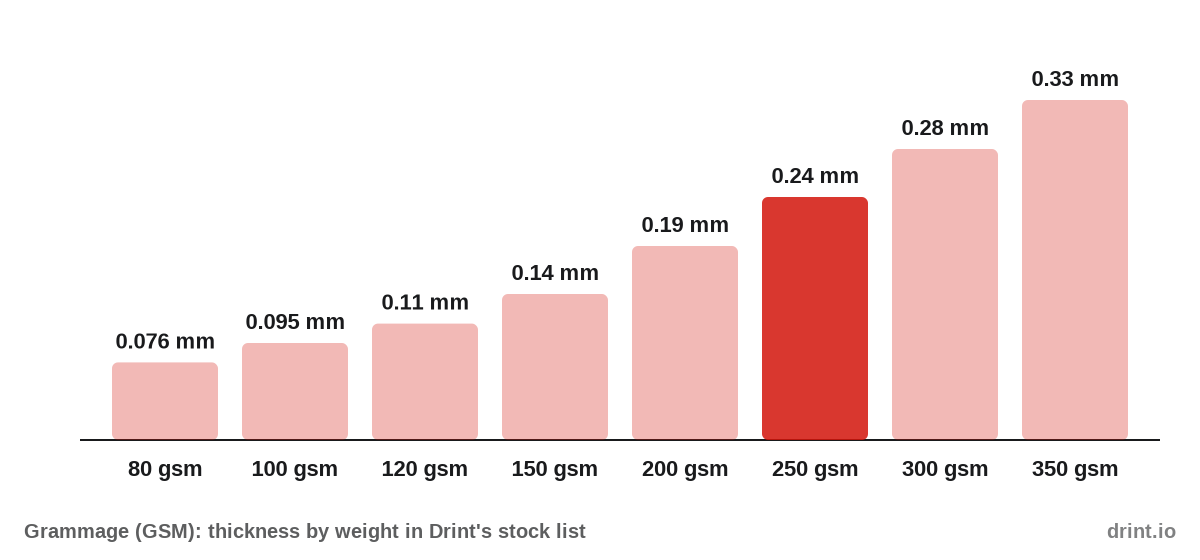
- Weights in Drint
- 80 gsm → 0.076 mm
100 gsm → 0.095 mm
120 gsm → 0.114 mm
150 gsm → 0.143 mm
200 gsm → 0.19 mm
250 gsm → 0.238 mm
300 gsm → 0.285 mm
350 gsm → 0.333 mm - Product types that start on it
- 17
- Measured
Grammage tells you how much fibre is in a sheet, not directly how thick or stiff it is. Two boards of the same gsm can feel quite different, because bulk, fibre type and coating change thickness and stiffness.
Packaging buyers usually specify papers and boards by gsm, from light wraps and labels to heavy carton board. For a box, choose gsm together with the stock type and the box size: larger or heavier products need a heavier board or a stiffer stock, and the creases must match the resulting thickness.
Caliper = weight × 0.95 ÷ 1,000: the thickness Drint’s die engine allows at every fold for this stock.
Questions
What is a grammage (gsm)?
The weight of paper or board per square metre, written in grams per square metre (gsm, g/m²).
Does a higher gsm always mean a thicker board?
Not across stocks. Within one stock it does, but a bulky board can be thicker than a denser one with a higher gsm.
More terms
Cite this page: Drint (2026). “Grammage (GSM)”. Drint Knowledge. https://drint.io/glossary/grammage-gsm