Drint Knowledge › Packaging glossary › Ivory board
Ivory board
A bright white paperboard coated on the print side and white right through, the everyday board for printed folding cartons.
- Also called
- C1S ivory board, folding boxboard, FBB, white cardboard
- Kind
- Board & materials
- Weights in Drint
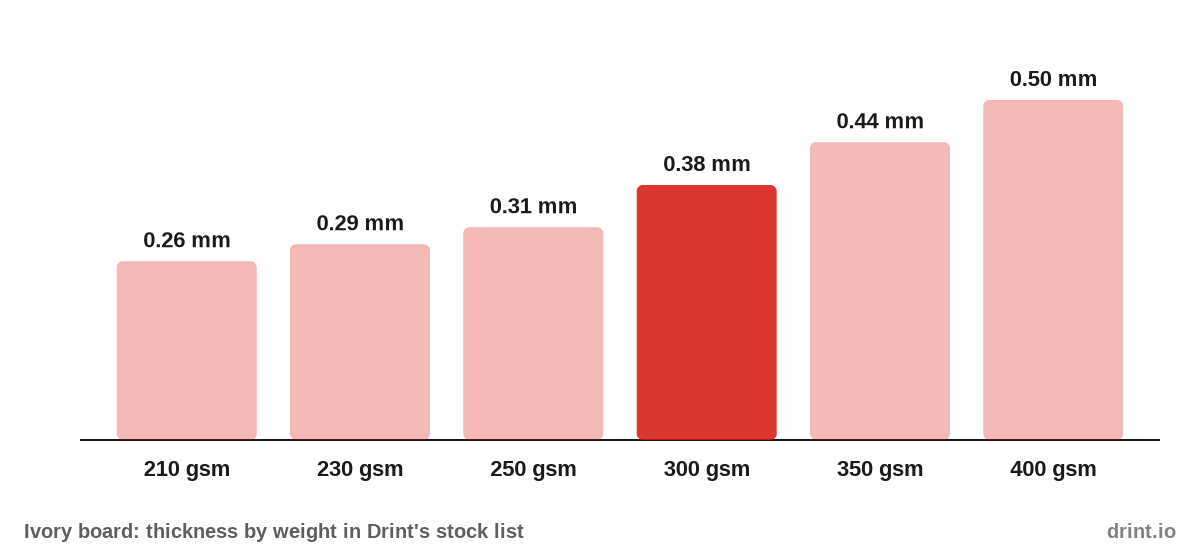
- 210 gsm → 0.263 mm
230 gsm → 0.288 mm
250 gsm → 0.313 mm
300 gsm → 0.375 mm
350 gsm → 0.438 mm
400 gsm → 0.5 mm - Product types that start on it
- 22
- Measured
Ivory board is built from bleached pulp layers with a mineral coating on the top side, so the face is smooth for print while the back stays white but uncoated. It is stiff and bulky for its weight, which lets a carton stand square without going to a very heavy grammage.
It suits cosmetics, pharmacy, food and gift cartons, hang tags and sleeves, usually in the 250–350 gsm range. Offset prints sharply on the coated face; lamination, spot UV, foil and embossing all work well, and heavier weights should be creased with a matching rule and channel so folds do not crack.
Caliper = weight × 1.25 ÷ 1,000: the thickness Drint’s die engine allows at every fold for this stock.
Questions
What is a ivory board?
A bright white paperboard coated on the print side and white right through, the everyday board for printed folding cartons.
Is ivory board the same as duplex?
No. Ivory is white on both sides, while duplex has a grey recycled back, so ivory looks cleaner inside the box and costs more.
More terms
Cite this page: Drint (2026). “Ivory board”. Drint Knowledge. https://drint.io/glossary/ivory-board