Drint Knowledge › Packaging glossary › Coated vs uncoated
Coated vs uncoated
Whether a paper or board carries a mineral surface coating: coated stock holds ink on top for sharp print, uncoated stock absorbs it for a natural look.
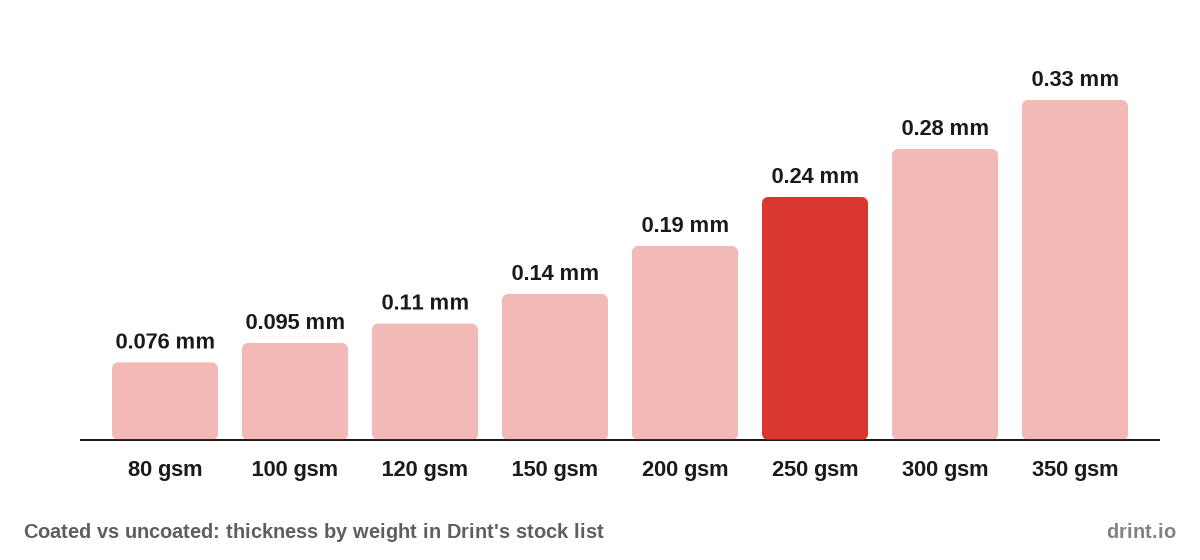
- Also called
- coated paper, uncoated paper, C1S, C2S
- Kind
- Board & materials
- Weights in Drint
- 80 gsm → 0.076 mm
100 gsm → 0.095 mm
120 gsm → 0.114 mm
150 gsm → 0.143 mm
200 gsm → 0.19 mm
250 gsm → 0.238 mm
300 gsm → 0.285 mm
350 gsm → 0.333 mm - Product types that start on it
- 17
- Measured
Coated stocks have a layer of clay or calcium carbonate with binders, giving a smooth, closed surface in gloss, silk or matt. Uncoated stocks show the fibre directly, feel softer and more tactile, and absorb more ink, so dots spread and colours print duller.
Coated one side (C1S) boards like ivory and duplex are standard for cartons, while two-side coated (C2S) papers suit leaflets and wraps. Ask for colour proofs on the right surface, since the same file prints visibly differently on coated and uncoated stock, and choose finishes accordingly: lamination and spot UV suit coated, foil and emboss work on both.
Caliper = weight × 0.95 ÷ 1,000: the thickness Drint’s die engine allows at every fold for this stock.
Questions
What is a coated vs uncoated?
Whether a paper or board carries a mineral surface coating: coated stock holds ink on top for sharp print, uncoated stock absorbs it for a natural look.
More terms
Cite this page: Drint (2026). “Coated vs uncoated”. Drint Knowledge. https://drint.io/glossary/coated-vs-uncoated