Drint Knowledge › Packaging glossary › Cut line
Cut line
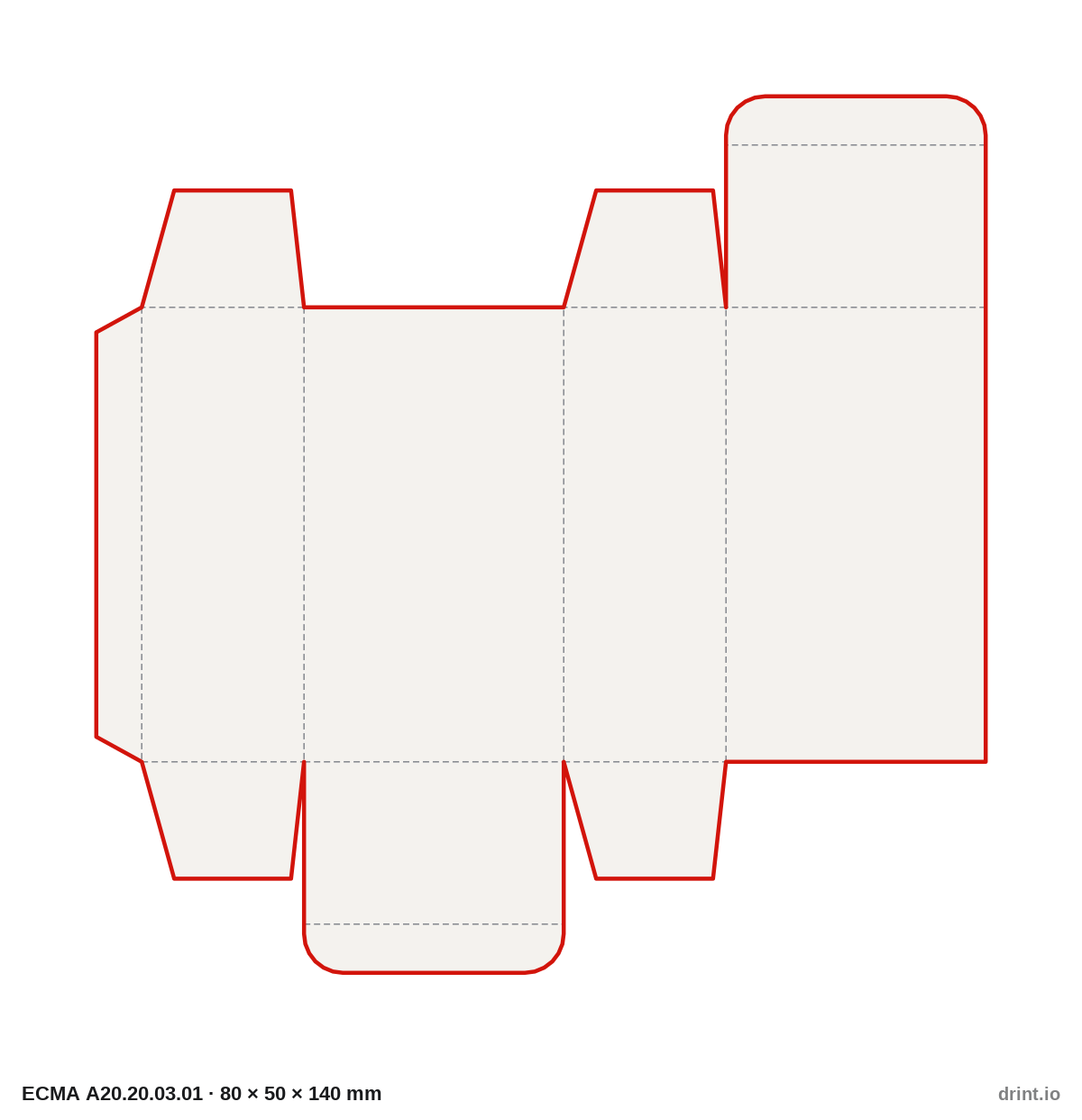
A line on the dieline where the steel knife cuts right through the board; drawn solid, usually in red.
- Also called
- cutting rule, knife line, die line
- Kind
- Die lines
- Where Drint finds it
- 1011 of the 1011 FEFCO / ECMA codes Drint draws
288 of the 292 product dies Drint draws - Drawn on
- ECMA A20.20.03.01
- Length on ECMA A20.20.03.01
- 1.29 m
- Measured
Every outer edge of a blank is a cut line, and so are slots, cut-outs and slits inside it. In the die, each cut line becomes a bent strip of steel rule set in a wooden board.
Long cut lines are given small nicks — tiny gaps in the knife — so the blanks stay attached to the sheet until they are stripped out.
Open ECMA A20.20.03.01 in the studio
Codes with a cut line
Questions
What is a cut line?
A line on the dieline where the steel knife cuts right through the board; drawn solid, usually in red.
How many standard box styles have a cut line?
Of the 1011 FEFCO and ECMA codes Drint draws, 1011 have a cut line, and so do 288 of its 292 product dies (bags, displays, pouches, rigid boxes…) — counted by Drint’s die engine, 2026-11-28.
What colour is a cut line?
There is no single law; most die-makers read solid red (or a named spot colour such as "CutContour") as cut and dashed lines as creases. Name the layers in the file so nobody has to guess.
More terms
Cite this page: Drint (2026). “Cut line”. Drint Knowledge. https://drint.io/glossary/cut-line