Dielines › Dielines by standard code › FEFCO 0226
FEFCO 0226 — Bellows-style box (unslotted, gusset-folded ends)
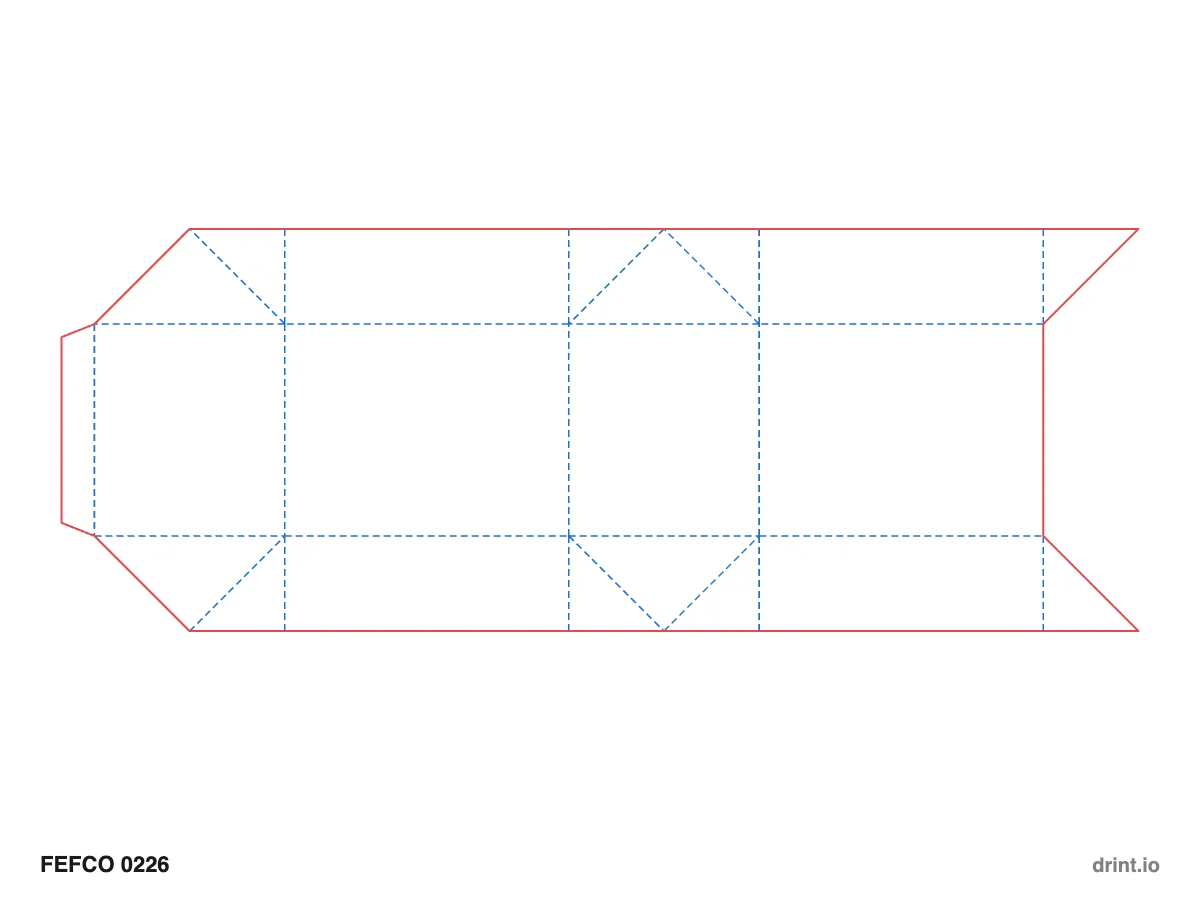
FEFCO 0226 is a glued corrugated box whose ends are creased rather than slotted, so the corners fold in as gussets and the closure has no open cuts. It is used for powders, granules, bagged liquids and anything that must not sift or seep out at the corners. Drint draws a free FEFCO 0226 dieline at any size: type the length, width and height and design on it, or download it as PDF or SVG with Pro.
- Code
- FEFCO 0226
- Standard
- FEFCO — corrugated board
- Group
- FEFCO 02 · Slotted cartons
- Drawn at
- 300 × 200 × 220 mm
- Flat sheet
- 1149 × 429 mm
- Also written
- FEFCO 226
- Drawing
- Follows the code’s drawing
In Claude or ChatGPT, add the Drint connector (drint.io/mcp) and ask: “FEFCO 0226 dieline, 300 × 200 × 100 mm, PDF”.
How it folds
FEFCO 0226 has four walls and a glue flap like every 02 carton, but the flap strip at each end is left as one continuous band. In place of slots, diagonal creases at the four corners let the board between the flaps pleat inwards as triangular gussets while the two long flaps close over them. Because nothing is cut, each corner stays joined. That is the difference from the 0201, where a slot opens at every corner. Drint's sample is 300 × 200 × 220 mm on a 1149 × 429 mm blank.
What it is used for
It serves products that find the smallest gap: flour, sugar, pigments, plastic granules, seeds, small hardware, and liquids or pastes packed in an inner bag. The uncut corners also slow down moisture and dust entering, which helps hygroscopic goods and items for clean areas.
Blank size by box size
The flat sheet a FEFCO 0226 needs at each box size, measured on Drint’s own dieline with the board’s thickness allowed for. Add your press’s trim and gripper margin. Each size opens the die in the studio.
| Box, L × W × H | Flat sheet | Sheet area |
|---|---|---|
| 150 × 100 × 110 mm | 599 × 219 mm | 0.13 m² |
| 210 × 140 × 155 mm | 819 × 304 mm | 0.25 m² |
| 300 × 200 × 220 mm | 1149 × 429 mm | 0.49 m² |
| 390 × 260 × 285 mm | 1479 × 554 mm | 0.82 m² |
| 480 × 320 × 350 mm | 1809 × 679 mm | 1.23 m² |
| 600 × 400 × 440 mm | 2249 × 849 mm | 1.91 m² |
Board
The gussets stack several plies of board at each corner, so a thin, easily creased grade matters more here than raw strength: E or B flute single wall is the usual limit, and stiff double wall rarely folds acceptably. Order deep, accurate creases on the diagonals and test the fold on real board before the run.
Printing and die notes
The outside reads like a slotted carton, four walls and two closing flaps, and can be flexo printed in the normal way. The triangular gusset areas disappear inside the fold, so keep text and barcodes out of them. Diagonal creases need a die or special scoring, and ink solids across them tend to crack.
Common mistakes
- Specifying heavy double-wall board, so the pleated corners will not flatten and the closing flaps stand open.
- Calling it leakproof for loose liquid, when the folded corners only resist sifting and still need an inner bag or liner for fluids.
- Running the diagonal creases to the wrong corner point, so the gussets fight the flap creases and the board tears where they meet.
Mockups on this dieline
Questions
What is FEFCO 0226?
FEFCO 0226 is a glued corrugated box whose ends are creased rather than slotted, so the corners fold in as gussets and the closure has no open cuts. It is used for powders, granules, bagged liquids and anything that must not sift or seep out at the corners.
Is a FEFCO 0226 bellows box liquid-tight?
Not by itself. The uncut corners remove the open slots of a normal carton, which stops powders and small parts escaping, but corrugated board absorbs liquid and the glue joint is a seam. For liquids use an inner bag, or a coated board with a properly sealed joint.
Why is the blank of a FEFCO 0226 the same height as a 0201 but harder to make?
The board area is similar because the flaps are the same depth; what changes is the tooling. A 0201 runs on a slotter, while the bellows ends need diagonal creases and no slots, which normally means die-cutting and slower, more careful folding.
What size sheet does a 300 × 200 × 220 mm FEFCO 0226 need?
A FEFCO 0226 of 300 × 200 × 220 mm unfolds to a flat sheet of 1149 × 429 mm (0.49 m²) on Drint’s dieline, before trim and gripper margins. The table on this page gives the sheet for other sizes; in the studio, type any length, width and height and the sheet is measured again.
How do I get a FEFCO 0226 dieline at my size?
Open it in Drint and type your length, width and height — inside, on the crease or outside. The die is redrawn at that size with the board’s thickness allowed for, and you design straight on it. In Claude or ChatGPT with the Drint connector, ask for “FEFCO 0226 dieline” and your size.
What board is FEFCO 0226 made from?
The gussets stack several plies of board at each corner, so a thin, easily creased grade matters more here than raw strength: E or B flute single wall is the usual limit, and stiff double wall rarely folds acceptably. Order deep, accurate creases on the diagonals and test the fold on real board before the run.
Is the FEFCO 0226 dieline free?
Designing on the die, the 3D fold and preflight are free in the browser. Downloading the dieline (SVG, PDF / AI, or DXF and CF2 for the die-maker) and the CMYK print PDF needs Pro.