Drint Knowledge › Packaging glossary › Longitudinal seal
Longitudinal seal
The vertical overlap where the two edges of a liquid carton’s web are sealed into a tube, usually protected by a strip on the inside.
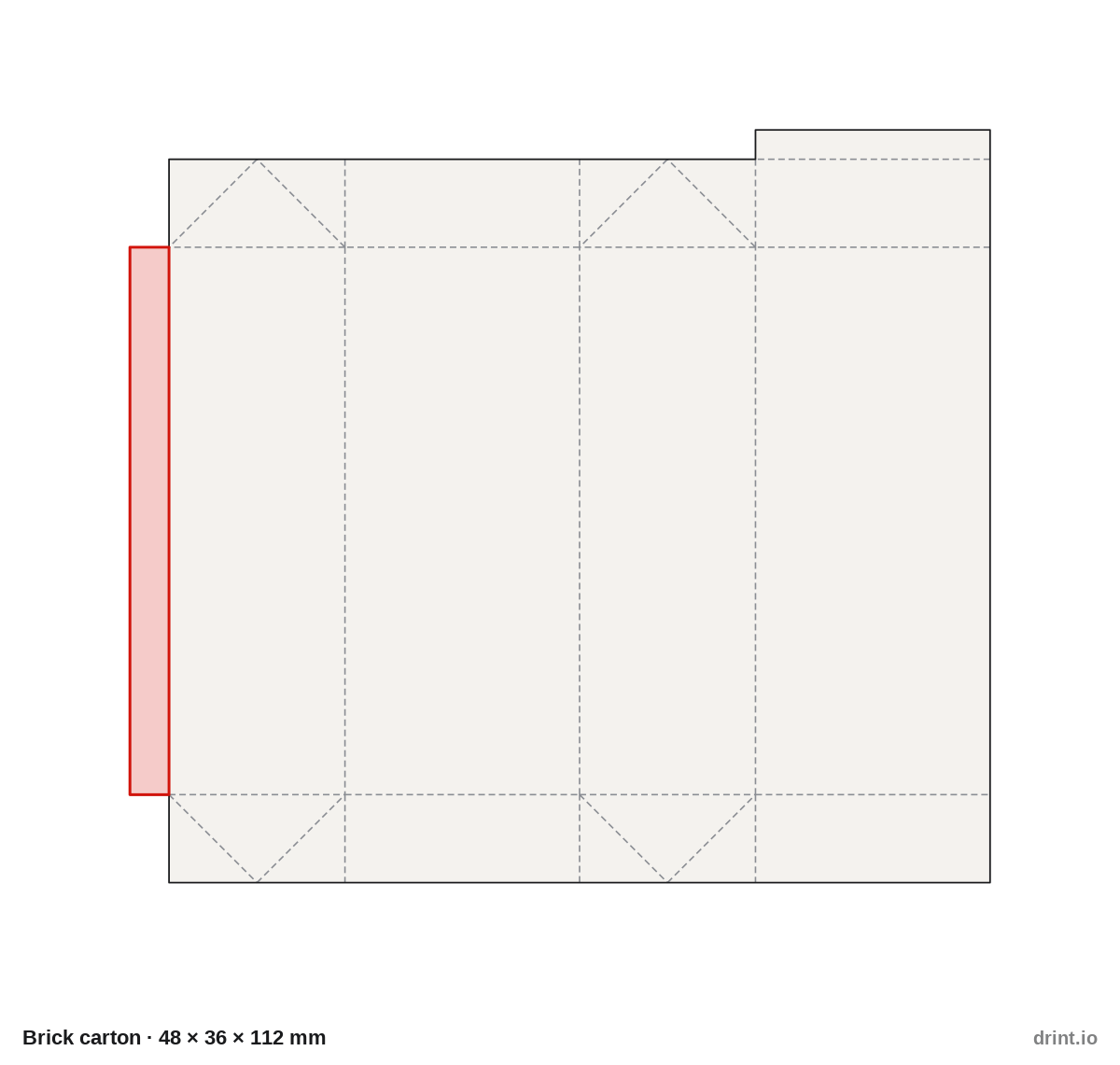
- Also called
- LS seam, side seam of a liquid carton
- Kind
- Parts of a pack
- Where Drint finds it
- 1 of the 292 product dies Drint draws
- Drawn on
- Brick carton
- Share of the Brick carton blank
- 3.4%
- Measured
Liquid cartons are formed from a reel or blank into a tube, and the overlap is heat-sealed along the full height. On aseptic packs a narrow plastic strip covers the cut edge inside so the board cannot absorb liquid.
The seam runs down one side or the back, and print across it can shift slightly. Keep barcodes and legal text away from the seam, and plan the layout so a break in the pattern there looks intended.
Questions
What is a longitudinal seal?
The vertical overlap where the two edges of a liquid carton’s web are sealed into a tube, usually protected by a strip on the inside.
How many standard box styles have a longitudinal seal?
Of the 1011 FEFCO and ECMA codes Drint draws, 0 have a longitudinal seal, and so do 1 of its 292 product dies (bags, displays, pouches, rigid boxes…) — counted by Drint’s die engine, 2026-11-28.
More terms
Cite this page: Drint (2026). “Longitudinal seal”. Drint Knowledge. https://drint.io/glossary/longitudinal-seal-strip