Drint Knowledge › Packaging glossary › Locking tongue
Locking tongue
A shaped tongue on one panel that is pushed through a matching slot in another panel and catches behind it, holding the two together without glue.
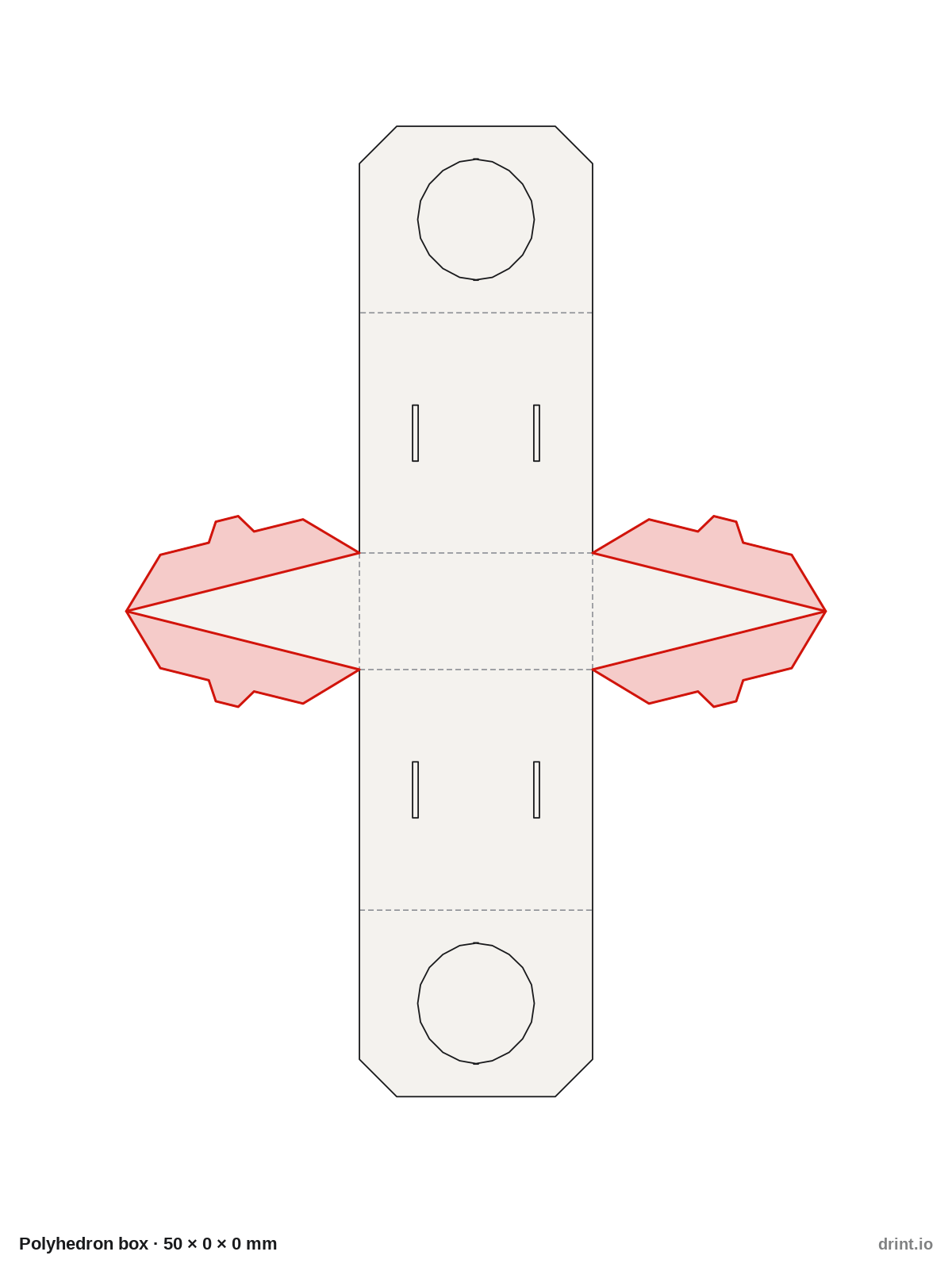
- Also called
- lock tongue, tab-and-slot tongue
- Kind
- Parts of a pack
- Where Drint finds it
- 2 of the 292 product dies Drint draws
- Drawn on
- Polyhedron box
- Share of the Polyhedron box blank
- 13.4%
- Measured
The tongue usually has shoulders or a barb that is slightly wider than the slot, so it springs out behind the slot once pushed through. It is used to close roofs, ends and lids on gift and tote-style boxes.
Slot and tongue sizes depend on board thickness; a small change in stock can make the lock too stiff or too loose. Avoid printing fine detail on the tongue, because it bends every time the box is closed.
Questions
What is a locking tongue?
A shaped tongue on one panel that is pushed through a matching slot in another panel and catches behind it, holding the two together without glue.
How many standard box styles have a locking tongue?
Of the 1011 FEFCO and ECMA codes Drint draws, 0 have a locking tongue, and so do 2 of its 292 product dies (bags, displays, pouches, rigid boxes…) — counted by Drint’s die engine, 2026-11-28.
More terms
Cite this page: Drint (2026). “Locking tongue”. Drint Knowledge. https://drint.io/glossary/locking-tongue