Drint Knowledge › Packaging glossary › Back seal fin
Back seal fin
The lengthwise heat-sealed seam on the back of a flow wrap or side-gusset bag, where the two edges of the film web are joined.
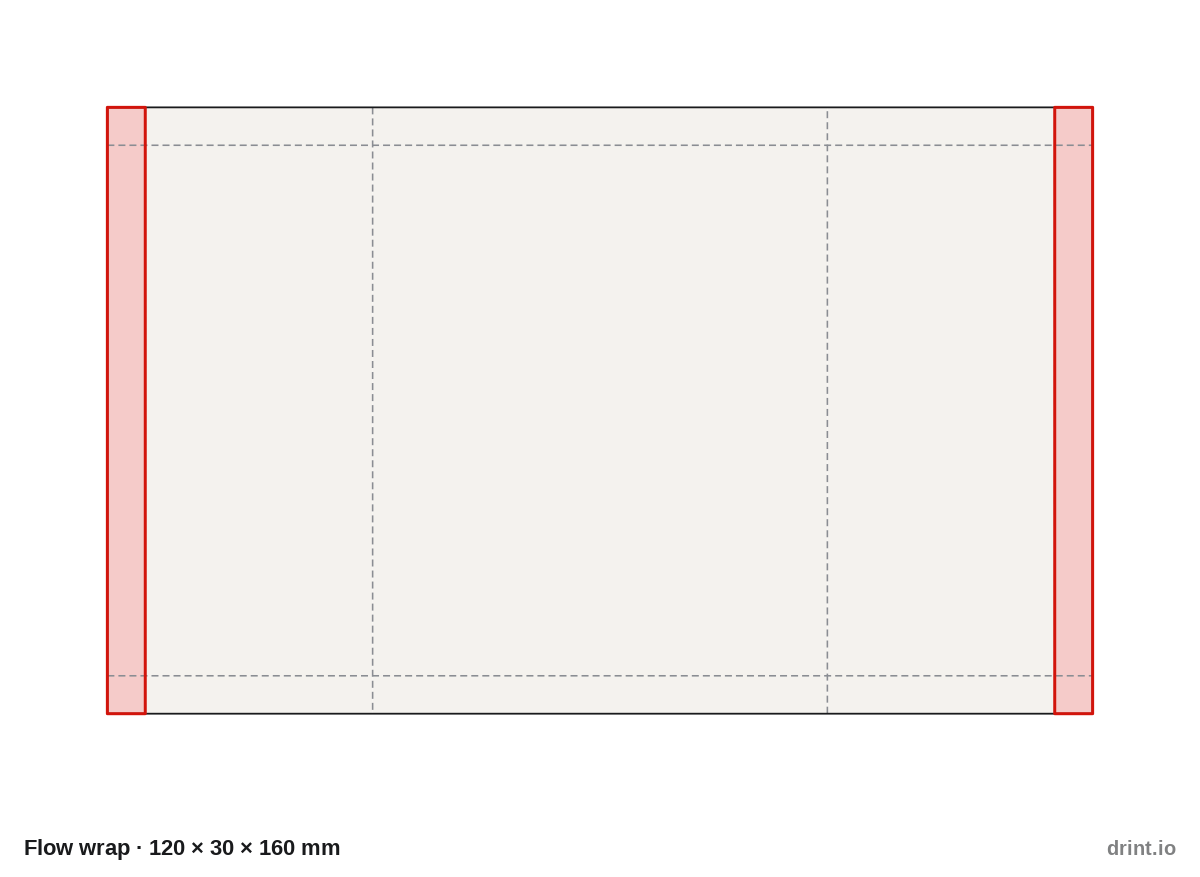
- Also called
- fin seal, long seal, back seam
- Kind
- Parts of a pack
- Where Drint finds it
- 2 of the 292 product dies Drint draws
- Drawn on
- Flow wrap
- Share of the Flow wrap blank
- 7.7%
- Measured
The film is wrapped around the product into a tube and its edges are sealed together, either inside face to inside face standing up as a fin, or overlapping as a lap seal. The fin is then usually laid flat against the back.
The seal area loses some image definition and may cover part of the back, so keep text, nutrition panels and barcodes off it. Leave the seal zone in a solid colour or unprinted as the converter specifies.
Questions
What is a back seal fin?
The lengthwise heat-sealed seam on the back of a flow wrap or side-gusset bag, where the two edges of the film web are joined.
How many standard box styles have a back seal fin?
Of the 1011 FEFCO and ECMA codes Drint draws, 0 have a back seal fin, and so do 2 of its 292 product dies (bags, displays, pouches, rigid boxes…) — counted by Drint’s die engine, 2026-11-28.
What is the difference between a fin seal and a lap seal?
A fin seal joins the inner faces and stands up as a strip; a lap seal overlaps the edges so the inner face seals to the outer face, which needs a film that seals on both sides.
More terms
Cite this page: Drint (2026). “Back seal fin”. Drint Knowledge. https://drint.io/glossary/back-seal-fin