Drint Knowledge › Packaging glossary › Common-line cutting
Common-line cutting
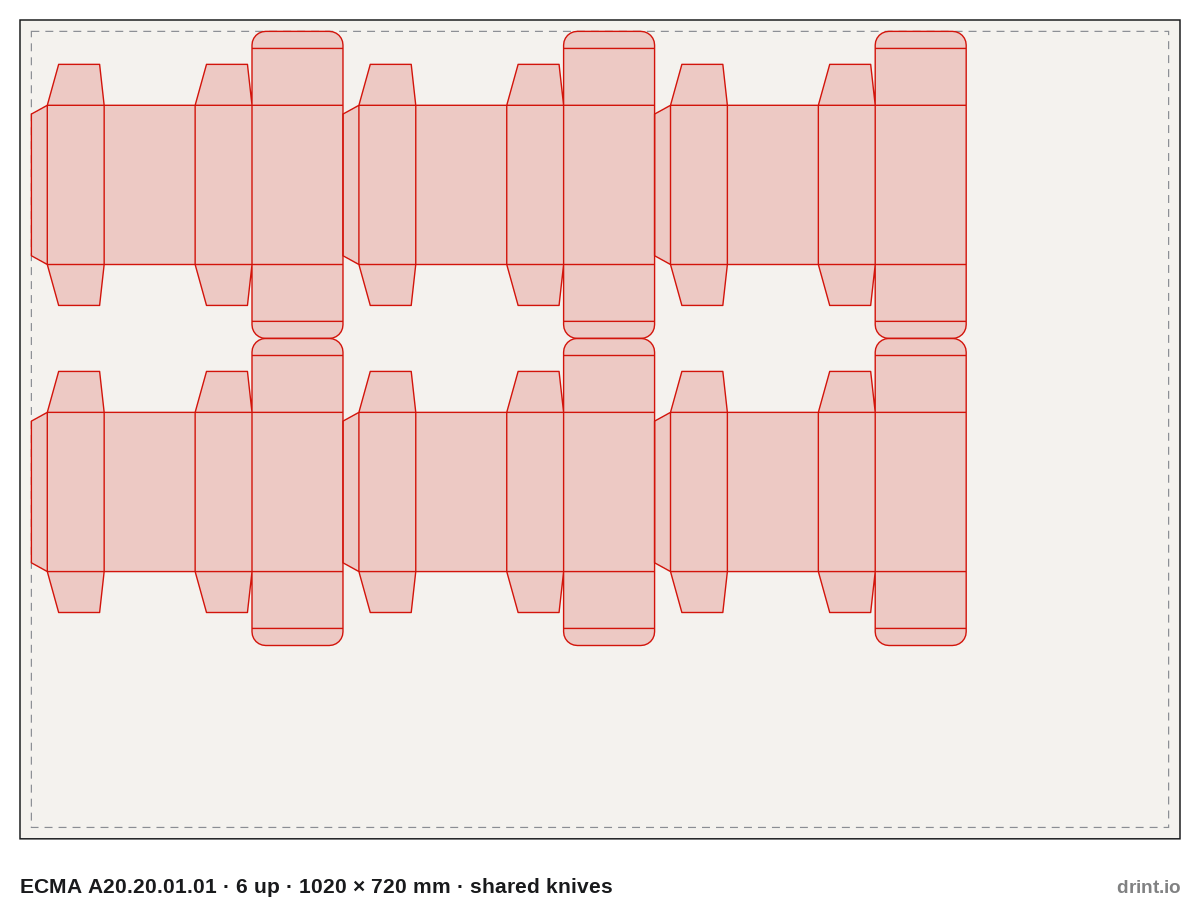
An imposition where neighbouring blanks touch along a straight edge, so a single knife cuts both at once instead of each copy having its own knife and gap.
- Also called
- shared-knife cutting, common cut, butted layout
- Kind
- Die & press
- Sheet or roll
- 1020 × 720 mm · margin 10 mm, 4 mm between copies
- Copies
- 6
- Area used
- 44.7%
- Rule on the whole form
- 13.58 m with shared knives, against 14.24 m cut separately
- Measured
In a normal layout, each blank has its own cutting rule with a strip of waste between copies. With common-line cutting, straight edges of adjacent blanks are butted together and share one knife, which saves board, reduces the amount of steel rule in the die and leaves less waste to strip.
It works best on shapes with long straight sides, such as slotted cartons and simple trays. The trade-off is that there is no bleed past the shared line: any ink at that edge runs straight into the neighbouring blank, so either the colours on both sides match or the design must tolerate a slight shift in the cut. Discuss it with the die maker before finishing edge artwork.
Open ECMA A20.20.01.01 in the studio
Questions
What is a common-line cutting?
An imposition where neighbouring blanks touch along a straight edge, so a single knife cuts both at once instead of each copy having its own knife and gap.
More terms
Cite this page: Drint (2026). “Common-line cutting”. Drint Knowledge. https://drint.io/glossary/common-line-cutting