Dielines › Dielines by standard code › ECMA A55.20.03.02
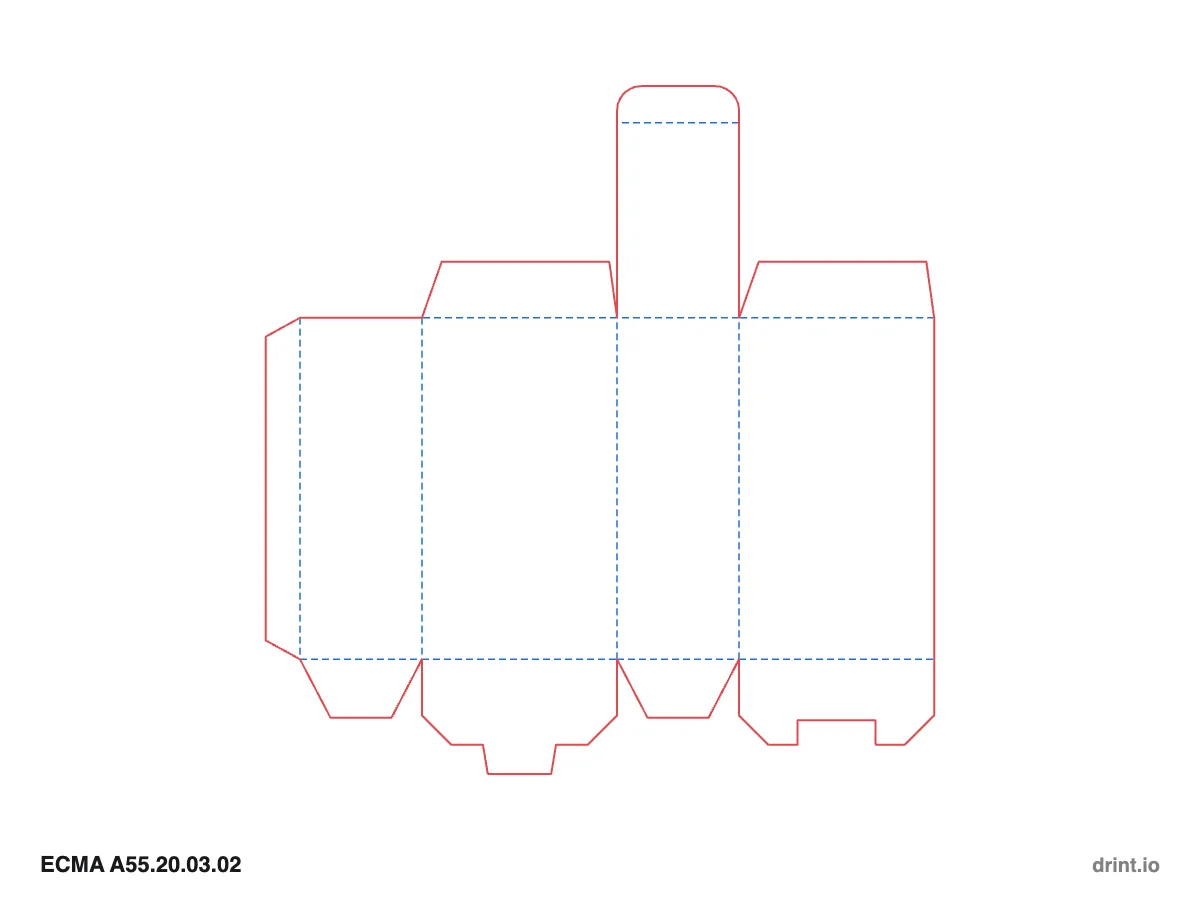
ECMA A55.20.03.02 — Tuck top · snap lock (1-2-3) bottom · top on right side, bottom on front panel
ECMA A55.20.03.02 is a folding carton (ECMA A-series) whose top is a tuck-in flap and whose bottom is a 1-2-3 snap lock, the top hinged on the right side panel and the bottom on the front panel. The 1-2-3 snap lock bottom is folded by hand without glue and carries medium-weight products such as bottles and jars. Drint draws a free ECMA A55.20.03.02 dieline at any size: type the length, width and height and design on it, or download it as PDF or SVG with Pro.
- Code
- ECMA A55.20.03.02
- Standard
- ECMA — folding carton
- Group
- ECMA A55 · Snap lock (1-2-3) bottom
- Drawn at
- 80 × 50 × 140 mm
- Flat sheet
- 274 × 282 mm
- Drawing
- Follows the code’s drawing
In Claude or ChatGPT, add the Drint connector (drint.io/mcp) and ask: “ECMA A55.20.03.02 dieline, 300 × 200 × 100 mm, PDF”.
How it folds
In A55.20.03.02 the bottom is a 1-2-3 snap lock with its main locking flap on the front panel: four interlocking flaps folded in by hand in sequence, with no glue. The top is a tuck lid hinged on the right side panel; it hinges along the width W and is L deep, its tongue tucks down inside the left side panel and the two dust flaps come from the front and back. Hanging the top on the right side panel means it opens side-to-side across the carton rather than front-to-back. On the right side panel (02) the hinge sits beside the back, away from the glue seam; the 04 version is its mirror image.
What it is used for
The tuck lid recloses every time, which suits cosmetics, supplements, tea, small electronics and toys that are opened and closed in use. The snap-lock bottom carries medium-weight goods such as glass jars, bottles and tins, and needs no gluing machine, so it fits short and medium runs packed by hand. Hinging the top on a side panel keeps the front free of hinge lines and suits long, narrow products slid in end-first or cartons displayed end-on.
Blank size by box size
The flat sheet a ECMA A55.20.03.02 needs at each box size, measured on Drint’s own dieline with the board’s thickness allowed for. Add your press’s trim and gripper margin. Each size opens the die in the studio.
| Box, L × W × H | Flat sheet | Sheet area |
|---|---|---|
| 40 × 25 × 70 mm | 144 × 149 mm | 0.02 m² |
| 55 × 35 × 100 mm | 194 × 204 mm | 0.04 m² |
| 80 × 50 × 140 mm | 274 × 282 mm | 0.08 m² |
| 105 × 65 × 180 mm | 354 × 361 mm | 0.13 m² |
| 130 × 80 × 225 mm | 434 × 442 mm | 0.19 m² |
| 160 × 100 × 280 mm | 534 × 537 mm | 0.29 m² |
Measured by Drint’s die engine
These numbers are measured on the ECMA A55.20.03.02 die at 80 × 50 × 140 mm, drawn by the same engine as the studio — not copied from a catalogue.
| Cutting rule | 1.28 m |
|---|---|
| Creasing rule | 1.08 m |
| Total rule per copy | 2.36 m |
| Blank area (board in the box) | 0.054 m² |
| Share of the bounding box used | 69.2% |
| Board per 1,000 blanks (bounding box) | 77 m² |
| Best press sheet | 60 × 84 cm: 6 up nested (grid: 4), 63.7% of the sheet used |
Parts of this die: Glue flap · Dust flap · Tuck flap · Closure panel · Snap-lock bottom · Front panel · Side panel · Back panel
Board
Folding boxboard of 300–400 gsm is usual, moving to E-flute micro-flute for heavier glass. A tuck holds by friction, so it needs crisp creases and friction slits or tongue locks at the shoulders; 250–350 gsm folding boxboard is usual for the lid. The cost is a flap L deep instead of W, so more board and a longer sheet than the same top on a wide panel.
Printing and die notes
The lid face is the top of the carton and the tongue is hidden once closed; put any opening cue on the lid edge and keep coatings thin around the friction slits. With the bottom on the front panel and the top on the right side panel the two ends turn through 90°, so check the reading direction of any text on the end flaps.
Common mistakes
- Cutting the bottom lock slots too tight for the board caliper, so the 1-2-3 bottom of A55.20.03.02 will not close flat or tears when snapped in.
- Leaving out friction slits or tongue locks, so the lid springs open on the shelf.
- Sizing the top flap of A55.20.03.02 to W as if it hung on a wide panel; on the right side panel it must be L deep, or the end is left partly open.
Questions
What is ECMA A55.20.03.02?
ECMA A55.20.03.02 is a folding carton (ECMA A-series) whose top is a tuck-in flap and whose bottom is a 1-2-3 snap lock, the top hinged on the right side panel and the bottom on the front panel. The 1-2-3 snap lock bottom is folded by hand without glue and carries medium-weight products such as bottles and jars.
Can the top of A55.20.03.02 be reclosed?
Yes. It is a tuck lid: the tongue slides back down inside the left side panel each time it is closed.
Why does the top of A55.20.03.02 open side to side?
The top closure hangs on the right side panel (the last two digits 02), so it hinges along the width W and is L deep; the front stays clear of the hinge, at the cost of a deeper flap and a longer blank.
What size sheet does a 80 × 50 × 140 mm ECMA A55.20.03.02 need?
A ECMA A55.20.03.02 of 80 × 50 × 140 mm unfolds to a flat sheet of 274 × 282 mm (0.08 m²) on Drint’s dieline, before trim and gripper margins. The table on this page gives the sheet for other sizes; in the studio, type any length, width and height and the sheet is measured again.
How do I get a ECMA A55.20.03.02 dieline at my size?
Open it in Drint and type your length, width and height — inside, on the crease or outside. The die is redrawn at that size with the board’s thickness allowed for, and you design straight on it. In Claude or ChatGPT with the Drint connector, ask for “ECMA A55.20.03.02 dieline” and your size.
What board is ECMA A55.20.03.02 made from?
Folding boxboard of 300–400 gsm is usual, moving to E-flute micro-flute for heavier glass. A tuck holds by friction, so it needs crisp creases and friction slits or tongue locks at the shoulders; 250–350 gsm folding boxboard is usual for the lid. The cost is a flap L deep instead of W, so more board and a longer sheet than the same top on a wide panel.
Is the ECMA A55.20.03.02 dieline free?
Designing on the die, the 3D fold and preflight are free in the browser. Downloading the dieline (SVG, PDF / AI, or DXF and CF2 for the die-maker) and the CMYK print PDF needs Pro.