Dielines › Dielines by standard code › ECMA X33
ECMA X33 — Tuck closure with lock tongue into front slot
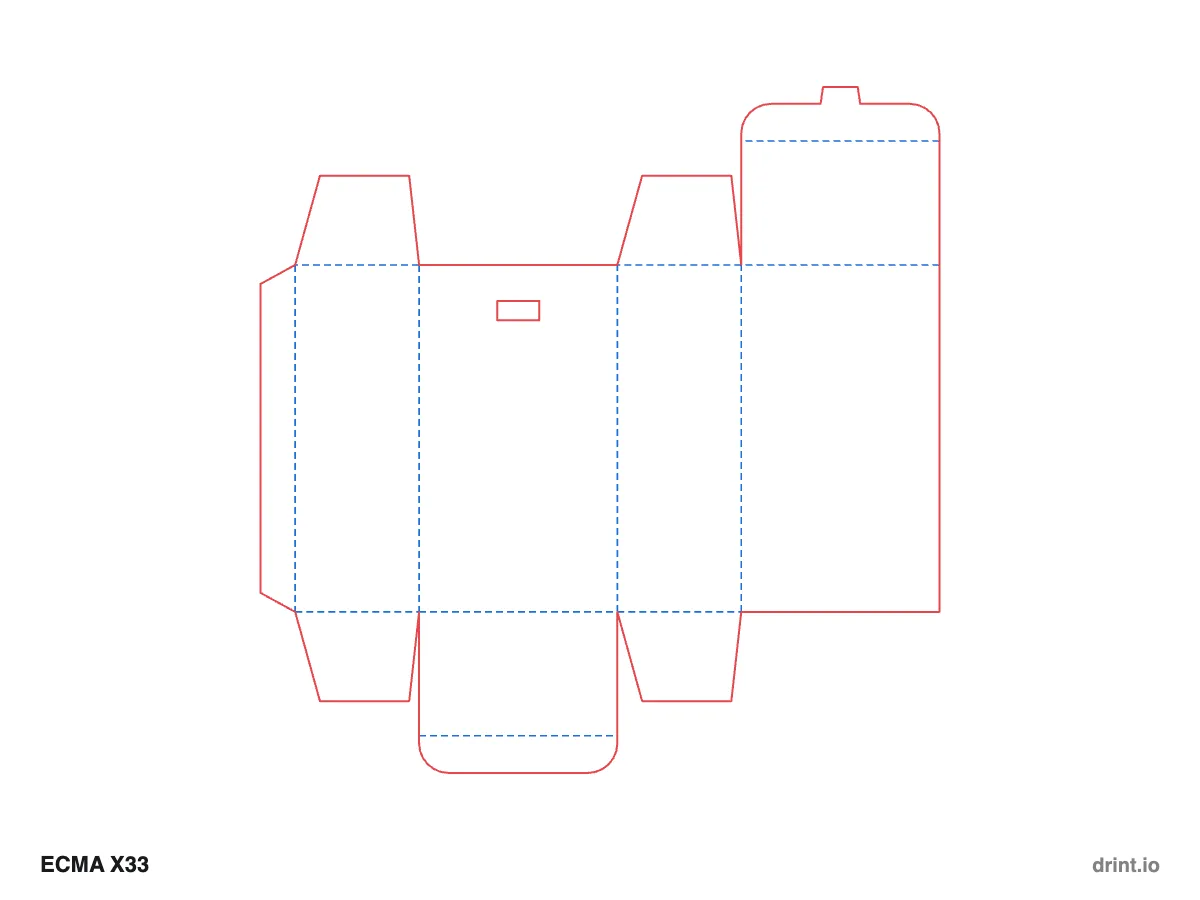
ECMA X33 is a tuck-closure lock where a tongue on the tuck flap goes through a slot in the front panel to hold the lid shut. Drint draws a free ECMA X33 dieline at any size: type the length, width and height and design on it, or download it as PDF or SVG with Pro.
- Code
- ECMA X33
- Standard
- ECMA — folding carton
- Group
- ECMA X · Locks and auxiliary features
- Drawn at
- 80 × 50 × 140 mm
- Flat sheet
- 274 × 277 mm
- Also called
- Tuck closure with securing lock tongue into front slot
- Drawing
- Close to the code’s drawing, not exact
In Claude or ChatGPT, add the Drint connector (drint.io/mcp) and ask: “ECMA X33 dieline, 300 × 200 × 100 mm, PDF”.
How it folds
X33 adds a 16 × 6.8 mm locking tongue to the tip of the tuck flap; when the lid is closed, the tongue passes into a hole in the front panel and is visible from outside. Drint shows it on an 80 × 50 × 140 mm carton with tuck ends top and bottom, in its own geometry in the style of the code; check the slot size against the board with the box maker.
What it is used for
Mail-order and retail cartons that must stay closed without tape: toys, kits, hardware, apparel accessories and samples. It can be reopened but a visibly disturbed tongue shows handling.
Blank size by box size
The flat sheet a ECMA X33 needs at each box size, measured on Drint’s own dieline with the board’s thickness allowed for. Add your press’s trim and gripper margin. Each size opens the die in the studio.
| Box, L × W × H | Flat sheet | Sheet area |
|---|---|---|
| 40 × 25 × 70 mm | 144 × 157 mm | 0.02 m² |
| 55 × 35 × 100 mm | 194 × 207 mm | 0.04 m² |
| 80 × 50 × 140 mm | 274 × 277 mm | 0.08 m² |
| 105 × 65 × 180 mm | 354 × 347 mm | 0.12 m² |
| 130 × 80 × 225 mm | 434 × 422 mm | 0.18 m² |
| 160 × 100 × 280 mm | 534 × 517 mm | 0.28 m² |
Measured by Drint’s die engine
These numbers are measured on the ECMA X33 die at 80 × 50 × 140 mm, drawn by the same engine as the studio — not copied from a catalogue.
| Cutting rule | 1.36 m |
|---|---|
| Creasing rule | 1.08 m |
| Total rule per copy | 2.44 m |
| Blank area (board in the box) | 0.055 m² |
| Share of the bounding box used | 72.3% |
| Board per 1,000 blanks (bounding box) | 76 m² |
| Best press sheet | 60 × 84 cm: 6 up nested (grid: 4), 65.3% of the sheet used |
Parts of this die: Glue flap · Dust flap · Tuck flap · Closure panel · Front panel · Side panel · Back panel · Cut-out
Board
Folding boxboard 300–350 gsm; the slot should be a little wider than the tongue plus board thickness.
Printing and die notes
Design the front panel around the slot; a small printed frame around it can make the lock look deliberate. Keep barcodes and text away from the slot.
Common mistakes
- Slot through the main graphic.
- Slot too narrow for the tongue and board, so it tears.
- Forgetting that the tongue must be long enough to reach the slot after the tuck folds.
Questions
What is ECMA X33?
ECMA X33 is a tuck-closure lock where a tongue on the tuck flap goes through a slot in the front panel to hold the lid shut.
Can the X33 lid be reopened?
Yes, the tongue is pulled out of the slot and the tuck opens as usual.
How big is the locking tongue?
Drint draws 16 × 6.8 mm; enlarge it for thicker board.
What size sheet does a 80 × 50 × 140 mm ECMA X33 need?
A ECMA X33 of 80 × 50 × 140 mm unfolds to a flat sheet of 274 × 277 mm (0.08 m²) on Drint’s dieline, before trim and gripper margins. The table on this page gives the sheet for other sizes; in the studio, type any length, width and height and the sheet is measured again.
How do I get a ECMA X33 dieline at my size?
Open it in Drint and type your length, width and height — inside, on the crease or outside. The die is redrawn at that size with the board’s thickness allowed for, and you design straight on it. In Claude or ChatGPT with the Drint connector, ask for “ECMA X33 dieline” and your size.
What board is ECMA X33 made from?
Folding boxboard 300–350 gsm; the slot should be a little wider than the tongue plus board thickness.
Is the ECMA X33 dieline free?
Designing on the die, the 3D fold and preflight are free in the browser. Downloading the dieline (SVG, PDF / AI, or DXF and CF2 for the die-maker) and the CMYK print PDF needs Pro.
Is Drint’s ECMA X33 exactly the FEFCO drawing?
Not exactly: Drint draws this code close to the FEFCO drawing. Check the die with your die-maker before production.