Dielines › Dielines by standard code › ECMA C10.50.20.20
ECMA C10.50.20.20 — Octagonal carton, tuck top and tuck bottom
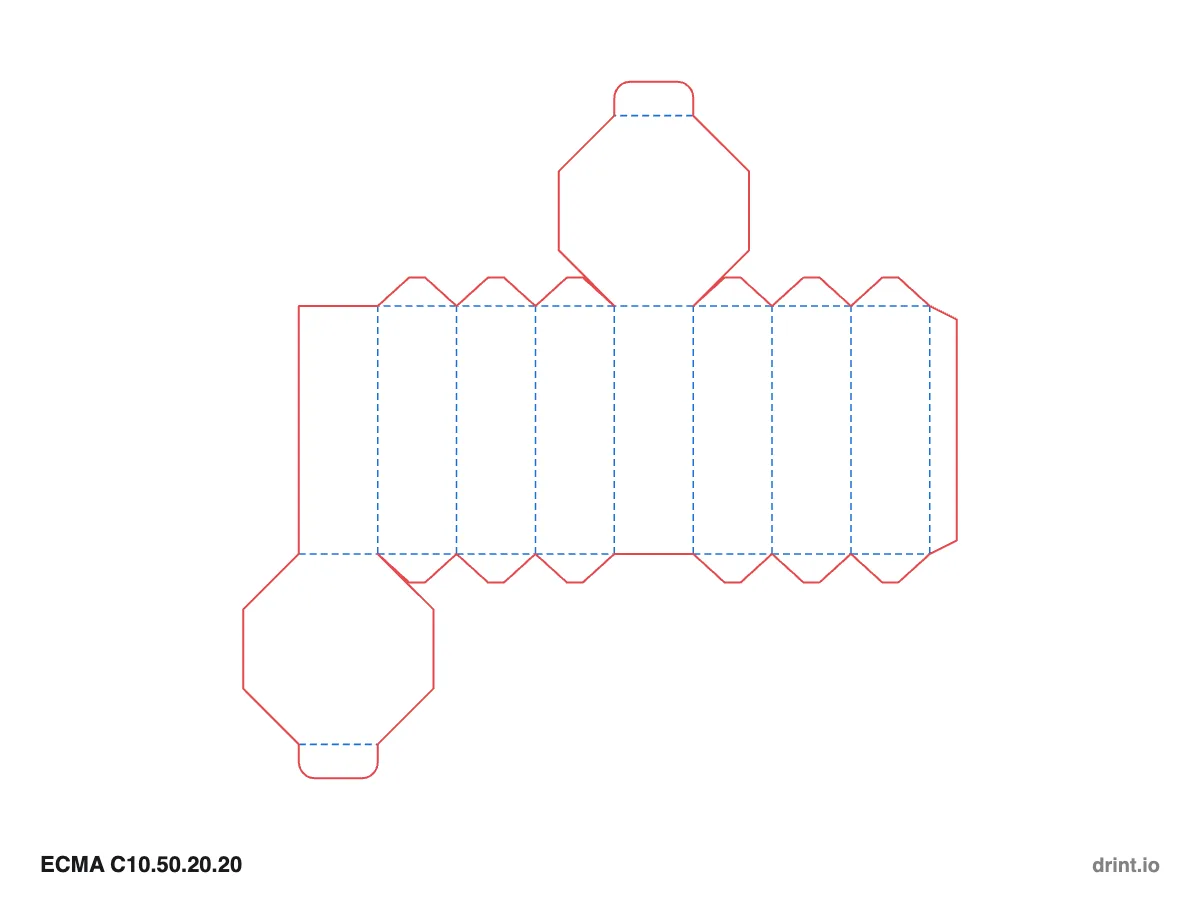
ECMA C10.50.20.20 is a glued eight-sided carton closed at both ends by tuck-in lids with dust flaps. Drint draws a free ECMA C10.50.20.20 dieline at any size: type the length, width and height and design on it, or download it as PDF or SVG with Pro.
- Code
- ECMA C10.50.20.20
- Standard
- ECMA — folding carton
- Group
- ECMA C · Polygonal cartons, glued side seam
- Drawn at
- 35 × 60 × 110 mm
- Flat sheet
- 317 × 309 mm
- Also called
- Polygonal carton bát giác prism glued seam tuck ECMA C10
- Drawing
- Close to the code’s drawing, not exact
In Claude or ChatGPT, add the Drint connector (drint.io/mcp) and ask: “ECMA C10.50.20.20 dieline, 300 × 200 × 100 mm, PDF”.
How it folds
C10.50.20.20 is an octagonal prism with a glued side seam and a tuck lid at each end: one octagonal lid panel with a 15 mm tongue, and 14 mm dust flaps on the other seven sides, trimmed at half the corner angle. Drint's sample has 35 mm sides, folds to 84.5 × 84.5 × 110 mm and needs a 316.7 × 309 mm blank. The die is Drint's own geometry in the style of the code, so check flap sizes against the box maker's drawing.
What it is used for
The octagon reads almost round on shelf, so it is popular for tea, coffee, premium sweets, candles, perfume and gift sets where a rectangular box feels ordinary. Tuck ends at both sides keep it hand-assembled and reopenable, suited to light contents.
Blank size by box size
The flat sheet a ECMA C10.50.20.20 needs at each box size, measured on Drint’s own dieline with the board’s thickness allowed for. Add your press’s trim and gripper margin. Each size opens the die in the studio.
| Box, L × W × H | Flat sheet | Sheet area |
|---|---|---|
| 20 × 30 × 55 mm | 186 × 182 mm | 0.03 m² |
| 25 × 40 × 75 mm | 230 × 226 mm | 0.05 m² |
| 35 × 60 × 110 mm | 317 × 309 mm | 0.10 m² |
| 45 × 80 × 145 mm | 404 × 392 mm | 0.16 m² |
| 55 × 95 × 175 mm | 491 × 471 mm | 0.23 m² |
| 70 × 120 × 220 mm | 621 × 588 mm | 0.37 m² |
Measured by Drint’s die engine
These numbers are measured on the ECMA C10.50.20.20 die at 35 × 60 × 110 mm, drawn by the same engine as the studio — not copied from a catalogue.
| Cutting rule | 1.38 m |
|---|---|
| Creasing rule | 1.44 m |
| Total rule per copy | 2.82 m |
| Blank area (board in the box) | 0.048 m² |
| Share of the bounding box used | 49.1% |
| Board per 1,000 blanks (bounding box) | 98 m² |
| Best press sheet | 70 × 100 cm: 8 up nested (grid: 6), 54.9% of the sheet used |
Parts of this die: Glue flap · Dust flap · Tuck flap · Closure panel · Front panel · Back panel
Board
SBS or folding boxboard 300–350 gsm; eight creases close together make the board work hard, so check that the chosen board creases cleanly without cracking. Lamination or soft-touch film suits the premium uses but should stay off the side-seam glue flap.
Printing and die notes
With eight narrow faces, design as a continuous band and avoid small text sitting across creases. The two octagonal lids are natural places for a logo or seal; place opening cues on the tongue side.
Common mistakes
- Letting the dust flaps overlap at the corners because they were not trimmed to the half-angle.
- Putting the barcode on one narrow face so it wraps across two creases.
- Using a tuck bottom for heavy contents; the rosette bottom version holds better.
Questions
What is ECMA C10.50.20.20?
ECMA C10.50.20.20 is a glued eight-sided carton closed at both ends by tuck-in lids with dust flaps.
What changes between the hexagonal and octagonal versions?
Only the base: eight narrower faces make a rounder silhouette and shorter dust flaps (14 mm here against 18 mm on the hexagon).
Can the octagon have a rosette bottom instead?
Yes, that is C10.50.90.20, tuck top with a twist-lock bottom.
What size sheet does a 35 × 60 × 110 mm ECMA C10.50.20.20 need?
A ECMA C10.50.20.20 of 35 × 60 × 110 mm unfolds to a flat sheet of 317 × 309 mm (0.10 m²) on Drint’s dieline, before trim and gripper margins. The table on this page gives the sheet for other sizes; in the studio, type any length, width and height and the sheet is measured again.
How do I get a ECMA C10.50.20.20 dieline at my size?
Open it in Drint and type your length, width and height — inside, on the crease or outside. The die is redrawn at that size with the board’s thickness allowed for, and you design straight on it. In Claude or ChatGPT with the Drint connector, ask for “ECMA C10.50.20.20 dieline” and your size.
What board is ECMA C10.50.20.20 made from?
SBS or folding boxboard 300–350 gsm; eight creases close together make the board work hard, so check that the chosen board creases cleanly without cracking. Lamination or soft-touch film suits the premium uses but should stay off the side-seam glue flap.
Is the ECMA C10.50.20.20 dieline free?
Designing on the die, the 3D fold and preflight are free in the browser. Downloading the dieline (SVG, PDF / AI, or DXF and CF2 for the die-maker) and the CMYK print PDF needs Pro.
Is Drint’s ECMA C10.50.20.20 exactly the FEFCO drawing?
Not exactly: Drint draws this code close to the FEFCO drawing. Check the die with your die-maker before production.