Dielines › Dielines by standard code › ECMA C10.10.01.20
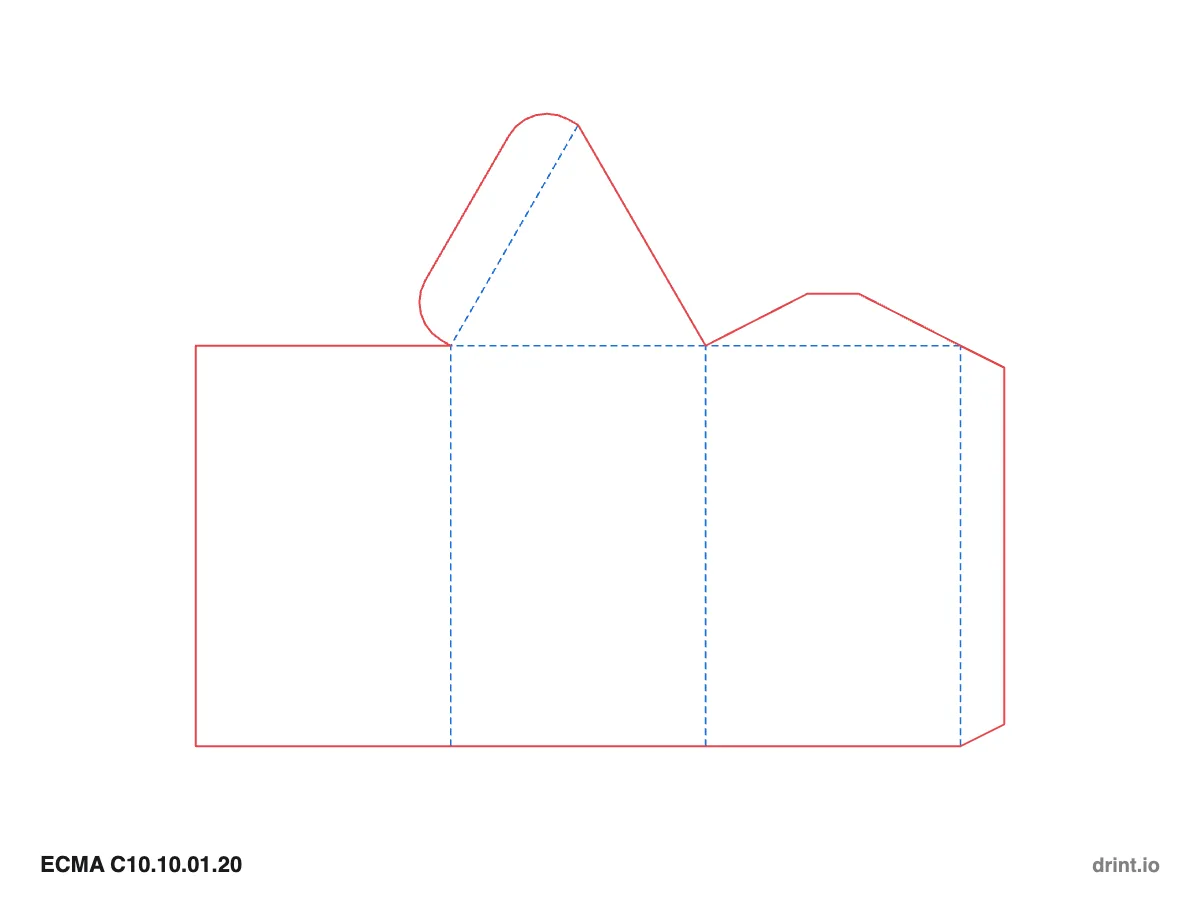
ECMA C10.10.01.20 — Triangular carton with tuck top, open bottom
ECMA C10.10.01.20 is a triangular prism folding carton with a glued side seam, an open bottom and a tuck top. Drint draws a free ECMA C10.10.01.20 dieline at any size: type the length, width and height and design on it, or download it as PDF or SVG with Pro.
- Code
- ECMA C10.10.01.20
- Standard
- ECMA — folding carton
- Group
- ECMA C · Polygonal cartons, glued side seam
- Drawn at
- 70 × 60 × 110 mm
- Flat sheet
- 222 × 174 mm
- Also called
- Polygonal carton tam giác prism glued seam openTuck ECMA C10
- Drawing
- Close to the code’s drawing, not exact
In Claude or ChatGPT, add the Drint connector (drint.io/mcp) and ask: “ECMA C10.10.01.20 dieline, 300 × 200 × 100 mm, PDF”.
How it folds
The bottom end is left open, and the top closes with a tuck flap (15 mm tongue) and two half-angle dust flaps (21.2 mm). The side seam is a 12 mm glue flap. Drint's die follows the style of the code in its own geometry, so check the box maker's drawing for exact flap sizes. The blank is 222 × 173.7 mm.
What it is used for
It works as a cover placed over a product or base from above: over a tray, a bottle base, a candle or a stacked product, with a closed tuck top. It can also be used as a lid-and-sleeve on a separate base.
Blank size by box size
The flat sheet a ECMA C10.10.01.20 needs at each box size, measured on Drint’s own dieline with the board’s thickness allowed for. Add your press’s trim and gripper margin. Each size opens the die in the studio.
| Box, L × W × H | Flat sheet | Sheet area |
|---|---|---|
| 35 × 30 × 55 mm | 117 × 90 mm | 0.01 m² |
| 50 × 40 × 75 mm | 162 × 122 mm | 0.02 m² |
| 70 × 60 × 110 mm | 222 × 174 mm | 0.04 m² |
| 90 × 80 × 145 mm | 282 × 226 mm | 0.06 m² |
| 110 × 95 × 175 mm | 342 × 273 mm | 0.09 m² |
| 140 × 120 × 220 mm | 432 × 344 mm | 0.15 m² |
Measured by Drint’s die engine
These numbers are measured on the ECMA C10.10.01.20 die at 70 × 60 × 110 mm, drawn by the same engine as the studio — not copied from a catalogue.
| Cutting rule | 0.75 m |
|---|---|
| Creasing rule | 0.54 m |
| Total rule per copy | 1.29 m |
| Blank area (board in the box) | 0.028 m² |
| Share of the bounding box used | 72.7% |
| Board per 1,000 blanks (bounding box) | 39 m² |
| Best press sheet | 72 × 102 cm, cut in 3: 6 up nested (grid: 3), 68.8% of the sheet used |
Parts of this die: Glue flap · Dust flap · Tuck flap · Closure panel · Front panel · Back panel
Board
Folding boxboard of 250–350 gsm.
Printing and die notes
Sides and top tuck are visible; the open bottom edge sits on the base, so keep important text above it. Keep the tuck crease free of heavy solids.
Common mistakes
- Expecting the carton to hold product on its own; the bottom is open.
- No clearance for the base it fits over.
- Full-angle dust flaps that jam.
Questions
What is ECMA C10.10.01.20?
ECMA C10.10.01.20 is a triangular prism folding carton with a glued side seam, an open bottom and a tuck top.
Why leave the bottom open?
The carton is a cover that drops over a product, tray or base that already supports the contents.
Which end is closed on C10.10.01.20?
Only the top, with a tuck flap.
What size sheet does a 70 × 60 × 110 mm ECMA C10.10.01.20 need?
A ECMA C10.10.01.20 of 70 × 60 × 110 mm unfolds to a flat sheet of 222 × 174 mm (0.04 m²) on Drint’s dieline, before trim and gripper margins. The table on this page gives the sheet for other sizes; in the studio, type any length, width and height and the sheet is measured again.
How do I get a ECMA C10.10.01.20 dieline at my size?
Open it in Drint and type your length, width and height — inside, on the crease or outside. The die is redrawn at that size with the board’s thickness allowed for, and you design straight on it. In Claude or ChatGPT with the Drint connector, ask for “ECMA C10.10.01.20 dieline” and your size.
What board is ECMA C10.10.01.20 made from?
Folding boxboard of 250–350 gsm.
Is the ECMA C10.10.01.20 dieline free?
Designing on the die, the 3D fold and preflight are free in the browser. Downloading the dieline (SVG, PDF / AI, or DXF and CF2 for the die-maker) and the CMYK print PDF needs Pro.
Is Drint’s ECMA C10.10.01.20 exactly the FEFCO drawing?
Not exactly: Drint draws this code close to the FEFCO drawing. Check the die with your die-maker before production.