Dielines › Dielines by standard code › ECMA C10.50.20.01
ECMA C10.50.20.01 — Octagonal cup, tuck bottom, open top
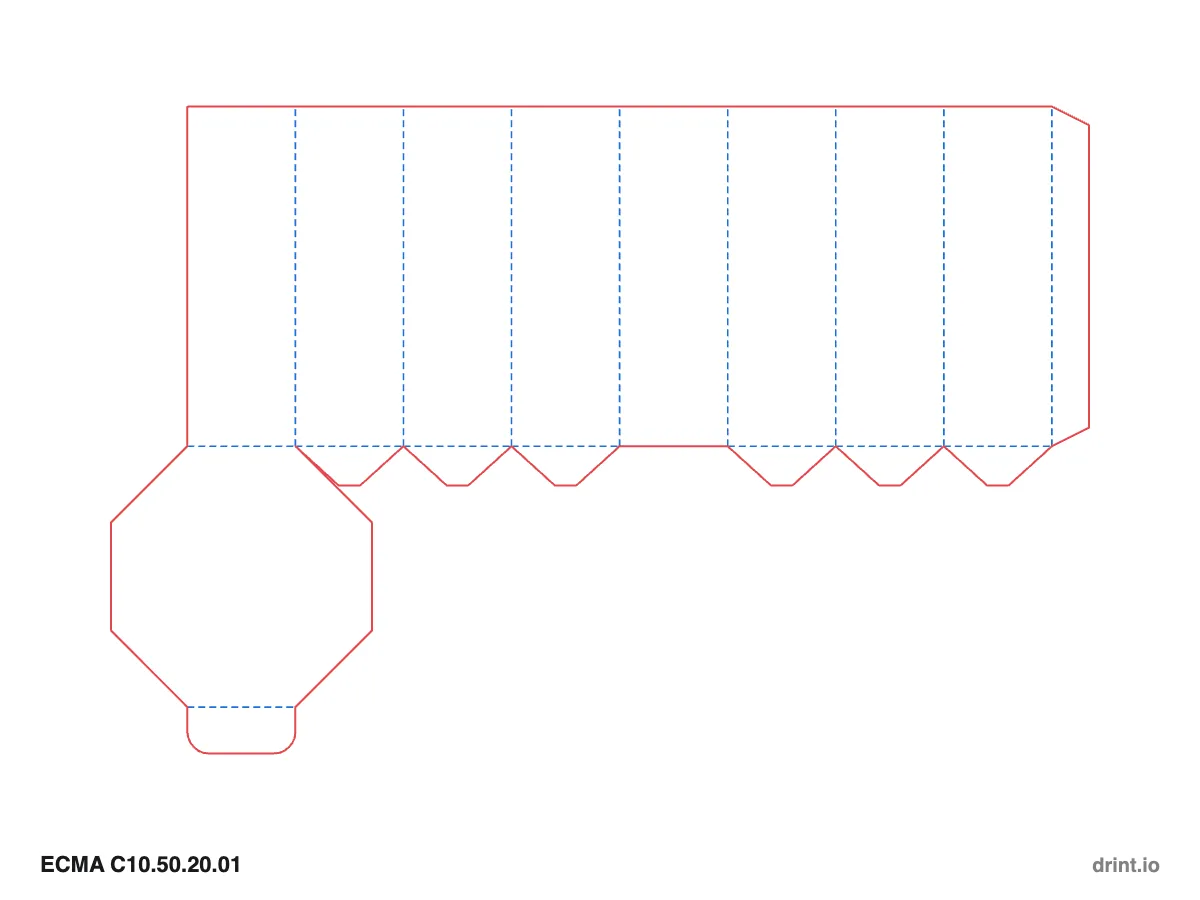
ECMA C10.50.20.01 is a glued eight-sided carton with a tuck-in bottom and an open top. Drint draws a free ECMA C10.50.20.01 dieline at any size: type the length, width and height and design on it, or download it as PDF or SVG with Pro.
- Code
- ECMA C10.50.20.01
- Standard
- ECMA — folding carton
- Group
- ECMA C · Polygonal cartons, glued side seam
- Drawn at
- 35 × 60 × 110 mm
- Flat sheet
- 317 × 209 mm
- Also called
- Polygonal carton bát giác prism glued seam tuckOpen ECMA C10
- Drawing
- Close to the code’s drawing, not exact
In Claude or ChatGPT, add the Drint connector (drint.io/mcp) and ask: “ECMA C10.50.20.01 dieline, 300 × 200 × 100 mm, PDF”.
How it folds
C10.50.20.01 closes the bottom of an octagonal prism with a tuck lid (15 mm tongue, 14 mm half-angle dust flaps) and leaves the top open. Drint's 35 mm-side sample is 84.5 × 84.5 × 110 mm on a 316.7 × 209.5 mm blank. Drint's geometry follows the code's style, so confirm flap sizes against the box maker's drawing.
What it is used for
An octagonal cup: pot covers, holders for pens or brushes, display cups for sweets, or the base of a two-part octagonal box with C10.50.01.20 as the lid. It suits light contents because the tuck is the only support underneath.
Blank size by box size
The flat sheet a ECMA C10.50.20.01 needs at each box size, measured on Drint’s own dieline with the board’s thickness allowed for. Add your press’s trim and gripper margin. Each size opens the die in the studio.
| Box, L × W × H | Flat sheet | Sheet area |
|---|---|---|
| 20 × 30 × 55 mm | 186 × 118 mm | 0.02 m² |
| 25 × 40 × 75 mm | 230 × 150 mm | 0.03 m² |
| 35 × 60 × 110 mm | 317 × 209 mm | 0.07 m² |
| 45 × 80 × 145 mm | 404 × 269 mm | 0.11 m² |
| 55 × 95 × 175 mm | 491 × 323 mm | 0.16 m² |
| 70 × 120 × 220 mm | 621 × 404 mm | 0.25 m² |
Measured by Drint’s die engine
These numbers are measured on the ECMA C10.50.20.01 die at 35 × 60 × 110 mm, drawn by the same engine as the studio — not copied from a catalogue.
| Cutting rule | 1.09 m |
|---|---|
| Creasing rule | 1.16 m |
| Total rule per copy | 2.25 m |
| Blank area (board in the box) | 0.040 m² |
| Share of the bounding box used | 60.4% |
| Board per 1,000 blanks (bounding box) | 66 m² |
| Best press sheet | 70 × 100 cm: 10 up nested (grid: 9), 57.2% of the sheet used |
Parts of this die: Glue flap · Dust flap · Tuck flap · Closure panel · Front panel · Back panel
Board
Folding boxboard 300–400 gsm. For heavier loads, the rosette version C10.50.90.01 gives a firmer base.
Printing and die notes
The inside shows through the open top, so print or use white-back board. Keep the bottom tuck plain unless it is seen.
Common mistakes
- Putting heavy goods on a tuck base.
- Leaving a grey inside visible.
- Sizing base and lid the same when making a two-part box.
Questions
What is ECMA C10.50.20.01?
ECMA C10.50.20.01 is a glued eight-sided carton with a tuck-in bottom and an open top.
Tuck or rosette bottom for an open octagon?
Tuck is quick and flat; the rosette (C10.50.90.01) supports more weight.
Can it take a separate lid?
Yes, an octagonal cover such as C10.50.01.20 made slightly larger fits over it.
What size sheet does a 35 × 60 × 110 mm ECMA C10.50.20.01 need?
A ECMA C10.50.20.01 of 35 × 60 × 110 mm unfolds to a flat sheet of 317 × 209 mm (0.07 m²) on Drint’s dieline, before trim and gripper margins. The table on this page gives the sheet for other sizes; in the studio, type any length, width and height and the sheet is measured again.
How do I get a ECMA C10.50.20.01 dieline at my size?
Open it in Drint and type your length, width and height — inside, on the crease or outside. The die is redrawn at that size with the board’s thickness allowed for, and you design straight on it. In Claude or ChatGPT with the Drint connector, ask for “ECMA C10.50.20.01 dieline” and your size.
What board is ECMA C10.50.20.01 made from?
Folding boxboard 300–400 gsm. For heavier loads, the rosette version C10.50.90.01 gives a firmer base.
Is the ECMA C10.50.20.01 dieline free?
Designing on the die, the 3D fold and preflight are free in the browser. Downloading the dieline (SVG, PDF / AI, or DXF and CF2 for the die-maker) and the CMYK print PDF needs Pro.
Is Drint’s ECMA C10.50.20.01 exactly the FEFCO drawing?
Not exactly: Drint draws this code close to the FEFCO drawing. Check the die with your die-maker before production.