Dielines › Dielines by standard code › ECMA C10.40.20.21
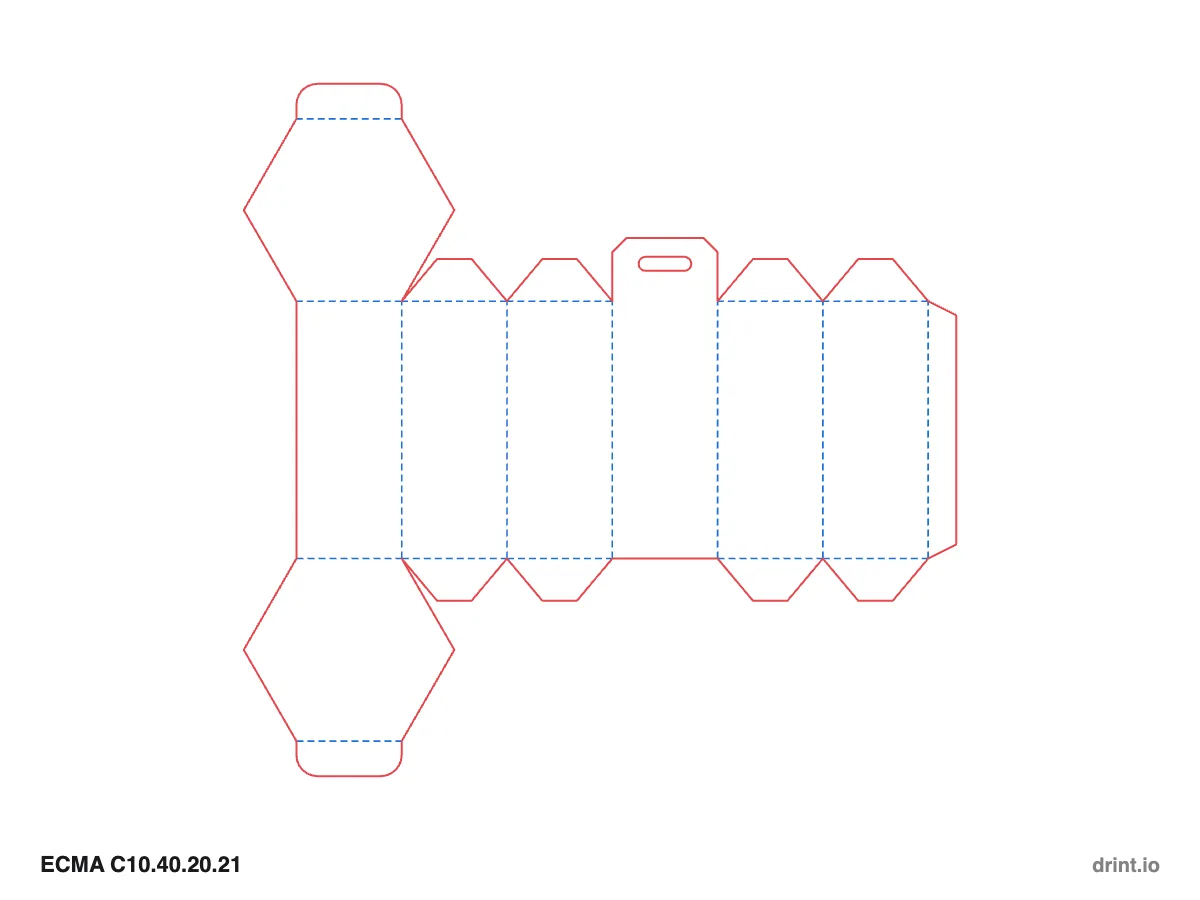
ECMA C10.40.20.21 — Hexagonal tuck-end carton with hang tab
ECMA C10.40.20.21 is a hexagonal prism folding carton with tuck ends and an extended hang tab with a euro hole. Drint draws a free ECMA C10.40.20.21 dieline at any size: type the length, width and height and design on it, or download it as PDF or SVG with Pro.
- Code
- ECMA C10.40.20.21
- Standard
- ECMA — folding carton
- Group
- ECMA C · Polygonal cartons, glued side seam
- Drawn at
- 45 × 60 × 110 mm
- Flat sheet
- 305 × 296 mm
- Also called
- Polygonal carton lục giác prism glued seam hang ECMA C10
- Drawing
- Close to the code’s drawing, not exact
In Claude or ChatGPT, add the Drint connector (drint.io/mcp) and ask: “ECMA C10.40.20.21 dieline, 300 × 200 × 100 mm, PDF”.
How it folds
Both ends close with 15 mm tucks and half-angle dust flaps (18 mm); at the top the back panel extends 27 mm into a hang tab with a euro hole. The side seam is a 12 mm glue flap. Drint's die follows the style of the code in its own geometry, so check the box maker's drawing for exact flap sizes. The blank is 304.5 × 295.9 mm.
What it is used for
Peg-hung packs for round or cylindrical items: lip balm and cosmetics, small bottles, accessories, confectionery and gifts. It also stands on a shelf.
Blank size by box size
The flat sheet a ECMA C10.40.20.21 needs at each box size, measured on Drint’s own dieline with the board’s thickness allowed for. Add your press’s trim and gripper margin. Each size opens the die in the studio.
| Box, L × W × H | Flat sheet | Sheet area |
|---|---|---|
| 25 × 30 × 55 mm | 175 × 172 mm | 0.03 m² |
| 30 × 40 × 75 mm | 207 × 209 mm | 0.04 m² |
| 45 × 60 × 110 mm | 305 × 296 mm | 0.09 m² |
| 60 × 80 × 145 mm | 402 × 383 mm | 0.15 m² |
| 70 × 95 × 175 mm | 467 × 447 mm | 0.21 m² |
| 90 × 120 × 220 mm | 597 × 562 mm | 0.34 m² |
Measured by Drint’s die engine
These numbers are measured on the ECMA C10.40.20.21 die at 45 × 60 × 110 mm, drawn by the same engine as the studio — not copied from a catalogue.
| Cutting rule | 1.41 m |
|---|---|
| Creasing rule | 1.20 m |
| Total rule per copy | 2.61 m |
| Blank area (board in the box) | 0.048 m² |
| Share of the bounding box used | 53.5% |
| Board per 1,000 blanks (bounding box) | 90 m² |
| Best press sheet | 79 × 109 cm: 9 up nested (grid: 6), 50.4% of the sheet used |
Parts of this die: Glue flap · Dust flap · Tuck flap · Closure panel · Front panel · Back panel · Cut-out
Board
Folding boxboard of 300–350 gsm for the tab.
Printing and die notes
Hang tab and front panels face the shopper; keep the euro hole clear.
Common mistakes
- Front panels facing away because the tab is on the wrong panel.
- Board too light at the hole.
- No room in the sheet layout for the 27 mm tab.
Questions
What is ECMA C10.40.20.21?
ECMA C10.40.20.21 is a hexagonal prism folding carton with tuck ends and an extended hang tab with a euro hole.
Where is the hang tab?
On the back panel, 27 mm high, with a euro hole.
Can it stand as well?
Yes; the tuck bottom is flat.
What size sheet does a 45 × 60 × 110 mm ECMA C10.40.20.21 need?
A ECMA C10.40.20.21 of 45 × 60 × 110 mm unfolds to a flat sheet of 305 × 296 mm (0.09 m²) on Drint’s dieline, before trim and gripper margins. The table on this page gives the sheet for other sizes; in the studio, type any length, width and height and the sheet is measured again.
How do I get a ECMA C10.40.20.21 dieline at my size?
Open it in Drint and type your length, width and height — inside, on the crease or outside. The die is redrawn at that size with the board’s thickness allowed for, and you design straight on it. In Claude or ChatGPT with the Drint connector, ask for “ECMA C10.40.20.21 dieline” and your size.
What board is ECMA C10.40.20.21 made from?
Folding boxboard of 300–350 gsm for the tab.
Is the ECMA C10.40.20.21 dieline free?
Designing on the die, the 3D fold and preflight are free in the browser. Downloading the dieline (SVG, PDF / AI, or DXF and CF2 for the die-maker) and the CMYK print PDF needs Pro.
Is Drint’s ECMA C10.40.20.21 exactly the FEFCO drawing?
Not exactly: Drint draws this code close to the FEFCO drawing. Check the die with your die-maker before production.